
we’re all beautiful golden sunflowers inside.’
― Allen Ginsberg
There was a time when Istanbul was not merely a destination but a threshold. In the late 1960s and throughout the 1970s, thousands of young Western travellers passed through the city on their way to Iran, Afghanistan, Pakistan, India and, ultimately, Kathmandu. They arrived in battered buses, second-hand cars and brightly painted Volkswagen vans, carrying sleeping bags, guitars, little money and the magnificent conviction that another life was possible.
Their journey would become known as the Hippie Trail. It usually began in the cities of Western Europe—London, Amsterdam, Paris—and led south-east through Istanbul, the last great European city before the long road into Asia. During the trail’s early years, travellers crossed the Bosphorus by ferry. Those travelling with cars and vans commonly used the Kabataş–Harem car ferry, then the principal vehicular connection between the two shores. After the Bosphorus Bridge opened in October 1973, it provided another passage into Anatolia.
From Istanbul, they continued across Turkey, often travelling through Ankara, Cappadocia, Erzurum or Lake Van before entering Iran. Beyond Tehran lay Herat and Kabul, then Peshawar, Lahore, Delhi, Goa and Kathmandu. The precise route varied, but its promise remained the same: the further east one travelled, the further one might escape the confines of the Western world.
For these travellers, Istanbul was both a real city and an imagined frontier. It was crowded, bewildering and imperfect, yet it also appeared to be their first encounter with the “mystical East” they had discovered in poetry, music and spiritual texts. Here, Europe and Asia did not meet as an abstraction but across a strip of moving blue water. The domes, minarets, ferries, bazaars and wooden houses of Istanbul seemed to announce that another civilisation—and perhaps another way of being—was beginning.
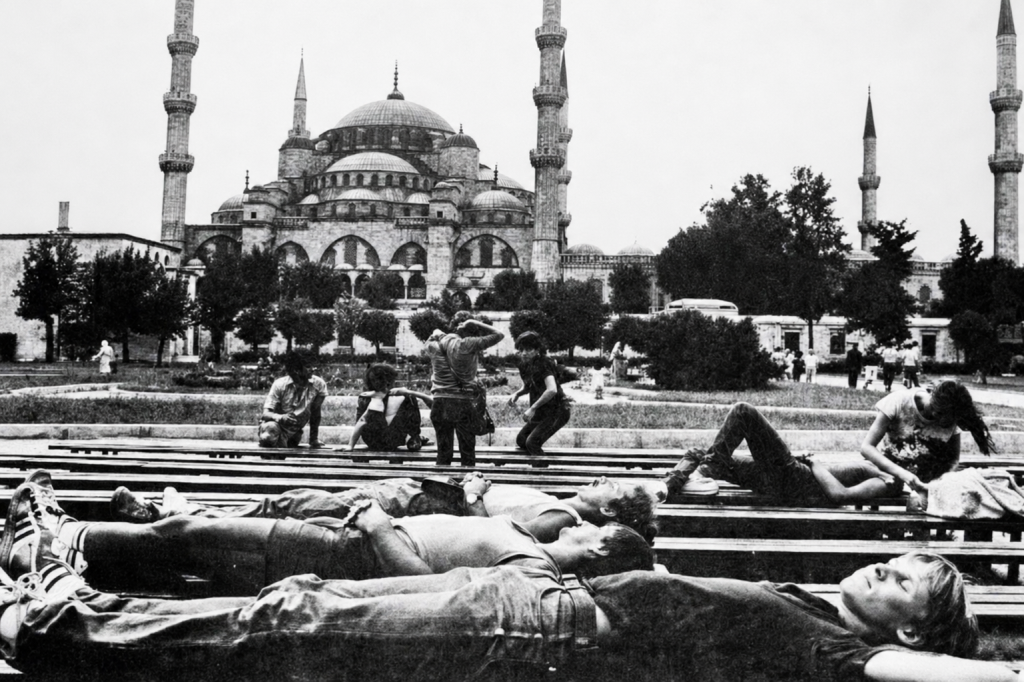
Hippies in Sultanahmet, late 1960s
Sultanahmet became their natural gathering place. It offered inexpensive pensions, modest hotels and easy access to Hagia Sophia, the Blue Mosque and the Grand Bazaar. Its streets filled with long-haired travellers dressed in embroidered shirts, Afghan coats, beads and faded denim.
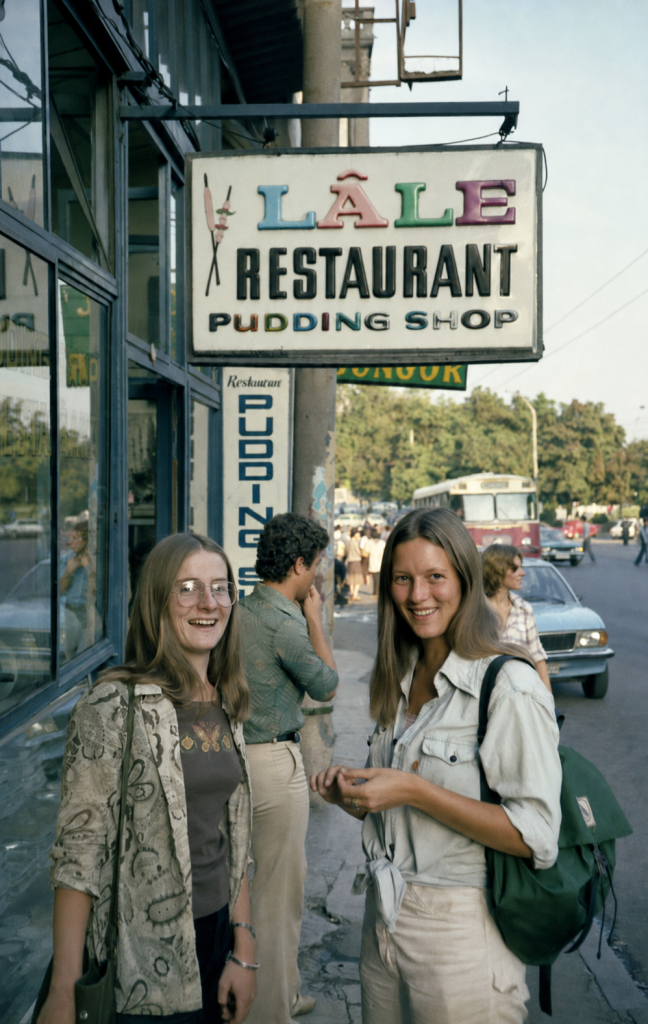
Two Hippie girls in front of Pudding Shop in Sultanahmet
At the centre of this small wandering world stood the Lale Restaurant, better known as the Pudding Shop. Its walls functioned as an improvised social network long before the internet. Travellers pinned up handwritten notes offering seats in vans, requesting information or searching for companions:
Leaving for Kabul. Two seats available.
Looking for travellers to India.
Anyone going to Kathmandu?
Maps, warnings, rumours and dreams circulated there. People found vehicles, travelling companions and places to sleep. Some arrived exhausted after days on the road and survived on fruit, roasted chestnuts and inexpensive puddings. Others wandered through the Grand Bazaar, astonished by its jewellers, shoemakers, carpet sellers, spice merchants, porters, tea houses and clouds of tobacco smoke. Istanbul was not yet arranged for their consumption. It confronted them in all its beauty, disorder, curiosity and intensity.
These travellers belonged to a generation that had begun to question almost everything their parents had accepted: war, authority, conventional marriage, organised religion, social conformity and the endless accumulation of possessions. Against the brutality of the Vietnam War, they placed flowers. Against the discipline of the office and factory, they proposed wandering. Against the respectable suburban household, they imagined communes, free love and lives liberated from ownership.

Bill and Hillary Clinton and Marylouise Oates in New Haven, circa 1971. Note that Bill Clinton were among the youth who travelled to the East via Istanbul. He even revisited Istanbul in 1999 to pay a visit to Sultanahmet and the Puding Shop.
Their rebellion was aesthetic, political and spiritual at once. They grew their hair, dressed in the colours of distant cultures and listened to music that seemed to tear open the fabric of the old world. They turned towards Hinduism, Buddhism, Sufism and other traditions in search of a wisdom that Western consumer society appeared unable to offer.

When I was a university student, I was fascinated by the hippies. By then, their great journey was already receding into history, but its afterglow remained. I loved the flowers in their hair, their dedication to peace and to the dream of a more just world, their relentless sense of freedom and their defiance of capitalism. They seemed to have stepped outside the architecture of ordinary life and declared that existence could be invented anew.
I was fascinated, too, by the poets and writers who had given language to that refusal. The Beat generation did not itself create the road to Kathmandu. Its writers had followed earlier paths through Tangier, Paris and Mexico in the 1950s, before the overland journey to India and Nepal became popular. Yet they had prepared the imaginative road on which the hippies would travel.
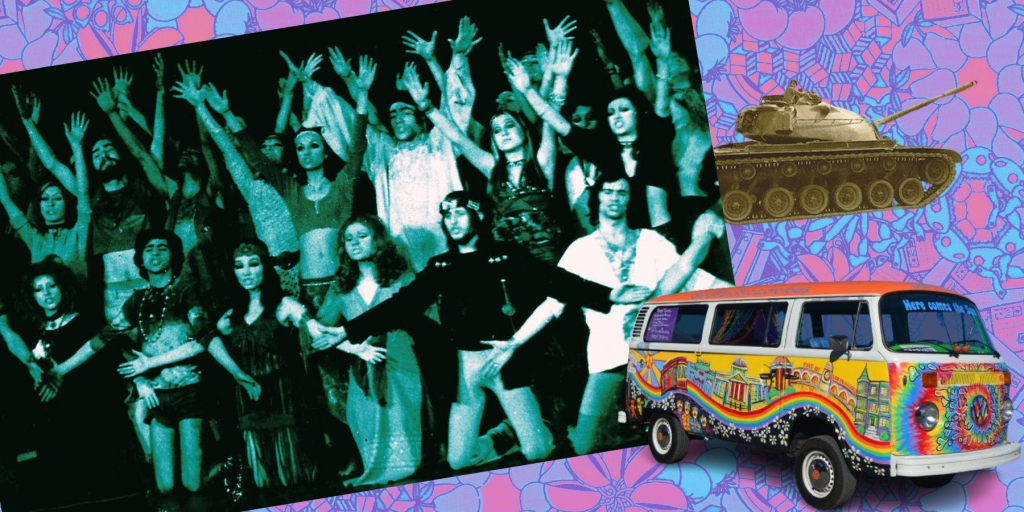
Hair, staged by the Engin Cezzar–Gülriz Sururi Theatre, 1971.
There was Lawrence Ferlinghetti, poet and publisher, who believed that poetry belonged in the streets; Allen Ginsberg, who turned protest into incantation; Jack Kerouac, who transformed movement into spiritual longing; and William S. Burroughs, dark, transgressive and impossible to domesticate. Their books carried the promise that would later animate the Hippie Trail: abandon the prescribed route, cross the border and awaken before the world succeeds in putting you to sleep.
The world through which they travelled has largely vanished. In 1979, two events decisively closed the traditional overland corridor: the Iranian Revolution and, at the end of that year, the Soviet invasion of Afghanistan. Iran ceased to be freely accessible to Western travellers, while Afghanistan entered an age of occupation, civil war and devastation from which it has never fully emerged. Borders hardened, roads became dangerous or impassable, and the leisurely journey from Istanbul to Kathmandu passed from lived experience into legend.
The hippies themselves grew older. Some preserved fragments of the dream; others entered the very institutions they had once rejected. The counterculture was gradually absorbed, packaged and sold back to the public. Rebellion became fashion. Spirituality became an industry. Freedom became an advertising slogan. Even the flower child was transformed into a consumer category.
Today, the hippies seem like a beautiful footnote in history—naïve perhaps, contradictory certainly, but touched by the radiance of a generation that dared to believe peace was more than a brief interval between wars.
Their dream did not prevail. The wars are raging still, and capitalism has become fiercer, more invasive and more triumphant than they could possibly have imagined. It has entered our homes, our relationships, our identities and even our most private desires, turning almost every human longing into something that can be measured, marketed and sold.
And yet I cannot dismiss those young travellers gathered in Sultanahmet with flowers in their hair, a Ferlinghetti poem in a backpack and Kathmandu written on a scrap of paper. History may have defeated their revolution, but it has not entirely extinguished the beauty of their refusal.
For one luminous moment, they passed through Istanbul believing that another world was possible.
Perhaps that belief, however defeated, is what remains.
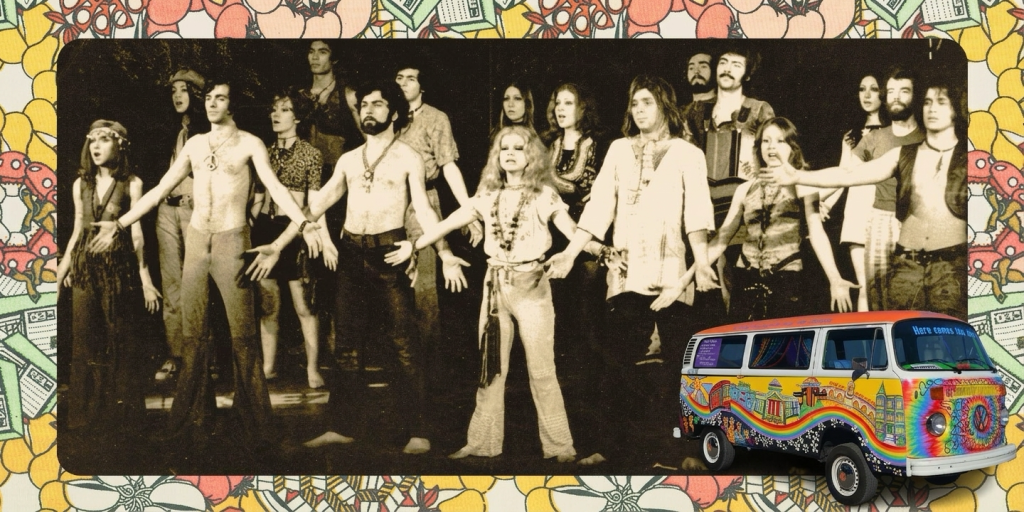
Hair, staged by the Engin Cezzar–Gülriz Sururi Theatre, 1971. Photograph: Olcayto Ahmet Tuğsuz Archive.
Visuals are taken from wanna.com, k24kitap.org, nostaljininsesi and oggito.com.
Note that the video is embedded via YouTube and all rights belong to the respective rights holders.