
There are museums in which one looks at the past, and others in which the past seems to close around you. The newly restored Museum of the Ancient Orient—Eski Şark Eserleri Müzesi—belongs decisively to the latter.
After four years of restoration, the museum has emerged not merely refurbished but transformed. Its extraordinary collections—Sumerian, Akkadian, Babylonian, Assyrian, Hittite, Urartian and ancient Egyptian—have been given a setting worthy of their civilisations. What was once an indispensable yet somewhat sombre repository has become an enveloping encounter with the earliest chapters of human memory.

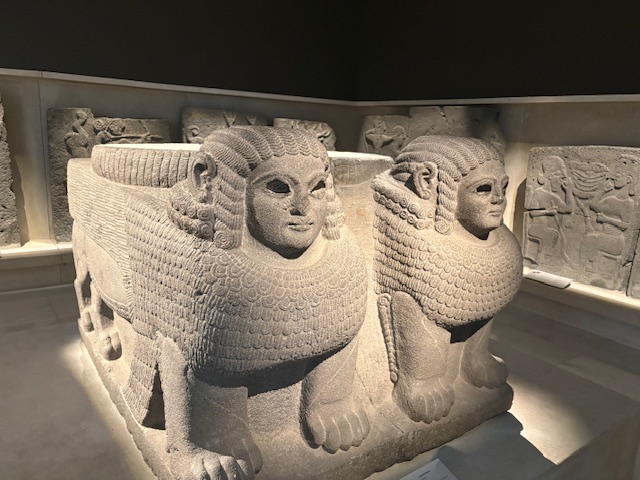
A sphinx from the Hittite period
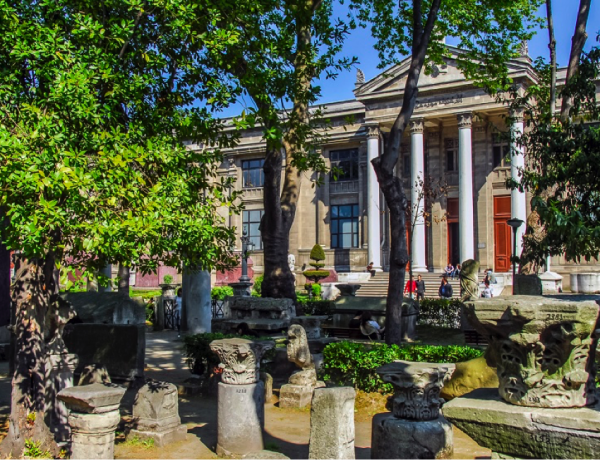
The experience begins with the building itself. Commissioned by Osman Hamdi Bey and designed by Alexandre Vallaury in 1883, it originally housed the Sanayi-i Nefise Mektebi, the Ottoman Empire’s first academy of fine arts. When the academy moved elsewhere in 1917, the building was entrusted with another form of artistic inheritance: the monuments and objects brought to Istanbul from the ancient lands of Anatolia, Mesopotamia, Egypt and the Arabian Peninsula.
There is something wonderfully fitting in this history. A building created for the teaching of art eventually became the home of objects made by the world’s earliest artists, scribes, architects and image-makers.
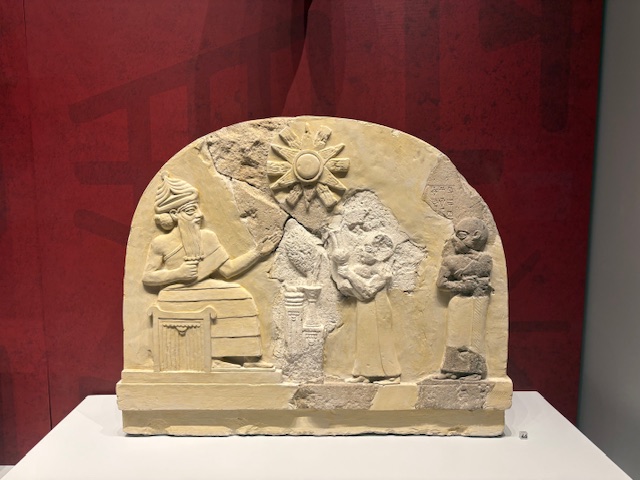
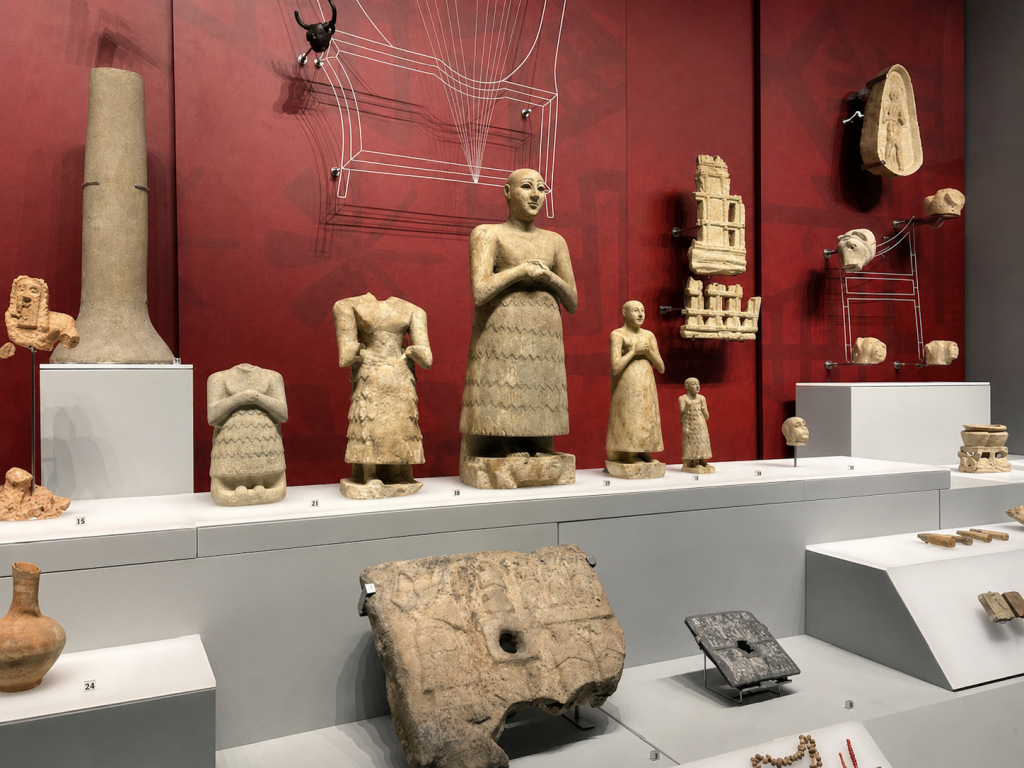
Sumerian votive stele
Following its restoration, however, the museum no longer feels like a succession of archaeological categories. The new display allows each civilisation to acquire its own atmosphere while remaining part of a larger human story. Darkened galleries, restrained colours and carefully directed light isolate the objects from the noise of the present. Stone reliefs emerge gradually from shadow. Cuneiform signs become visible as minute impressions made by a human hand. Small clay tablets, easily overlooked in a conventional display, possess an almost magnetic intensity.
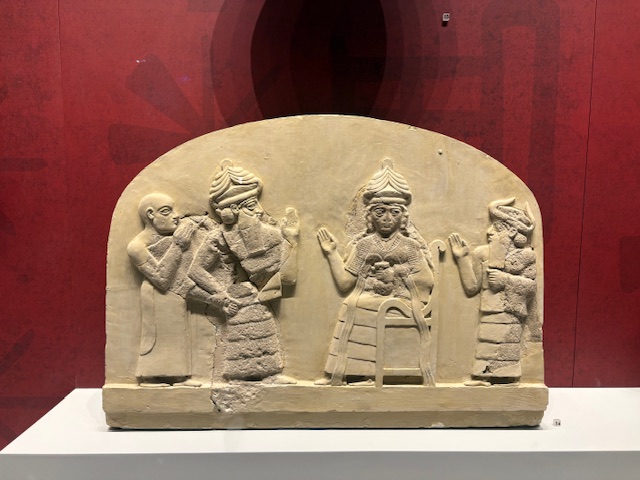
Sumerian votive stele
The lighting is dramatic without becoming theatrical. It does not compete with the objects; it reveals them. Every crack in the clay, every worn contour of stone and every surviving trace of pigment becomes part of the work’s long biography. The modern vitrines seem to disappear, leaving the visitor momentarily alone with things that have crossed four or five thousand years to arrive before us.
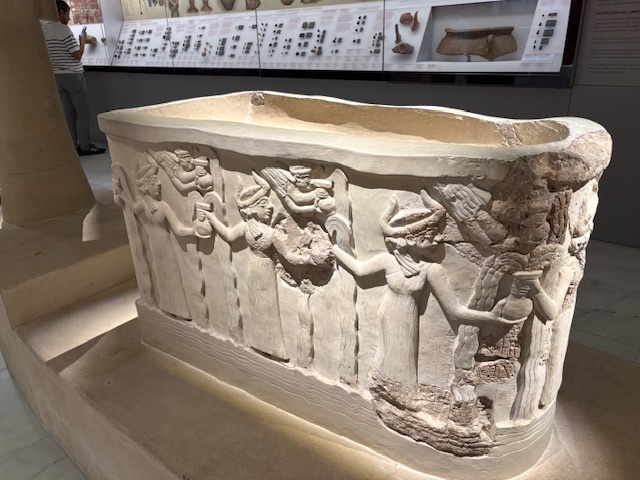
Sumerian votive basin
This is perhaps the museum’s greatest transformation. The collection has not simply been reorganised, it has been given a rhythm. One moves through the galleries as though travelling across the ancient lands surrounding the Tigris, the Euphrates and the Nile: from the Sumerian city-states to the empire of Akkad, from the monumental imagination of Babylon and Assyria to the Hittite world of Anatolia and the sacred universe of Egypt.
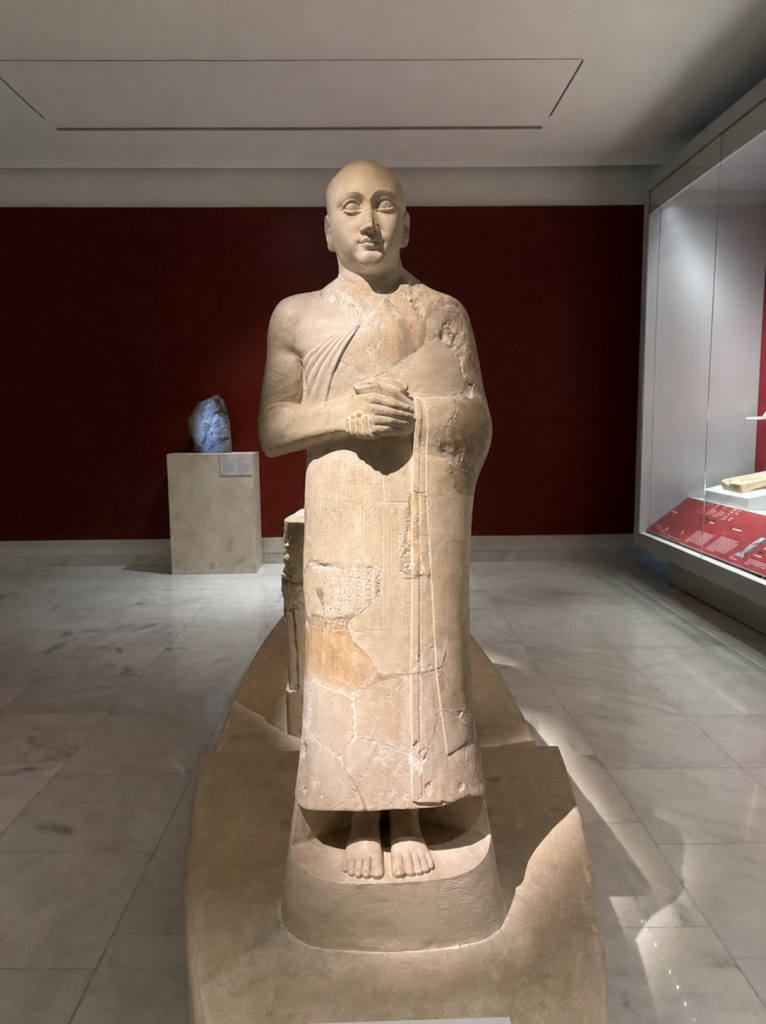
Sumerian Priest
These civilisations cease to feel like remote names in a history book. They become societies of astonishing complexity: people who calculated, negotiated, worshipped, desired, mourned and dreamed. They recorded harvests and royal victories, composed hymns, drew up treaties and wrote love poetry. In these galleries, the invention of writing is no longer an abstract milestone. It becomes something intimate—the mark of a reed stylus pressed into wet clay by a person whose name may have disappeared, but whose gesture survives.

Among the museum’s treasures is the celebrated Sumerian love poem known by its inventory number, Istanbul 2461, composed around the beginning of the second millennium BCE. Its survival is almost miraculous: human desire entrusted to a small piece of clay and carried across thousands of years. Nearby, tablets devoted to law, administration, religion and diplomacy reveal another miracle—the moment when memory learned to exist beyond the fragile limits of the human mind.

A relief from the Akkadian period
The famous clay tablet preserving the Hittite version of the Treaty of Kadesh stands among the most eloquent witnesses to this new world created by writing. Concluded between the Hittite king Hattusili III and the Egyptian pharaoh Ramesses II in the thirteenth century BCE, the agreement demonstrates that even in the age of warrior kings, peace could be negotiated, formulated and preserved in words.

Ornaments from the Sumerian period
Elsewhere, the stele of the Akkadian king Naram-Sin, Babylonian glazed-brick reliefs associated with the Ishtar Gate, Assyrian protective beings, Hittite monuments and Egyptian funerary objects speak in very different visual languages. Yet together they reveal recurring human preoccupations: power and mortality, divine protection, the desire for order, and the hope that something of us might endure.
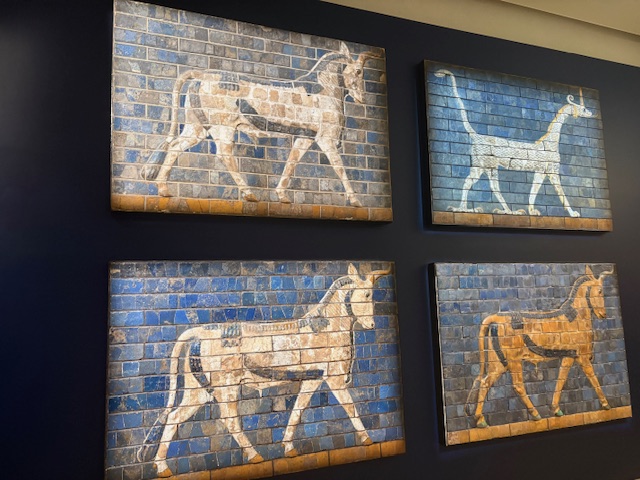
Reliefs from the Ishtar Gate
The restored museum also alters one’s sense of scale. Monumental lions, kings and supernatural guardians command the galleries, but the smallest objects can be equally affecting. A seal once rolled across damp clay, a household figurine held in someone’s hand, a tablet recording an ordinary transaction—each is a fragment of lived existence. History here is not composed only of empires. It is also made of touch.
And then there is Istanbul itself.
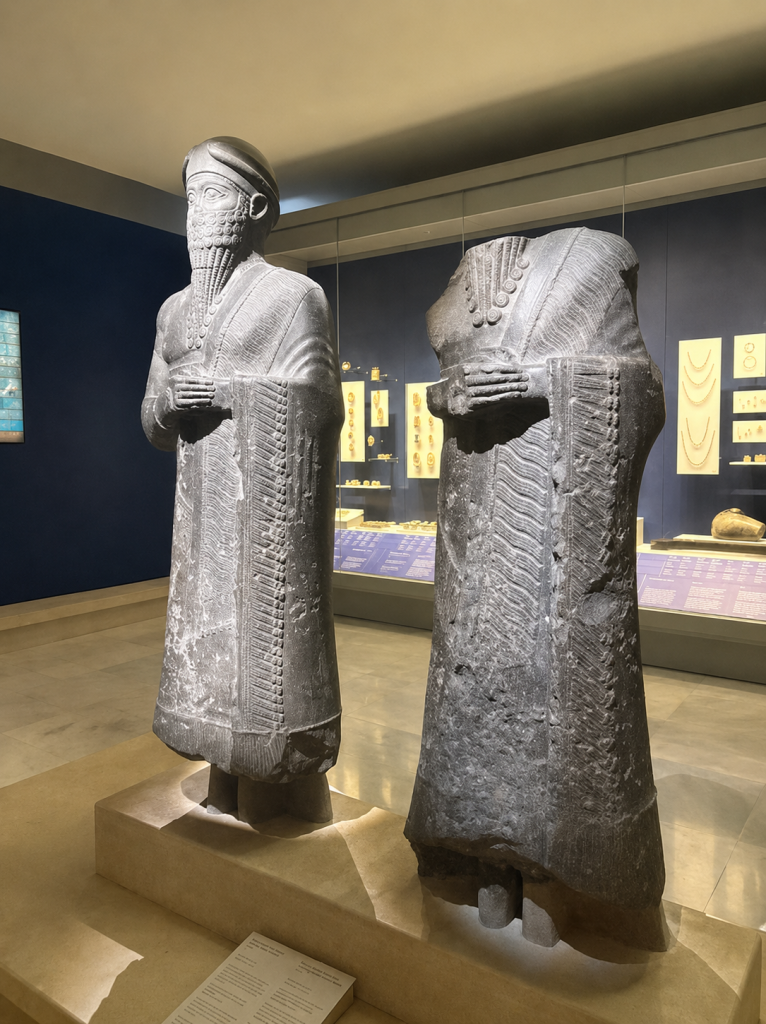
It is profoundly moving that these artefacts should be assembled in this particular city: the capital of an empire that once extended across many of the lands from which they came, and a city that has always stood between worlds. Within the museum garden, beside the Ottoman Çinili Köşk and the neoclassical Archaeological Museum, the Museum of the Ancient Orient forms part of a remarkable architectural and historical conversation. Byzantine, Ottoman, Anatolian, Mesopotamian and Mediterranean memories gather within a few steps of one another.
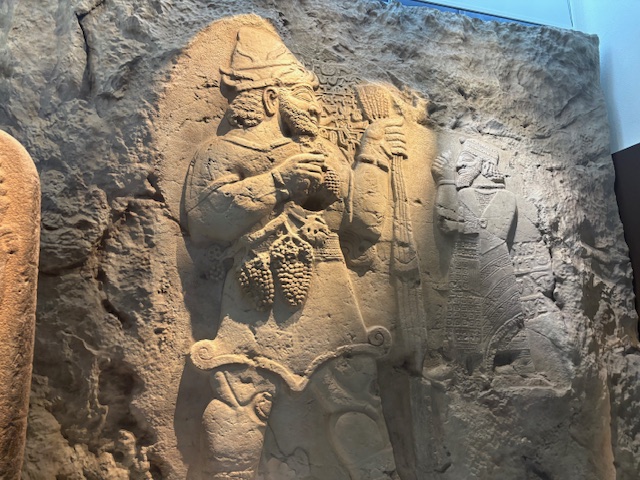
A replica of a Hittite relief
The restoration has allowed this once rather overlooked building to reclaim its place within that ensemble. It now feels less like an annex to the celebrated Archaeological Museum and more like its deep, mysterious prelude. Before the marble splendour of Greece and Rome, it reminds us, there was clay. There were temple cities, celestial omens, winged guardians, sacred marriages and words patiently impressed upon tablets.

Thousands of years later, in Istanbul, those voices can be heard again.
To leave the museum is to return to the bright air of Istanbul with one’s sense of time subtly disturbed. The modern city continues beyond the gates, yet the ancient world does not entirely release you. Its faces, animals, gods and undeciphered silences remain somewhere in the mind.
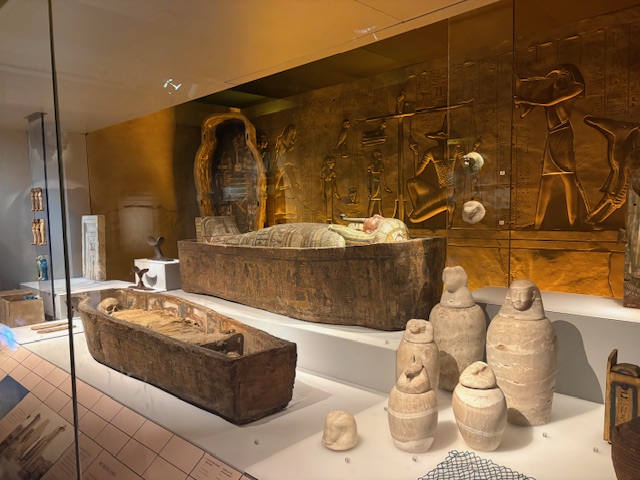

The renewed Museum of the Ancient Orient does more than display antiquities magnificently. It restores their capacity to overwhelm us. It reminds us that civilisation began not as an abstraction, but in the elemental human desire to make a mark—to shape clay, carve stone, address the gods, record a promise and send a voice into the future.
All photographs were taken by Mahan Doğrusöz at the Museum of the Ancient Orient, Istanbul.