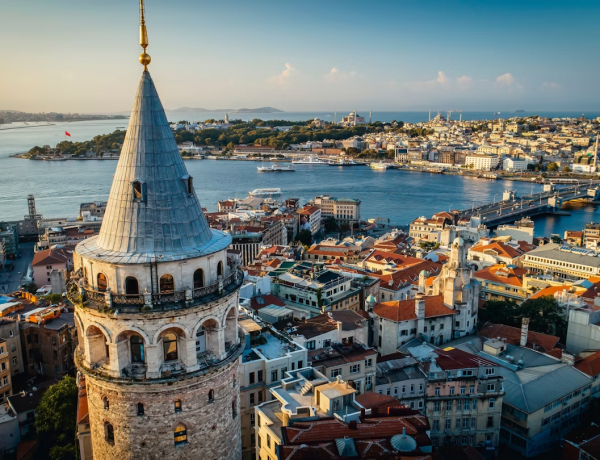

Shortly after my arrival, an Italian nun said to me: “Here, everyone feels at home.”
The following interview brings together my questions and the responses of Mr Antoine Antonioni, a reader of my work, translated from French. His reflections draw on his personal memories of Istanbul in 1973–74, his writings on the Levant, and his understanding of the city as a place shaped by cultural encounter and human connection.
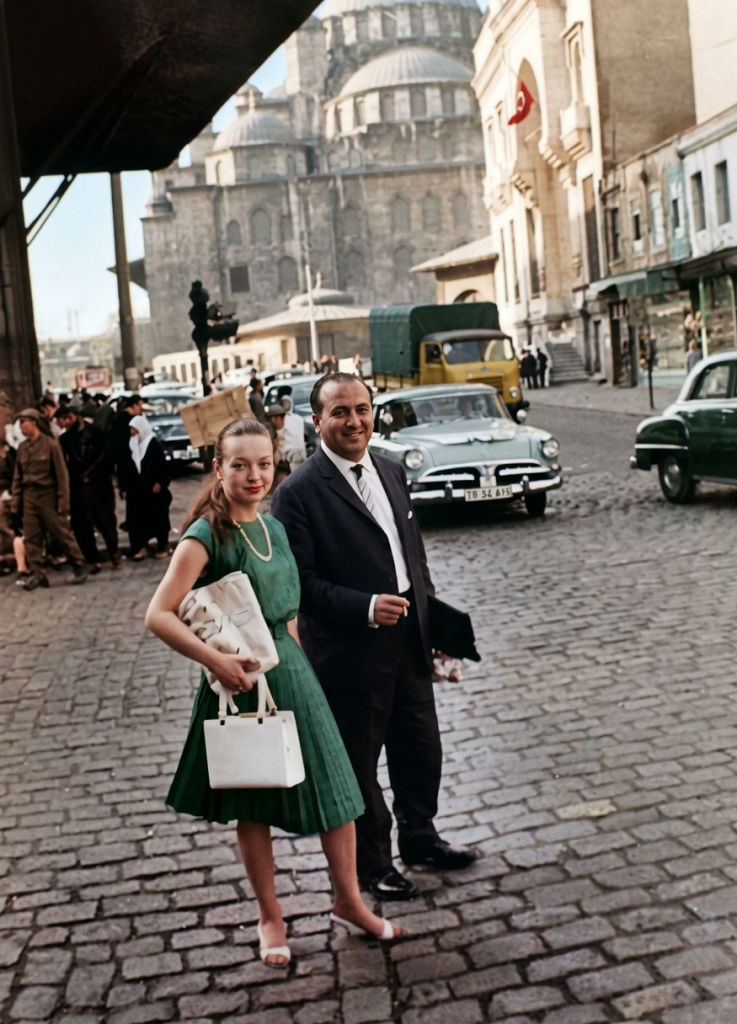
A glimpse at Eminönü, Istanbul in 1970s
Mahan Doğrusöz: You arrived in Istanbul by ship in the winter of 1973–74. Although your stay lasted only four months, your memories of the city have remained remarkably vivid. What do you remember most clearly about your first encounter with Istanbul, and what made the experience so enduring?
Antoine Antonioni: I am pleased that my modest personal experience has been considered worthy of your attention. However, my willingness to answer your questions does not mean that I claim to be knowledgeable about historical, geographical, or political matters, which you know much better than I do.
As for your first question, it almost makes me relive the moments when the passenger ship San Giorgio, on which I was travelling, had stopped at anchor to wait for the pilot boat. The lands of Asia and Europe, surrounding this beautiful sea—as your compatriot Loxandra calls it—seem to embrace those who arrive there as though they had reached the destination of a pilgrimage.
The memory of my stay has endured, not because I accomplished anything particularly important there, but because of the vital experience I gained from it: the experience of a social environment so full of life.
Shortly after my arrival, an Italian nun said to me: “Here, everyone feels at home.”
Mahan Doğrusöz: You recall a Levantine family whose everyday life brought together several languages and cultural traditions. What struck you about this multilingual world? Did it give you a particular understanding of how people in Istanbul could belong to several cultural worlds at once?
Antoine Antonioni: Getting to know a Levantine family in which three languages were routinely spoken at the dinner table, and a fourth—Turkish—outside the home, astonished me considerably. It was clearly a sign of different cultures meeting not only in the same place, but within the same people—a phenomenon that is very difficult to find elsewhere, after centuries of fanatical nationalism that has turned language into an ideological symbol.
Later, about fifteen years afterwards, I obtained further information about the Levantine community, which had once been very important, through a brief correspondence with a distinguished figure from that milieu, the late Mr Livio Missir, an official of the European Union who wrote books and articles on this subject, which is so little known in Italy.
Mahan Doğrusöz: You have recalled various encounters during your stay in Istanbul that left an impression on you. Looking back, what do these everyday experiences tell us about the social fabric of the city you knew? Do you think they reveal something of an older tradition of social solidarity?
Antoine Antonioni: You are teaching me that the social organisation of the Ottoman city was very complex: individuals were not isolated in relation to the state, but grouped according to their religious affiliation, each community having its own institutions for mutual assistance.
This multicultural structure, of course, had nothing in common with the present-day chaos of liquid society and its perpetual migratory movement, founded on the assumption of the free circulation of goods and of people treated as commodities. These are the consequences of absolute individualism, the absence of genuine relationships, and uprootedness.
Yet fifty years ago—I do not know whether this is still the case—I seemed to perceive traces of that older social sensibility.
I have already told you in my messages about some instances of courtesy and humanity that I encountered during my stay. I would like to add another encounter here. During my very first days, I was crossing the great square of Taksim, astonished by the enormous confusion of people moving in every direction, each going their own way and constantly crossing paths. (I eventually got used to it.) Amid this throng, a poor beggar held out his hand. And then one of those countless people, without slowing his pace, dropped a small coin into the beggar’s hand. What struck me was that the benefactor’s overcoat was almost as threadbare as the beggar’s!
Mahan Doğrusöz: In your reflections on Maria Iordanidou’s Loxandra, you draw attention to the richness of Istanbul’s multinational society as it emerges through everyday life, family traditions, and the experiences of ordinary people. What kind of historical understanding can a novel like this offer that a conventional account of political events might miss? And do you think the social sensibility it portrays survived into the Istanbul you experienced in 1973–74?
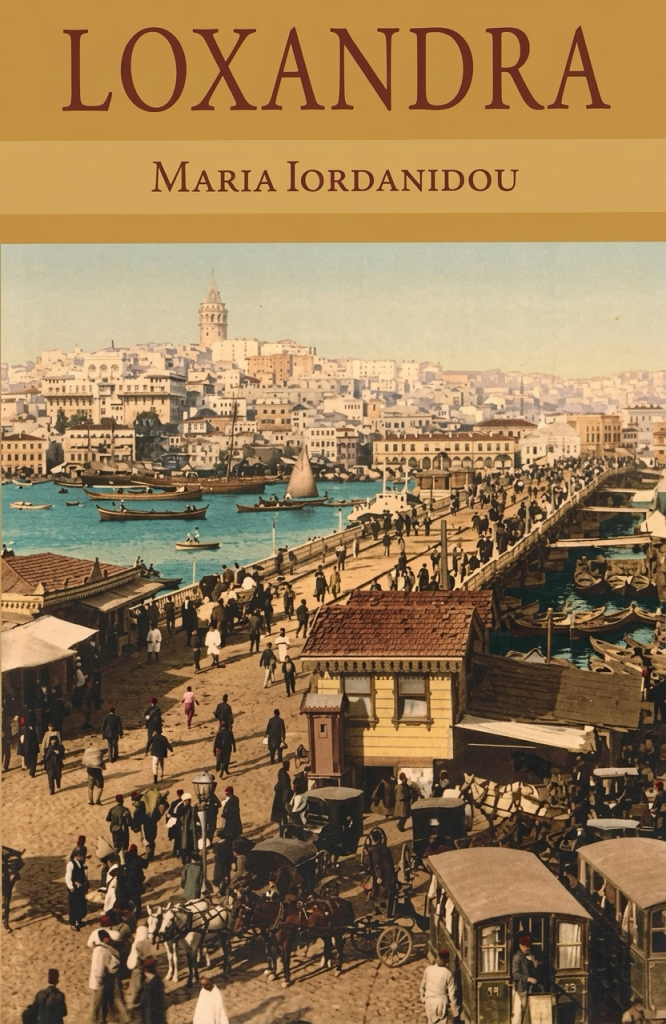
Antoine Antonioni: One must bear in mind that Loxandra is not what is ordinarily called a historical novel. In it, the author recounts memories of her childhood spent with her grandmother, preceded by stories she had heard within the family about her grandmother’s earlier life, extending approximately from 1830 to 1897. Both sets of stories have undoubtedly been transformed by the imagination, although it is impossible to say to what extent.
Events in political history—wars and so forth—enter the narrative only insofar as they are reflected, sometimes in a caricatured manner, in the everyday lives of very ordinary people, as I observed in Voci del Levante, 3.
Mahan Doğrusöz: In your Voci del Levante essays, you return to the suffering caused by nationalist fanaticism and ethnic cleansing, as well as to the destruction of multicultural communities. How important do you think literature is in challenging nationalist narratives and keeping alive an awareness of the human realities they obscure?
Antoine Antonioni: Yes, literature is extremely important in this respect!
In Voci del Levante, 2, I mentioned several Turkish authors who, in recent decades, have courageously denounced the antisocial consequences of nationalist fanaticism and ethnic cleansing.
I am pleased to have read something similar on your website as well.
Mahan Doğrusöz: More than fifty years after your stay, Istanbul continues to occupy a place in your thoughts and reflections. What do you think accounts for this enduring connection? What is it about the city that continues to draw you back to it, even after so many years?
Antoine Antonioni: You have astutely observed something that may seem rather curious: that, after fifty years, there is still something that turns my thoughts towards this city!
Perhaps it is because it is the City—Poli in Greek—in much the same way as Rome and perhaps Venice. Perhaps it is because the city itself is a symbol of the relationships that bind human beings to nature and to one another: relationships based not on power or domination, but on friendship (cf. Aristotle, Nicomachean Ethics, Book VIII, Chapter 9).
That is all! Please forgive me, and accept my warmest regards.
Following song was chosen by Mr. Antonioni for this interview as a reminder of his sentiments for Istanbul.
Antonio Antonioni is an Italian scholar and retired former Director of the University Library of Padua. He graduated in Letters from the University of Bologna in 1969 and later specialized in Classical Philology and Human Rights. His academic interests include Latin language and culture, European intellectual and legal history, and the history of duelling. Associated with Europa Latina, he spent the winter of 1973–1974 in Istanbul on a scholarship from the Italian Ministry of Foreign Affairs and subsequently participated in archaeological excavations at ancient Iasos, in Caria. He has also served as an instructor in international humanitarian law for the Italian Red Cross and participated in international missions in Bosnia and Herzegovina, Kosovo, and Armenia.