
We can emulate Orpheus and sing on in the face of horror, and not stop singing until the tide turns, and a better day begins.”
Salman Rushdie
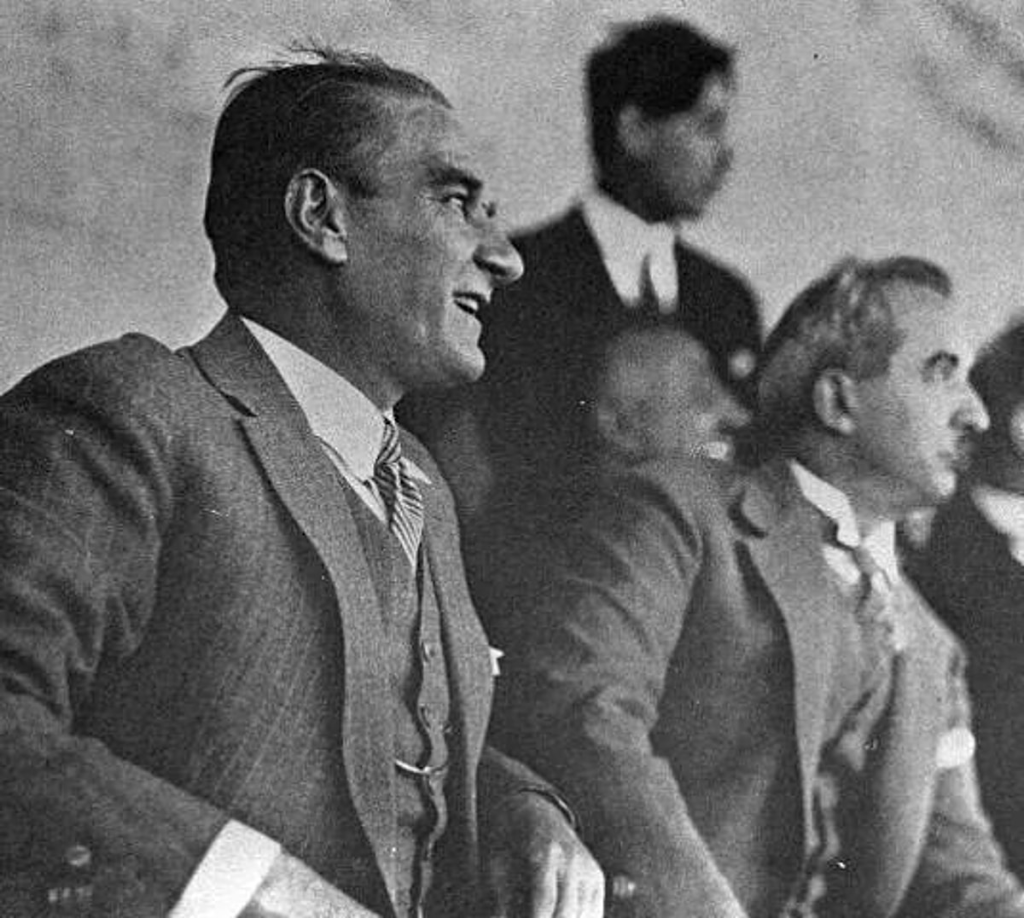
Atatürk was the founder of CHP (Republican People’s Party) and had left the party’s legacy to İsmet İnönü
When the Demokrat Parti (Democrat Party) came to power in 1950, Turkey experienced more than a routine electoral transition. For the first time since the founding of the Republic, the political order created by the founding party was being seriously challenged from within the democratic system. During the single-party era, CHP (Republican People’s Party) had become deeply intertwined with the institutions of the state. The distinction between party and state had gradually blurred. Buildings, cultural institutions, local organizations, and symbolic spaces often existed in an ambiguous zone where it was difficult to determine where the Republic ended and the party began.
In 1953, the Democrat Party took the unprecedented step of seizing all properties belonging to the Republican People’s Party , a dramatic act that left Turkey’s founding political movement stripped of its institutional foundations. After the Democrat Party confiscated the assets of the Republican People’s Party, the party was thrown into a kind of political and institutional exile. Its headquarters, newspapers, printing presses, local offices, and properties were seized by the Treasury under Law No. 6195.
The transfer of CHP properties to the Treasury in 1953 carried a message larger than law. This was not simply about assets. It was about dethronement.
Nowhere was this transformation felt more intensely than in Istanbul.
Istanbul has always been more than a city in Turkish political life. Ankara creates official ideology, but Istanbul tests whether that ideology can live inside society. In the 1950s, the city was rapidly transforming under the pressures of migration, economic liberalization, industrialisation, and growing American influence. A new urban middle class was emerging alongside a rising conservative-commercial culture that increasingly viewed the old Republican elite as distant, paternalistic, and culturally superior.
For many people arriving from Anatolia or climbing socially through trade and commerce, CHP did not appear merely as a political organization. It represented an entire social order. Its secularism was often experienced not as pluralism but as discipline; not as openness but as hierarchy. The seizure of party assets therefore became emotionally charged because it symbolized the weakening of an establishment identity that many felt had excluded them culturally, even when it claimed to represent the nation universally.
The language surrounding these events carried undertones of revenge, liberation, humiliation, and reversal. It was a political ritual through which a new social majority attempted to reclaim symbolic ownership of the country.
Yet Turkish political history has a peculiar tendency to circle back upon itself.
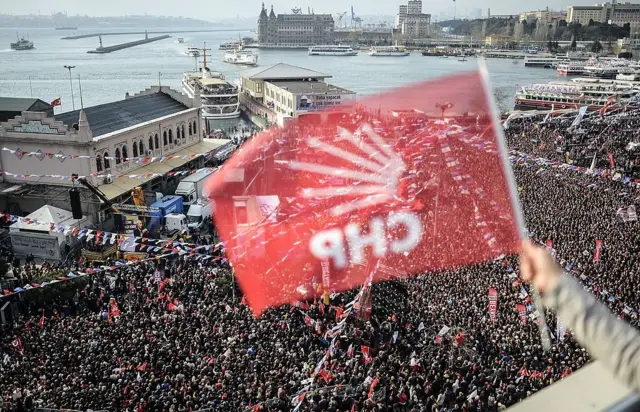
Istanbul once again stands at the center of Turkey’s struggle over legitimacy and representation. But the symbolic positions have partially reversed. Contemporary CHP, especially in Istanbul, no longer functions solely as the voice of the old bureaucratic Republican establishment. Over the last decade it has transformed into a broader urban coalition composed of secular middle classes, younger professionals, students, women, liberals, and economically anxious citizens searching for institutional stability and social normalcy.
The party’s tone has also changed. The rigid certainty has softened into a politics centered more on municipal life, inclusion, competence, and coexistence. Istanbul’s opposition politics today often speaks less in the language of ideological guardianship and more in the language of urban belonging.
Today, CHP finds itself in a very different environment, but some of the old dynamics still feel familiar in a new form. In Istanbul in particular, where CHP governs the metropolitan municipality as well as major municipalities, it operates under a political climate in which the ruling party is steadily reshaping the rules, limits, and meaning of political space. It is not about taking over physical property anymore, but about redrawing the boundaries of influence, decision-making, and even public narrative. In the end, CHP’s story—like Istanbul’s itself—has always been one of surviving pressure and returning, reshaped but still standing, into the center of political life.
I really hope that the tide turns and CHP, once again grows stronger from this stormy night.