

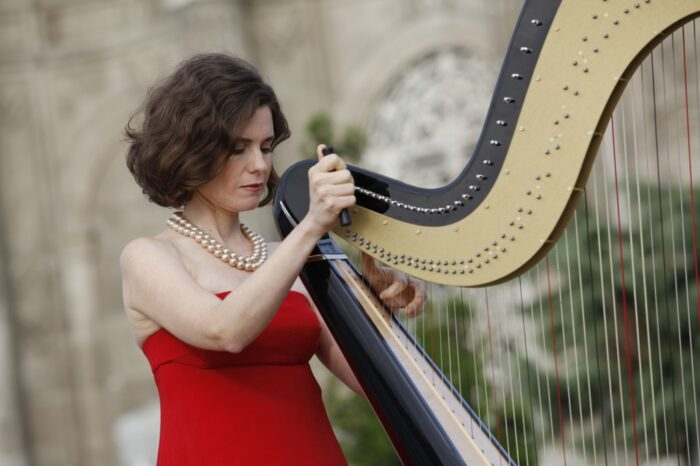
Şirin Pancaroğlu
Istanbul is never silent. Even in its quietest hours, it hums beneath the surface: ferry horns dissolving into fog, seagulls circling above the water, footsteps echoing beneath ancient vaults, and the call to prayer travelling from one shore to another. For harpist Şirin Pancaroğlu, the city’s voice seems to emerge from strings.
Her 2010 album İstanbul’un Ses Telleri began with a question: What do contemporary Turkish composers hear when they listen to this city?
The title contains a beautiful play on words. In Turkish, ses telleri literally means “vocal cords,” while tel also evokes the strings of a musical instrument. Istanbul is therefore imagined not merely as a city with strings, but as a living body whose voice is produced through them.
The composers’ answers form a musical map unlike any other. There are pigeons taking flight, solitary children, early mornings, underground waters and trees bearing silent witness to centuries of change. In pieces such as Güvercinler, Issız Çocuklar, Yerebatan and İstanbul’un Ağaçları, Istanbul is not described through monuments or imperial ceremonies. It is approached through glimpses, shadows and half-heard memories.
At the centre of the album is Pancaroğlu’s modern concert harp, surrounded by instruments including the flute, viola, kemençe, oud, kanun and double bass. Their voices meet as the city’s traditions have always met: sometimes in harmony, sometimes in tension, never entirely surrendering their separate identities. East and West cease to be opposing shores and become sounds carried across the same water.
A separate but equally evocative strand of Pancaroğlu’s work is her revival of the çeng, the angular harp once heard in Ottoman musical life and depicted in poetry and miniature painting. She began working on its reconstruction around 2008, collaborating with instrument makers to recover not only its form but also its musical possibilities. Her exploration would later find fuller expression in projects and recordings such as the 2014 album Çengnağme.
By the end of the seventeenth century, the çeng had fallen silent. Only its image remained: held against the body of a musician in a palace miniature, its curved neck rising like that of a bird. Pancaroğlu brought it back not as a museum object, but as a living instrument capable of entering contemporary music.
There is something profoundly Istanbulite in this return. The city is filled with things that have disappeared without entirely leaving: buried cisterns, vanished neighbourhoods, forgotten languages and melodies surviving only as echoes. The çeng belongs to this invisible city. Its reappearance resembles the sudden discovery of an ancient foundation beneath a modern street—a reminder that the past is never as distant as it seems.
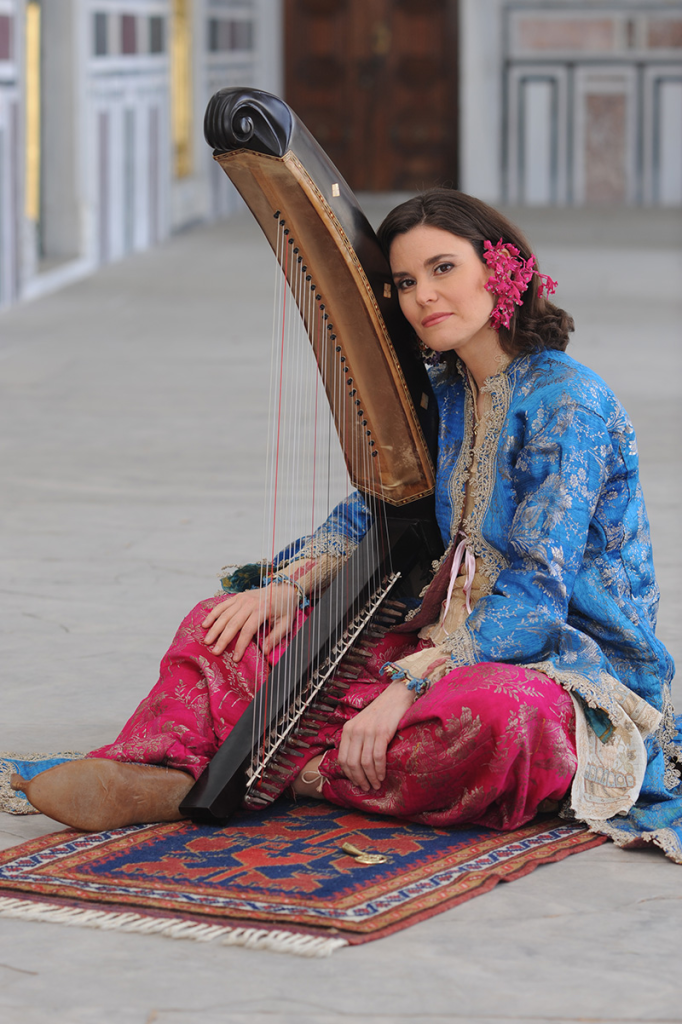
Şirin Pancaroğlu with the traditional Ottoman instrument Çeng
Pancaroğlu does not attempt to recreate a pure, untouched Ottoman world. Instead, she allows memory to enter the present and be transformed within it. The modern concert harp and its forgotten Ottoman relative belong to different chapters of her work, yet together they reveal the same impulse: to listen for voices that history has obscured and allow them to speak again.
Let me end with Şirin Pancaroğlu’s magical piece Resilience (Mukavemet), performed with Bülent Okan—a work that seems to distil Istanbul’s enduring spirit into sound.
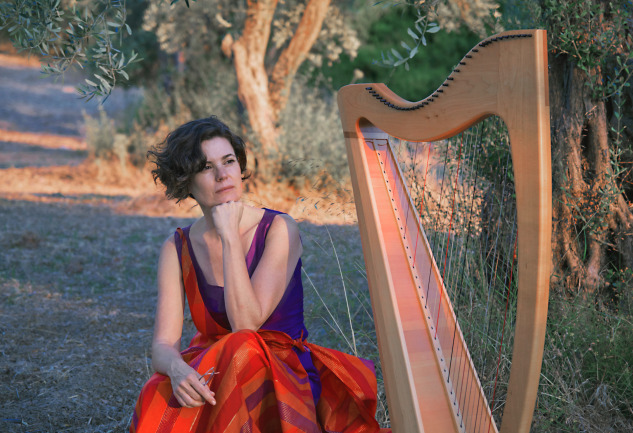
Note that the videos are embedded via YouTube and all rights belong to the respective rights holders.
Visuals are taken from tekfenflarmoni.com and themagger.com.