

Istanbul has carried many names across the centuries. It has been Byzantion, Constantinople, Konstantiniyye, İstanbul and, perhaps most poetically, Dersaadet: the Gate of Felicity, or the Gate of Happiness.
The name combines the Persian der, meaning “gate,” with the Arabic saadet, meaning happiness, prosperity or felicity. Dersaadet was therefore more than a geographical name. It presented Istanbul as a threshold: the entrance to good fortune, imperial favour and the heart of the Ottoman world.
This language of gates was not merely metaphorical. Ottoman Istanbul was a walled city entered through monumental gateways, while the empire itself was frequently imagined through the symbolism of the door and the threshold. The central government would eventually become known as the Bâbıâli, the Sublime Porte—or Sublime Gate. Authority did not simply reside in buildings; it waited behind doors, revealed itself at thresholds and regulated who might pass from one realm into another.
Nowhere is this idea expressed more powerfully than at Topkapı Palace.
Topkapı is not a European palace organised around a single monumental façade. It does not reveal itself all at once. Instead, it unfolds gradually through courtyards, walls and successive gates. With each threshold, the visitor moves further away from the city and deeper into the world of the dynasty. Space becomes more restricted, silence more pronounced and access more dependent upon rank and privilege.
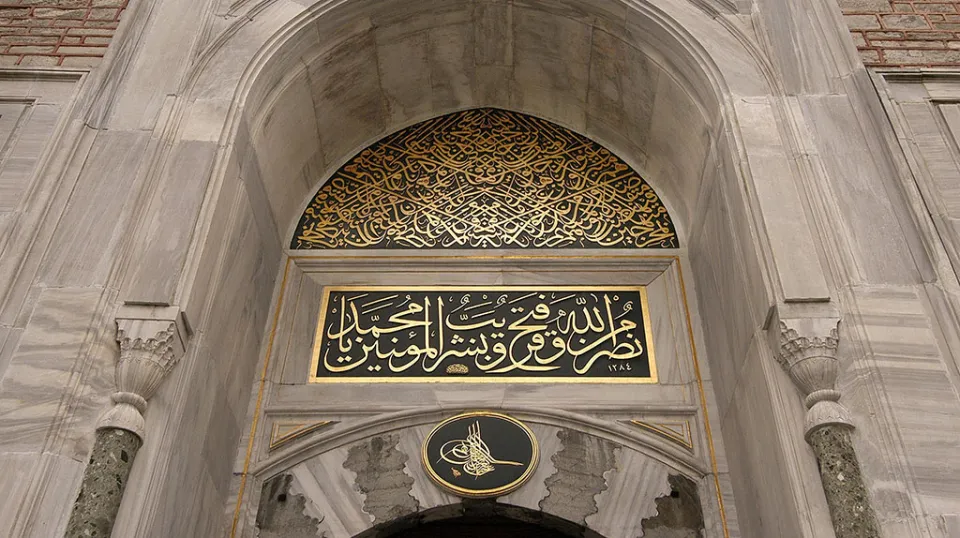
Bâb-ı Hümâyun
The journey begins at the Bâb-ı Hümâyun, the Imperial Gate. Built under Mehmed the Conqueror in 1478, it connected the city to the First Courtyard of the palace. The gate originally looked rather different from the structure we see today. Above it stood a wooden upper storey that served at different times as an imperial pavilion, a treasury and a vantage point from which members of the palace could observe ceremonial occasions. This upper structure was destroyed by fire in 1866 and never rebuilt, leaving the Imperial Gate with its present, more austere silhouette.
The First Courtyard was the most accessible part of the palace complex, containing service buildings and spaces connected to the daily workings of the imperial establishment. Yet even here, the monumental entrance announced that one was leaving ordinary urban life and entering the domain of the sultan.
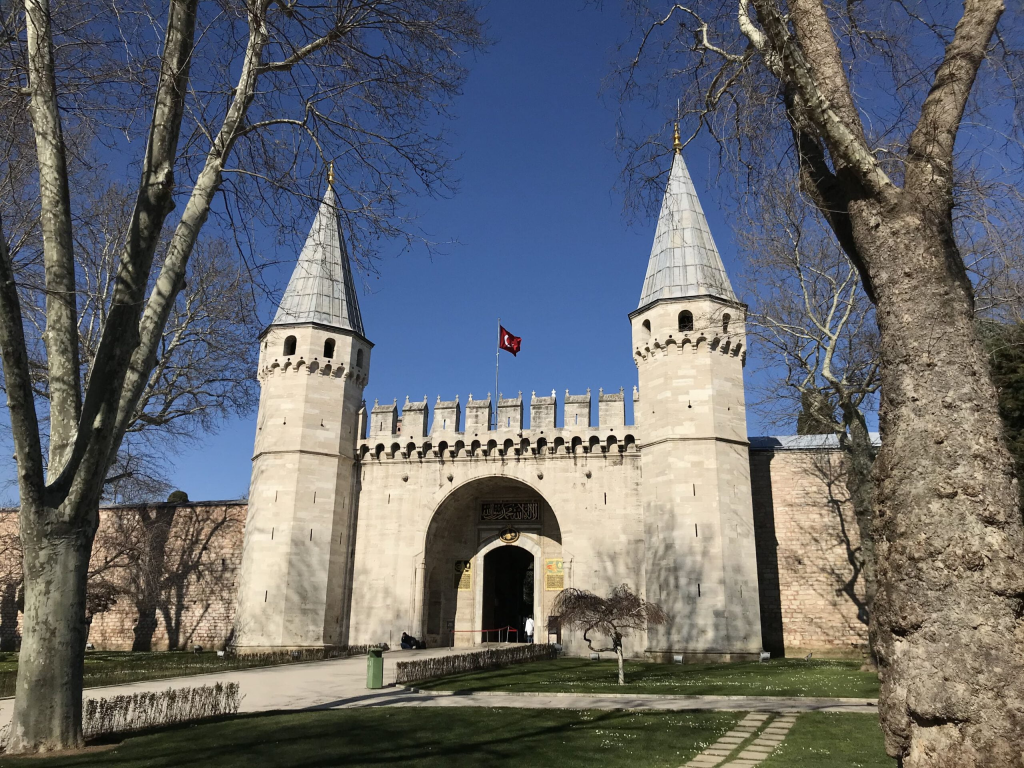
Bâbüsselâm
At the far end of the courtyard stands the Bâbüsselâm, the Gate of Salutation. Its core belongs to the early palace established under Mehmed II, but it acquired much of its familiar appearance during later alterations. The two polygonal towers with their pointed conical roofs are commonly associated with renovations undertaken during the reign of Süleyman the Magnificent in the sixteenth century. Their appearance, reminiscent of European fortified castles, gives the gate an almost medieval character unlike anything else within the palace.
Bâbüsselâm marked the entrance to the Second Courtyard and the administrative centre of the empire. Only the sultan could pass through this gate on horseback. Even the grand vizier was required to dismount, a carefully staged gesture reminding everyone that rank diminished in the presence of sovereign power.
Beyond it lay the Imperial Council, the kitchens, the treasury and the disciplined machinery through which a vast empire was governed. The gate therefore separated not simply one courtyard from another, but the relatively public world outside from the ordered and hierarchical world of the Ottoman state.
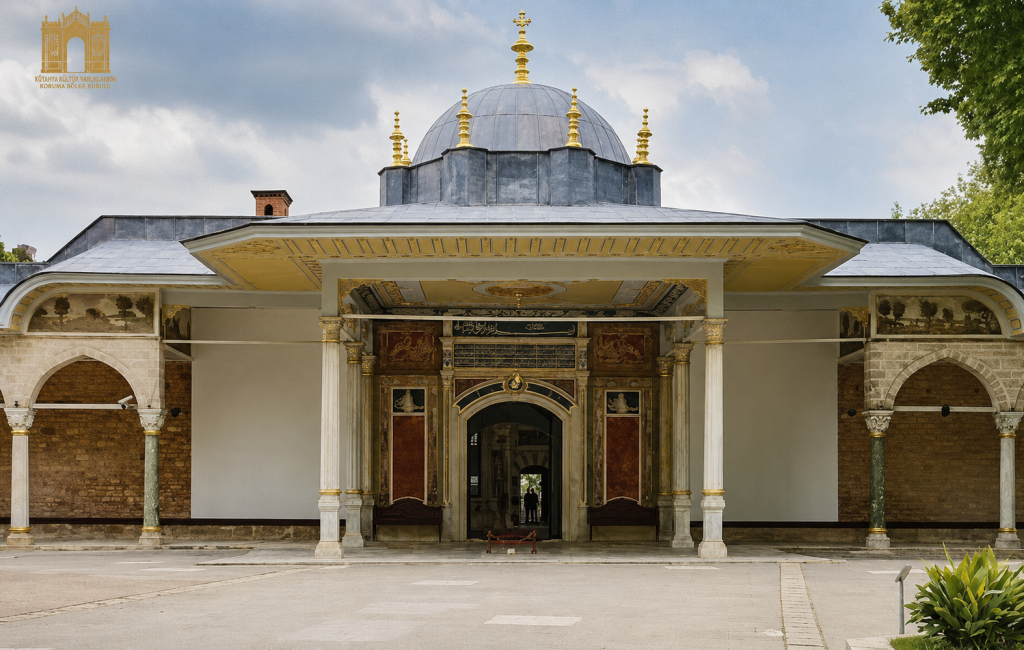
Bâbüssaâde
The final and most symbolically charged threshold was the Bâbüssaâde, the Gate of Felicity. It led from the Second Courtyard into the Third, where the Enderun, the Audience Chamber and the sultan’s private domain began. No one, not even the highest official of the empire, could cross it without the sultan’s permission.
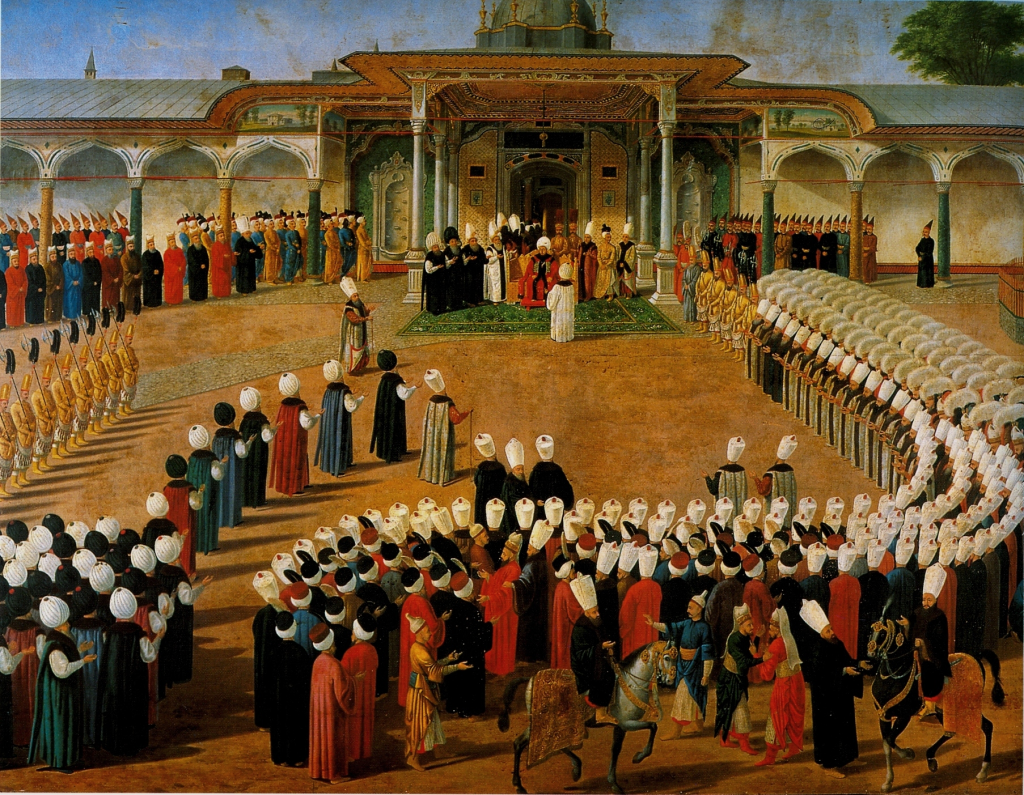
Sultan Selim III’s accession ceremony (1789), by Konstantin Kapıdağlı.
The Bâbüssaâde was also one of the principal ceremonial stages of Ottoman power. The throne was placed before it during accession ceremonies and religious festivals. Allegiance was offered at its threshold; the Sacred Standard was entrusted to commanders beneath its canopy. The sultan appeared framed by the gate—visible to the empire, yet separated from it.
There is an exquisite correspondence between the two names: Dersaadet, the poetic name of Istanbul, and Bâbüssaâde, the innermost ceremonial gate of Topkapı Palace. Both mean, in essence, the Gate of Felicity. The city was the fortunate gate of the empire; within it, the palace contained another gate of felicity leading towards the person of the sultan.
Yet every gate possesses a double meaning. It welcomes and excludes, reveals and conceals. It makes passage possible while controlling who may pass. The gates of Topkapı transformed architecture into protocol: each one brought a visitor closer to power, while making power more distant and mysterious. The deeper one entered, the fewer people were permitted to continue.
Perhaps this is why the image of the gate belongs so naturally to Istanbul. The city has always stood upon thresholds: between seas, continents, empires, religions and historical worlds. It is neither entirely one thing nor the other, but a passage between them. Its identity lies not only in what it contains, but in what it connects.
Istanbul is often called a city of domes, minarets and water. But it may also be understood as a city of thresholds. Its gates do more than open onto streets, courtyards and chambers. They open onto different degrees of visibility, belonging and power.


