
il faut cultiver notre jardin.’
Voltaire

I first encountered Voltaire long before I read him. His name appeared among the cornucopia of books in my grandfather’s library, on the spines of thick, solemn volumes printed in the early twentieth century. Their heavy bindings seemed to belong to another order of time. As a child, I imagined Voltaire must be an equally grave and forbidding writer, speaking from such a distant age that I could never understand him.

A glimpse at my grandfather Ali Fehmi Doğrusöz’s library
Years later, when I finally read Candide as an adult woman, I discovered someone entirely different: mischievous, merciless and astonishingly funny. Behind the powdered wig was a writer fascinated by questions that never grow old. Why do human beings suffer? Why do they inflict suffering upon one another? What remains of hope after experience has stripped it of innocence? Can optimism survive evil or does it become a form of cruelty when it refuses to see the world as it is?
Published in 1759, Candide follows a young man taught by his tutor, Pangloss, that he lives in “the best of all possible worlds.” He is then subjected to war, earthquake, persecution, betrayal and almost every imaginable form of misery. Voltaire piles catastrophe upon catastrophe with the speed of farce. The events are horrifying, but their rhythm is comic.
Voltaire is not laughing at suffering. He is laughing at the theories that try to make suffering respectable. Pangloss continues to explain every calamity as part of a perfect universal order, even when the evidence stands before him bruised, mutilated or dead.
After travelling across Europe and the Americas and surviving a seemingly inexhaustible catalogue of human cruelty, Candide’s long journey ends on the outskirts of Constantinople, in the cultivated landscape surrounding the city. The journey ends not in Paris or Rome, but near Istanbul, in the garden of an old Turkish man.

Panaroma of Istanbul in the second part of the 18th Century
By this point, Candide has endured the last straw. He does not quite conclude that human beings are born evil, but he has certainly discovered their extraordinary talent for cruelty, greed, vanity and self-deception. No elegant philosophy can explain these away.
The old man offers no grand theory. He lives quietly with his children and cultivates a small piece of land. Work, he says, keeps away three great evils: boredom, vice and need. His modest household possesses something that emperors and philosophers have failed to find: enoughness.
At the end of the novel, Pangloss is still insisting that every disaster was necessary to bring them to their present destination. Candide no longer argues with him. He simply replies: “That is well said, but we must cultivate our garden.”
The line is funny because it is so magnificently unimpressed. After chapters of metaphysics, violence and debate, Candide answers philosophy with gardening. Pangloss wants one more explanation of the universe; Candide has vegetables to attend to.
Yet the garden is not merely a retreat. It is an antidote to helplessness. We cannot abolish all evil or make human nature innocent. We can, however, care for the small part of the world entrusted to us. We can work, create, repair, feed, teach and protect. We can refuse both Panglossian optimism and sterile despair.
The solemn author I had glimpsed in my grandfather’s library turned out to be far less solemn than I imagined. Voltaire could see the worst in humanity and still make us laugh not because suffering was unimportant but the grand theories used to justify it deserved to be ridiculed.
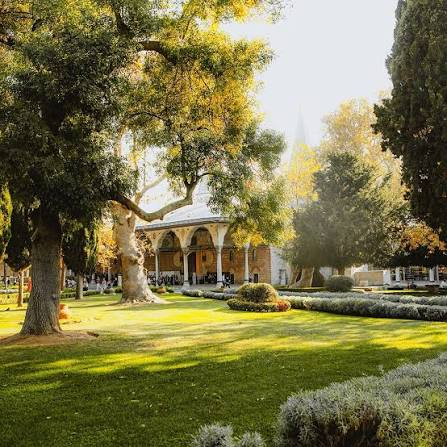
Garden of Topkapı Palace
In Istanbul, this ending acquires another resonance. The city was once interwoven with gardens: palace gardens descending towards the water, orchards behind wooden houses, flower gardens along the Bosphorus, vegetable plots beside the land walls and the celebrated pleasure grounds of Kağıthane. Many have disappeared beneath roads and apartment blocks, surviving only as botanical ghosts in the city’s memory.

The old gardens of Istanbul may have disappeared, but Candide’s instruction remains. When the world becomes unbearable and explanations begin to sound obscene, we return to what can still be tended. We cultivate our garden not because it is the best of all possible worlds, but because it is ours.
As a final note, I cannot help thinking that although nearly 270 years have passed since Voltaire wrote Candide, remarkably little has changed. Neither the flaws of human nature nor the senseless tragedies of the world have faded with time. Just as remarkably, our only true antidote remains much the same: to tune out the noise, turn away from grand but empty theories, and simply cultivate our own garden.
Note that the video is embedded via YouTube and all rights belong to the respective rights owners.


