
At the turn of the twentieth century, Istanbul attracted painters, writers, diplomats and travellers from across Europe, fascinated by a city that seemed to exist between worlds. Yet among the many foreign artists who painted Constantinople, few developed as intimate and enduring a relationship with the city as the Italian painter Leonardo de Mango.
For de Mango, Istanbul was not simply an exotic destination encountered during a journey through the East. It became his home.
From Southern Italy to Constantinople
Leonardo de Mango was born in Bisceglie, in southern Italy, in 1843. Showing an early talent for painting, he eventually studied at the Academy of Fine Arts in Naples, where he was trained in the academic traditions of nineteenth-century Italian painting.
Like many European artists of his generation, however, de Mango was drawn beyond Italy. He travelled through the eastern Mediterranean and the Middle East, spending time in places including Syria and Egypt, before eventually arriving in Constantinople in the 1880s.

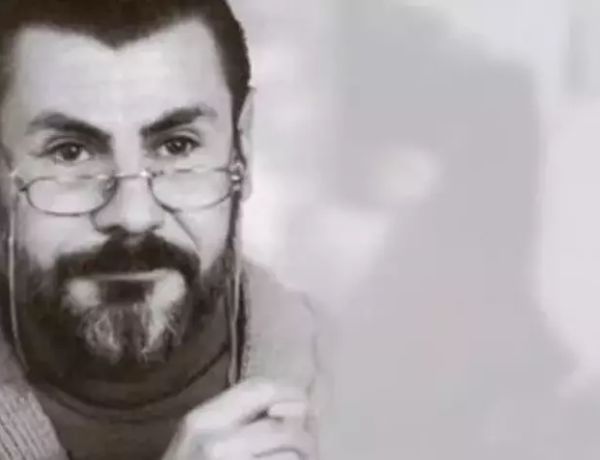
Leonardo de Mango
The city he encountered was one of extraordinary contrasts.
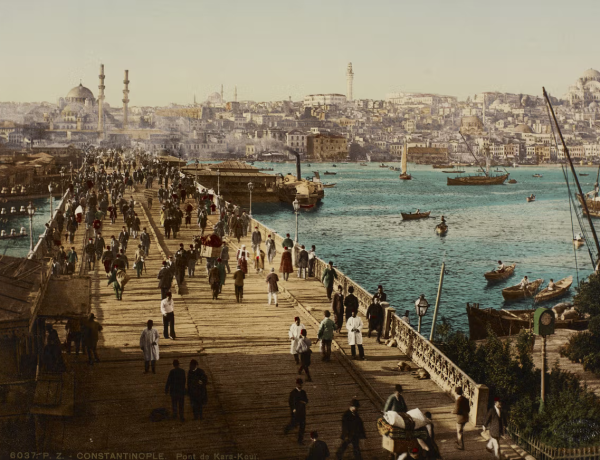
The Ottoman capital was undergoing rapid transformation. Modern apartment buildings and European fashions were appearing in Pera and Galata, while wooden neighbourhoods, mosques, cemeteries, fountains, dervish lodges and bustling markets preserved the rhythms of an older city. Steamships crossed the Bosphorus alongside caiques; foreign embassies and grand hotels stood within walking distance of streets that seemed scarcely altered for centuries.
De Mango found in this landscape an almost inexhaustible subject.
A Painter Who Stayed
What distinguishes de Mango from many painters commonly associated with Orientalism is the duration of his encounter with Istanbul.
He did not merely arrive, fill sketchbooks with picturesque scenes and return to Europe. He remained in the city for approximately half a century, living there until his death in 1930.
Istanbul consequently ceased to be an imagined “Orient” viewed from afar. It became the landscape of his everyday life.
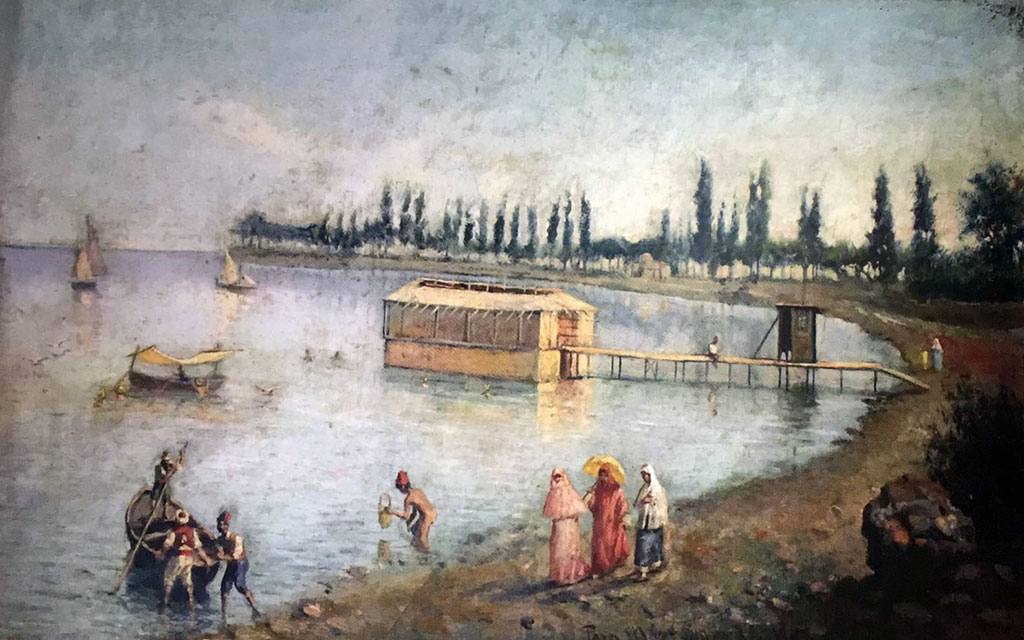
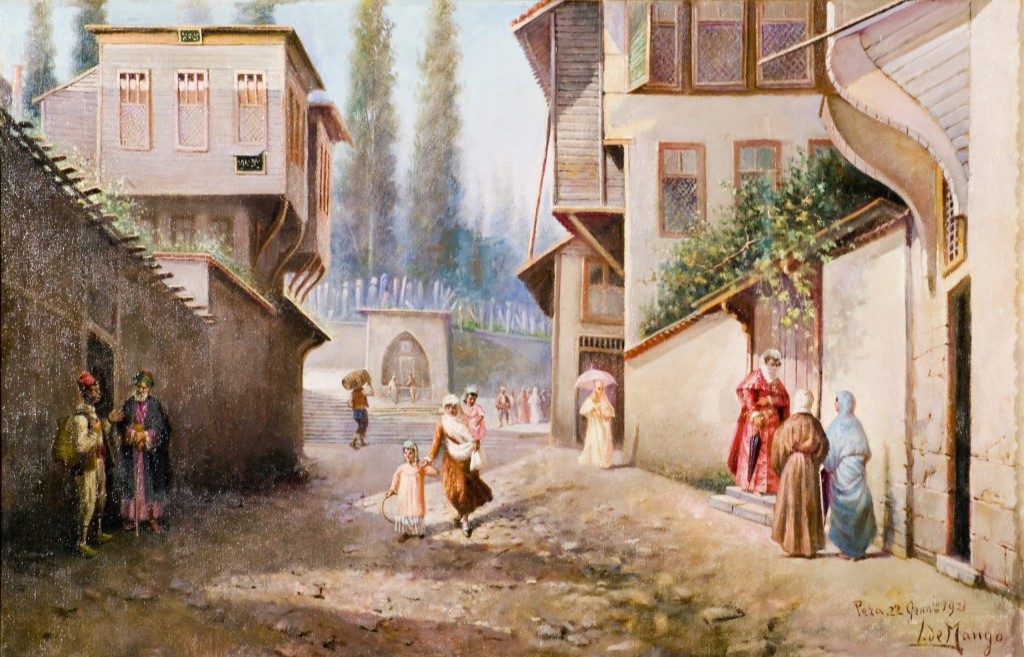
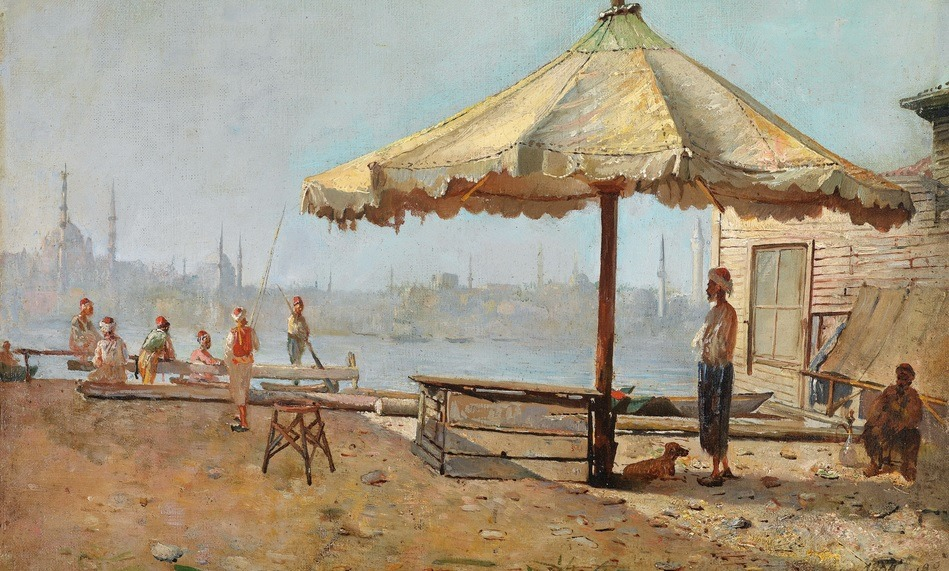
His paintings repeatedly return to the places that defined late Ottoman Istanbul: the Bosphorus and Golden Horn, mosques and minarets, neighbourhood streets, markets, waterfronts, cemeteries, boats and coffeehouses.
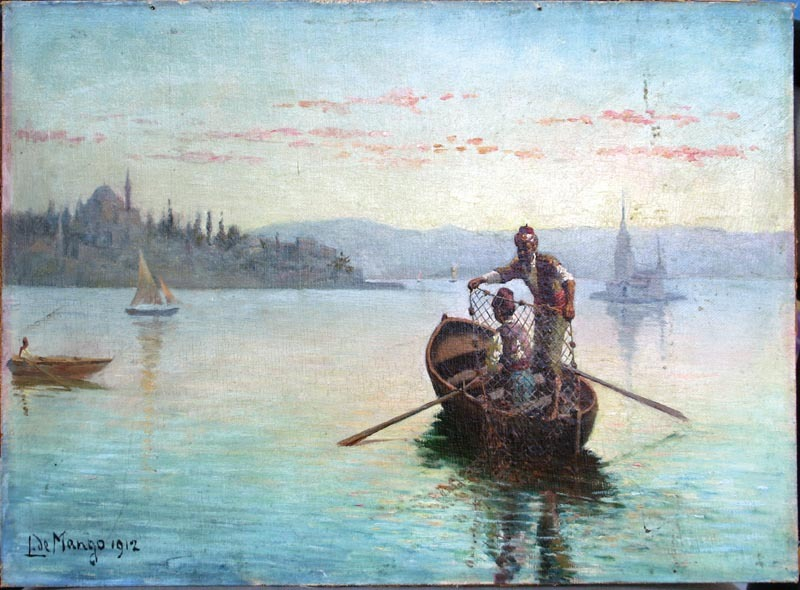
Yet people are rarely presented as monumental protagonists. They inhabit the city almost as naturally as the boats, trees, stones and buildings surrounding them. Fishermen work beside the water; figures pass through streets; boats glide across the Bosphorus. Human life becomes part of the larger rhythm of Istanbul.
This gives many of his paintings a quality quite different from the theatrical Orientalism fashionable in nineteenth-century Europe.
Between Orientalism and Observation
De Mango certainly belonged to the artistic world we broadly describe as Orientalist. His choice of subjects—mosques, bazaars, Ottoman streets, waterfront scenes and local types—corresponded to European fascination with the East.
Yet applying the label too mechanically obscures something important.
Much Orientalist painting depended upon distance. The East could become a stage on which European fantasies of sensuality, luxury, violence or timelessness were projected. De Mango’s long residence in Istanbul complicated that relationship.
The city in his paintings is picturesque, but it is also lived-in.
There is often surprisingly little drama. Instead, one finds atmospheric light, ordinary movement and fragments of daily existence. Istanbul is not merely a spectacle to be consumed by the foreign gaze; it is a place in which mornings begin, boats depart, people work, shadows lengthen and another day comes to an end.
That distinction makes his work particularly valuable today.
Painting a City That Was Disappearing
Without necessarily intending to become a historian, de Mango became a visual chronicler of a city undergoing enormous change.
Perhaps this is what ultimately separates Leonardo de Mango from so many painters of Constantinople.
The Istanbul of his lifetime experienced the final decades of the Ottoman Empire, the reign of Sultan Abdülhamid II, the Young Turk period, the Balkan Wars, the First World War, the Allied occupation of Constantinople and finally the establishment of the Turkish Republic.
The physical city was changing just as dramatically.
Fires repeatedly destroyed wooden neighbourhoods. New roads altered old urban patterns. Modern transport transformed movement through the city. Buildings disappeared, shorelines changed and entire ways of life gradually vanished.
Seen from the twenty-first century, de Mango’s paintings therefore possess a significance extending beyond their artistic qualities. They preserve glimpses of an Istanbul that photography recorded only partially and that urban transformation would eventually erase.
A wooden house, a waterside café, a cemetery shaded by cypress trees or a quiet stretch of the Golden Horn may appear incidental within a painting. A century later, such details become historical evidence.
The School of Fine Arts and Osman Hamdi Bey
De Mango also became part of Istanbul’s artistic world rather than remaining isolated within its European expatriate community.
He was associated with the Sanayi-i Nefise Mektebi, the Imperial School of Fine Arts founded under the leadership of Osman Hamdi Bey in 1882 and opened the following year. The institution—ancestor of today’s Mimar Sinan Fine Arts University—played a central role in the development of modern art education in the Ottoman Empire.
His presence places de Mango within a fascinating cosmopolitan artistic environment in which Ottoman, Levantine and European painters worked alongside one another.
This was, after all, one of the defining characteristics of late Ottoman Istanbul. Artistic life did not divide neatly into “East” and “West.” Italians, Greeks, Armenians, Ottoman Muslims, Levantines and other communities inhabited overlapping cultural worlds, exchanging techniques, tastes and ideas.
De Mango himself became part of that mixture.
The Light of Istanbul
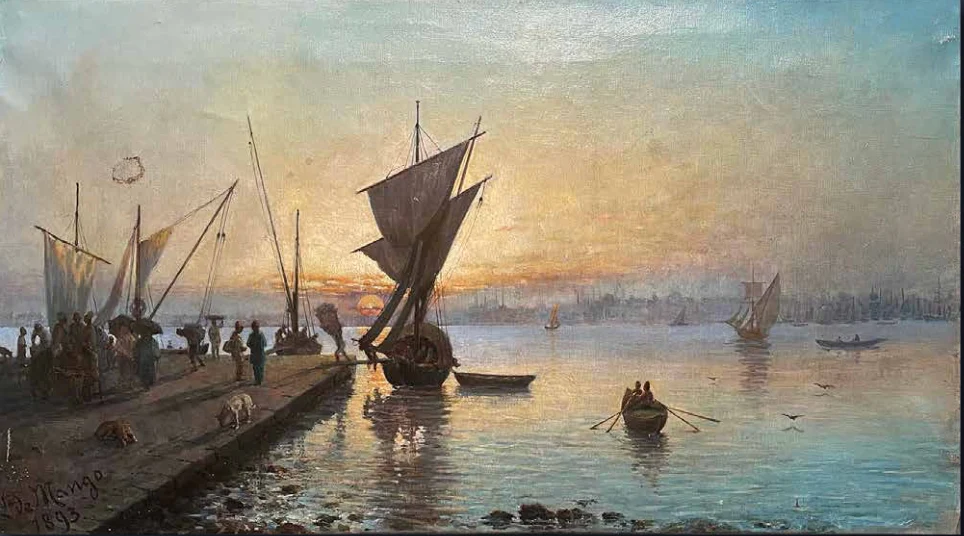
Perhaps the most seductive element in de Mango’s Istanbul paintings is light.
The city’s geography makes light almost impossible to ignore. Water surrounds and penetrates it: the Bosphorus, the Marmara and the Golden Horn constantly reflect the changing sky. Domes and minarets interrupt the horizon while hills create endlessly shifting perspectives.
De Mango repeatedly captured this atmospheric Istanbul.
His city can glow beneath a pale sky or dissolve into the warm colours of sunset. Water reflects architecture without perfectly reproducing it. Minarets appear as vertical accents against immense expanses of air. Even busy scenes frequently retain a curious stillness.

The monumental and the ordinary coexist.
That may be why his Istanbul feels convincing. The city is grand, but its grandeur is rarely forced upon the viewer. It emerges almost accidentally from the relationship between water, architecture, human movement and light.
An Italian Who Became Part of Istanbul
Leonardo de Mango died in Istanbul in 1930, after having spent most of his adult life in the city.
By then, Constantinople had officially become Istanbul and the imperial capital he had first encountered had disappeared with the Ottoman Empire itself. Yet de Mango had remained through these transformations, continuing to observe and paint the city.
His biography therefore belongs to a distinctive category of Istanbul stories: those of foreigners who arrived as visitors but gradually became part of the city’s cultural memory.
Today his paintings allow us to look again at the Istanbul of the late nineteenth and early twentieth centuries—not through the hurried eyes of a traveller, but through those of a man who had watched the same waters and streets for decades.
His Final Resting Place
De Mango’s bond with Istanbul did not end with his death. When he died in the city on 27 January 1930, after nearly half a century spent observing and painting its streets, shores and changing light, he was buried in the Feriköy Latin Catholic Cemetery. Having died in modest circumstances, he was initially laid to rest in the section reserved for those without a private grave, and his remains were later transferred to the cemetery’s ossuary. Decades later, through the efforts of researcher and collector Erol Makzume and with the support of Istanbul’s Italian community, his remains were located and reinterred in a proper grave in Feriköy in 2005. There is something deeply fitting in this final chapter: the Italian painter who came to Constantinople in search of subjects to paint stayed for almost fifty years, witnessed an empire disappear and a republic emerge, and ultimately became part of the city he had spent a lifetime depicting. Leonardo de Mango did not merely paint Istanbul; in the end, Istanbul became his final home.
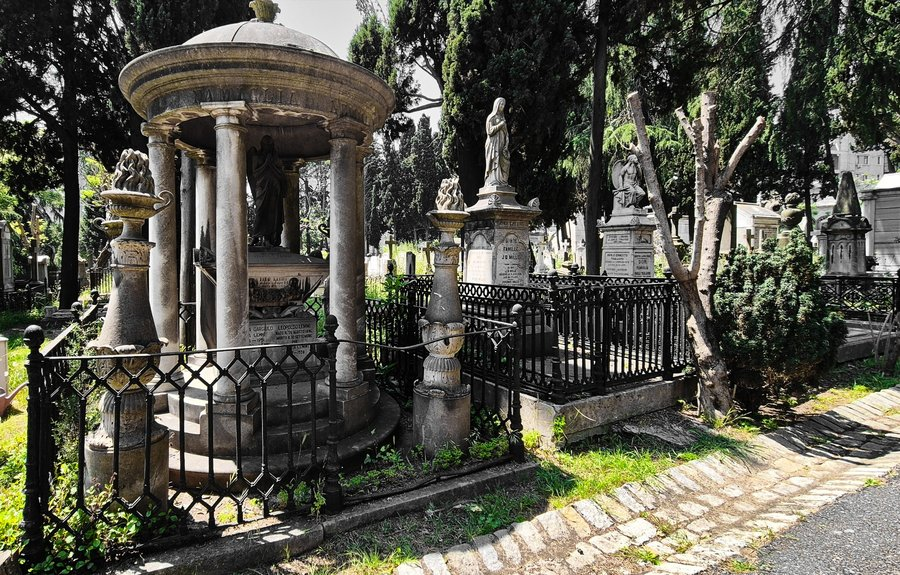
Feriköy Latin Catholic Cemetery