

Dedicated to my grandfather, Suat Vina, who was a virtuoso of the oud.

The oud’s earliest ancestors emerged in Ancient Mesopotamia, around 2000 BCE, in the fertile regions of today’s Iraq, Syria, and southeastern Anatolia. Archaeological depictions show short-necked, pear-shaped lutes, held close to the body and designed for melodic subtlety rather than rhythmic force. These instruments laid the foundation for the ud’s later expressive range, emphasizing timbre, microtonal nuance, and melodic improvisation.
From Mesopotamia, the instrument spread across Persian, Assyrian, and early Arab cultures, gradually evolving in structure and tuning, and acquiring the name al-ʿūd—“the wood”—in the Arab world. Here, the oud was systematized: its proportions refined, its modes codified, and its role as a vehicle for emotional and spiritual expression firmly established.

A glimpse at Ottoman Istanbul
While the oud was widely known before, it was in Ottoman Istanbul that it attained its mature musical identity. By the 17th century, Istanbul had become a crossroads where Byzantine, Persian, Arab, and Anatolian musical traditions converged. Within this melting pot, the ud underwent subtle but profound transformations.
Ottoman musicians emphasized clarity, elegance, and expressive restraint. The oud became central to classical Ottoman music, not as a spectacle, but as a voice capable of profound intimacy and complex emotional resonance. Istanbul nurtured virtuosos who expanded the instrument’s expressive capacity, developing solo improvisation (taksim) as an art form.
In the Ottoman Empire, women’s mastery of the oud was largely the result of systematic musical training within the palace and the harem. At the Harem-i Hümayun, concubines and female members of the royal household studied under professional music teachers using the “meşk” method, which emphasized learning through listening, imitation, and repetition; this education encompassed both instrumental and vocal training.
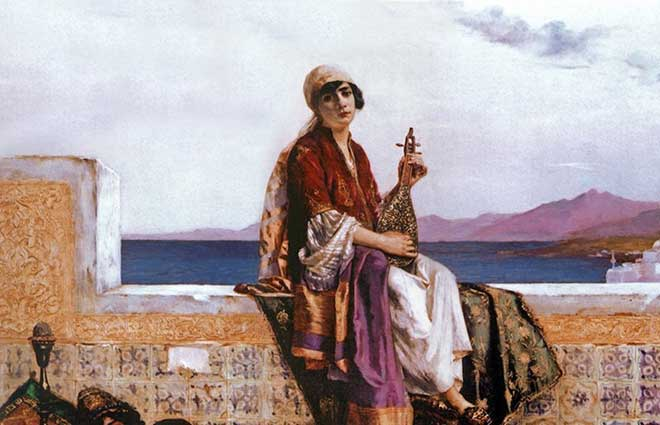
The oud, considered one of the most prestigious instruments in court music, required prolonged lessons and practical performance to master its intricacies. Women trained not only for daily entertainment but also to perform classical forms such as the fasıl at a high level, allowing some to gain recognition as accomplished musicians, teachers, and even composers within the harem. Ottoman court policies further supported this musical cultivation, with sultans ensuring that teachers and instruments were provided for the sultan’s wives, daughters, and senior female members, creating an environment where women could achieve true mastery of the oud.
In recent years, young Turkish artists have revived the classical Ottoman musical tradition which oud is a cornerstone of.
The oud traveled to Europe primarily through Al-Andalus (Islamic Spain), especially via the musician Ziryab in the 9th century. European craftsmen adapted it to local tastes: frets were added, the neck elongated, and tuning modified. These changes gradually transformed the oud into the lute, which became the centerpiece of Renaissance and Baroque music.
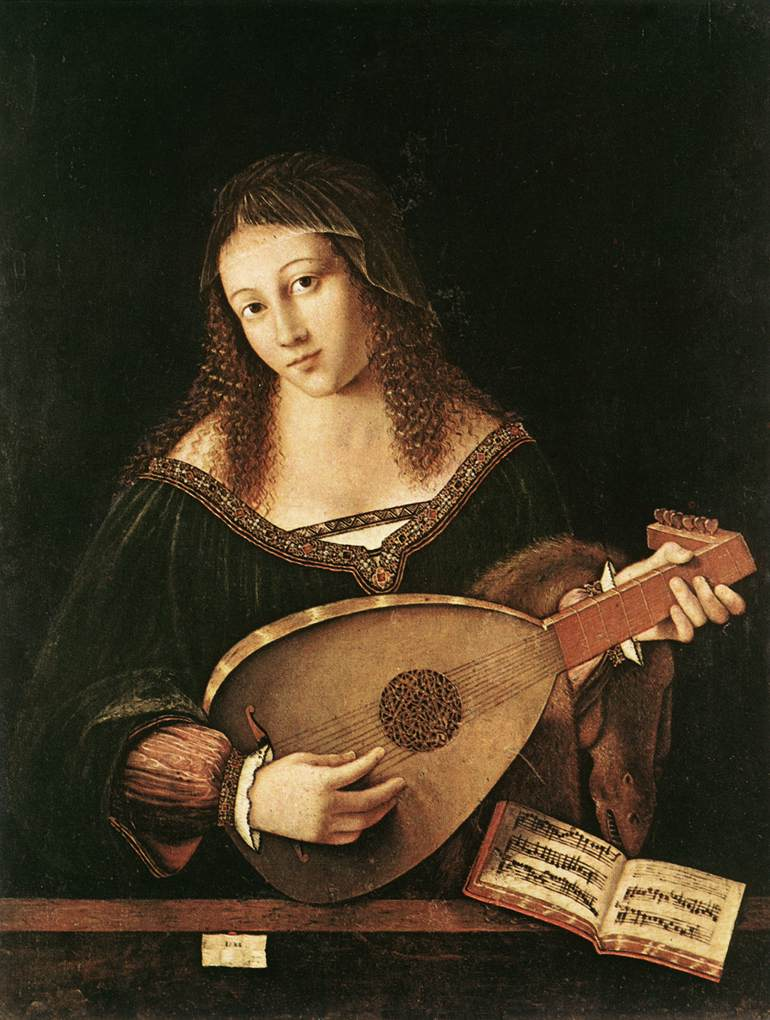
Lute in Renaissance Europe
Though the lute’s European evolution obscured its origins, the ud’s influence is unmistakable: its modal thinking, plucked articulation, and expressive subtlety shaped the development of Western art music. In this sense, Europe inherited the oud’s musical DNA while giving it new cultural and structural forms.
Oud is a beautiful example of how instruments travel not just as objects, but as living practices. Its journey reminds us that music is a bridge between cultures, and that the voice of a single instrument can resonate across millennia and continents.
Note that the videos are embedded via YouTube and all rights belong to the respective rights holders.