
Same-sex love is not new to Istanbul. Neither is the attempt to control it.
Long before there were words such as gay, lesbian, queer or LGBTQ+, there were people who desired and loved others of their own sex. They lived in the cities of antiquity, walked through imperial courts, served in armies, wrote poetry, met in bathhouses and taverns, and disappeared into the anonymity of ordinary life.
Istanbul was no exception.
Across nearly two thousand years, the city we now call Istanbul has been Roman, Byzantine and Ottoman; Christian and Muslim; imperial and republican. Its languages, religions, rulers and even its name have changed. Human desire has proved rather more persistent.
We know far less about love and sexuality between women. This silence should not be mistaken for absence. Historical archives were overwhelmingly produced by men, and women’s intimate lives were much less likely to enter chronicles, court documents or literature. There are nevertheless references to female same-sex sexuality in Byzantine and Ottoman sources. What survives, however, is fragmentary.
The history of desire between men is much harder to miss.
From Roman Constantinople to the Christian Empire
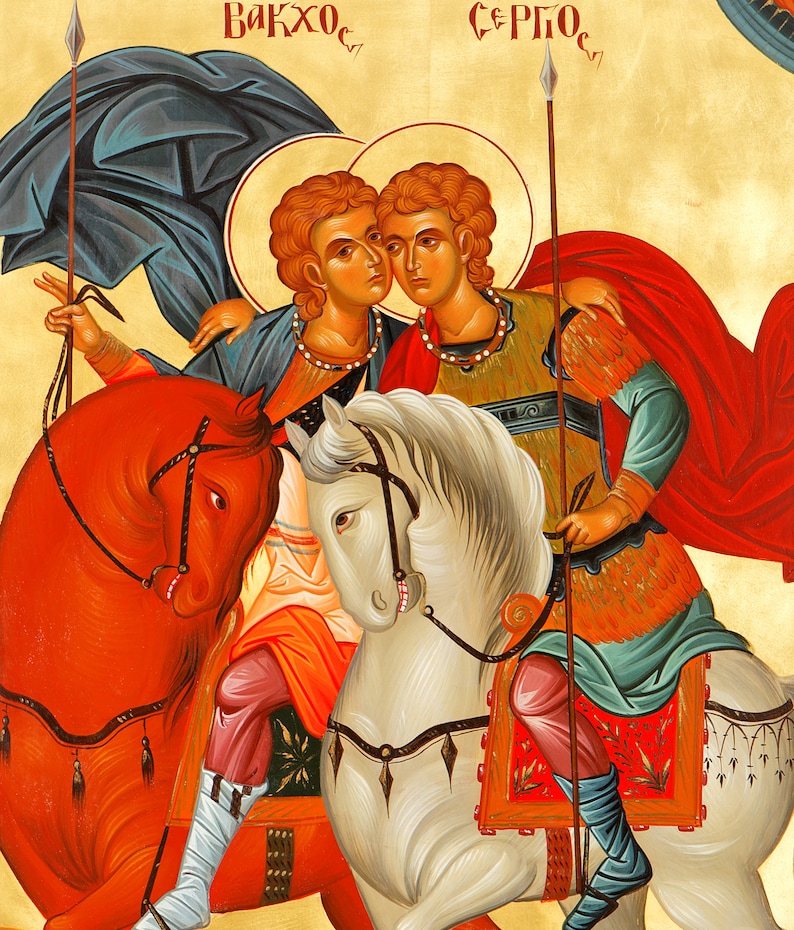
Saints Sergius and Bacchus, two Roman soldiers and inseparable companions whose bond has inspired modern queer interpretations of their story. Istanbul’s ‘Little Haghia Sophia’ was dedicated to them in the sixth century.
The Roman world into which Constantinople was born already possessed a long and complicated culture of sexual relationships between men. Soldiers, citizens, slaves, aristocrats and emperors inhabited a society in which male same-sex desire was familiar, although it was regulated by powerful distinctions of age, status and sexual role.
Christian Constantinople gradually developed much harsher moral and legal attitudes toward same-sex sexual acts. Under Emperor Justinian in the sixth century, legislation could be extraordinarily severe.
Yet laws tell us what authorities wished people to do, not necessarily what people actually did.
The very repetition of prohibitions reminds us that the behaviour being prohibited continued to exist. Studies of sexuality in sixth-century Constantinople reveal a city in which official Christian ideals coexisted with a considerably messier human reality. Desire did not disappear because an emperor legislated against it.
Somewhere beneath the monumental history of emperors, patriarchs, generals and wars were ordinary Roman men desiring other men: soldiers among soldiers, servants among servants, citizens among citizens. Most left no names behind.
But they were there.
The Male Beloved of Ottoman Istanbul
![WALSH, Robert/ALLOM, Thomas. Constantinople and the Scenery of the Seven Churches of Asia Minor illustrated…, With an historical Account of Constantinople, and Descriptions of the Plates…, Londra/Paris, Fisher, Son & Co. [1836-38]. - GEZGİNLERİN BAKIŞI - Yerler - Anıtlar – İnsanlar Güneydoğu Avrupa - Doğu Akdeniz Yunanistan - Anadolu - Güney İtalya - 15. yüzyıl - 20. yüzyıl](https://images.openai.com/static-rsc-4/8EQiq6kN9gZWGBAIuCe9jAkQ8n1_vk_uuIbN73_RMeU31HJYv1XJs0dhpGRHZg8kDcJqoOWtnjXnzsGsU14Tk-LUq7kbrje8zDyTl4BBeeB36VKz_hXy6V-zPL98nS1lCxDIVP7bAIEsVbw9t2_0Rx73eDZ1mgYlPEWuPGRrgJKHUqQRoFCdFnsKtwY-yLTe?purpose=fullsize)
An Ottoman Male Hammam
With the Ottoman conquest of Constantinople in 1453, the political and religious order of the city changed dramatically. Same-sex desire did not vanish with Byzantium. Instead, it entered another cultural universe with its own vocabulary, conventions, prohibitions and contradictions.
Anyone reading Ottoman poetry soon encounters a figure who can surprise the modern reader: the beautiful young man.
The mahbub — the beloved — could be male. Poets wrote of beautiful youths, their faces, their eyes, their hair, their cruelty toward the lover and the torment of longing for them. Homoerotic imagery was not an obscure underground language. It belonged to the literary vocabulary of the age.
As historian Noel Malcolm has shown, male-male relations were sufficiently visible in early-modern Istanbul that European visitors repeatedly commented upon them. Ottoman sources themselves confirm that attraction between men and youths formed a recognizable part of the society’s erotic culture. In Ottoman literary tradition, homoerotic love was not merely imaginable: it was one of the established languages through which beauty and desire could be expressed.
The city itself provided its stages.
There were hammams and coffeehouses, taverns and gardens. There were the celebrated köçeks, young male dancers whose beauty could inspire intense admiration and desire among male spectators. There were poems addressed to male beloveds and social spaces in which men watched, admired, courted and sometimes loved other men.

Dancing Boys in Ottoman Istanbul
This should not be romanticised into an Ottoman gay paradise. The erotic world of the period was profoundly hierarchical. Age, masculinity, social position and sexual role mattered enormously, and many historical relationships would sit uneasily beside contemporary ideas about equality and consent. Nor did Ottoman society possess a modern concept of homosexual identity.
But neither should that complexity be used to erase what is plainly there.
Men desired men.
Men wrote about desiring men.
And Istanbul knew it.
Scholars of Ottoman sexuality describe love and sexual relations between men as visible and prevalent in the empire’s early-modern urban centres. What existed was not modern LGBTQ+ culture, but a different historical organisation of same-sex desire.
A Refuge from Christian Europe
This difference did not escape European visitors.
Early-modern Christian Europe could punish sexual relations between men with imprisonment, public humiliation, exile and, in some jurisdictions and periods, death. Ottoman society also possessed religious prohibitions, but enforcement, social attitudes and cultural expression could be strikingly different.
The contrast was sufficiently noticeable that European travellers, diplomats and writers repeatedly described the visibility of male homoeroticism in Ottoman lands. Their accounts were sometimes exaggerated by Orientalist fantasy, but historians have demonstrated that they cannot simply be dismissed as invention: Ottoman sources independently reveal the same cultural world.

Pierre Loti, the French writer whose relationships with men are well documented, was also a lifelong lover of Istanbul. Like many European artists and intellectuals drawn to the Ottoman capital, he found in the city a world seemingly more fluid than the society he had left behind.
For some European men whose desires placed them dangerously outside the sexual morality of their own societies, the Ottoman East consequently acquired another meaning. Diplomats, aristocratic travellers and men of letters could encounter in Constantinople a world in which male beauty and male-male desire could be spoken about with a visibility that would have been far more dangerous in parts of Christian Europe.
We should again resist turning Ottoman Istanbul into a modern gay sanctuary. It was not one.
Yet there is a historical irony here that is difficult to overlook: an imperial Muslim capital that Europeans often portrayed as morally backward could, in certain periods and circumstances, provide considerably more room for male same-sex desire than the supposedly civilised Christian societies from which those Europeans had come.
The Great Historical Amnesia
Then something curious happened.
During the nineteenth and twentieth centuries, older ways of understanding sexuality were gradually replaced by modern categories of heterosexuality and homosexuality. Ottoman society itself changed, while European medical, psychiatric and moral discourses increasingly classified same-sex desire as a particular kind of deviance. Scholars of Ottoman literary history have traced this transformation from the older figure of the beloved toward the modern figure of the sexual pervert.
Eventually, something that had existed within the cultural memory of the city for centuries could be represented as foreign to it.
That historical amnesia matters today.
On 12 September 2026, Turkish authorities launched coordinated operations affecting LGBTQ+ organizations, activists and venues in Istanbul and elsewhere. The government presented the campaign in the language of protecting children, families and public order. Investigations ultimately encompassed 162 suspects, nine associations and 13 businesses across fifteen provinces. LGBTQ+ organizations and human-rights groups described the operation instead as a sweeping attack on queer civil society.
The irony is extraordinary.
A government attempting to portray queer existence as a threat to the social fabric is governing a city in which same-sex desire has itself been woven into that fabric for centuries. Before the Republic, there were Ottoman men writing poems about beautiful men. Before them were the inhabitants of Christian Constantinople, living their desires beneath the prohibitions of emperors and priests. Before the Christian Constantinople, there was the Roman world.
And before anyone invented the political vocabulary through which people are now told which forms of love belong to a nation and which supposedly do not, human beings were already falling in love. We cannot recover most of their names. We do not know the Roman soldier who desired another soldier behind the walls of Constantinople. We do not know most of the women who loved women behind the closed doors of Byzantine or Ottoman homes. We know only fragments of the lives behind the beautiful young men celebrated in Ottoman verse.
History preserves emperors much more carefully than lovers. But absence from the archive is not absence from humanity. Queer Istanbul did not begin with Pride marches. It did not arrive from Europe in the twentieth century. It was not invented by activists, NGOs, nightclubs or social media. Its forms and languages have changed radically, as have the identities through which people understand themselves. But the underlying human fact is ancient.
People of the same sex have desired, cherished and loved one another since time immemorial. They did so in Rome. They did so in Constantinople. They did so in Ottoman Istanbul. And they do so in Istanbul today.
Governments can close associations, raid bars, ban marches and erase words from public space. What they cannot plausibly erase is the past.
Queer people are not newcomers to Istanbul. They are part of its history.
Note that the video is embedded via YouTube and all rights belong to the respective rights holders.