
In general, Turks are superstitious people living in a magical world believing in fortune telling, the evil eye and protection against it and wishful thinking through tying up rags. Maybe it would be more correct to say that Turkish women are superstitious for everyone I know who are superstitious are almost always women.
Have a glimpse at this photo showing a royal Ottoman woman along with two fortune tellers who are looking at ‘beans’ to tell her what is awaiting her in the future. Nothing much has changed till this 19th century photo as İstanbulites’ fascination with the superstitious is still alive.

İstanbul today is still a city filled with fortune tellers who are ready to tell you about what haunted you in the past and what awaits you in the future. Almost like a Turkish type of psychotherapy, fortunetellers are in cafes across İstanbul neighbourhoods telling you to hang on, not to lose your hope, smile to that guy whom you fell for, keep up the good work and go for it! There is almost always fortune, love and success in a coffee cup if there is a fortune teller looking at it except for the cynical ones you might run into. Cynical fortunetellers run the risk of going our of business as fortune tellers’ sole survival rests on word of mouth which is tied to their ‘sweet talk’. Now, tarot is also a growing genre among fortune tellers but it can never beat the Turkish coffee cup which has been with us for centuries.

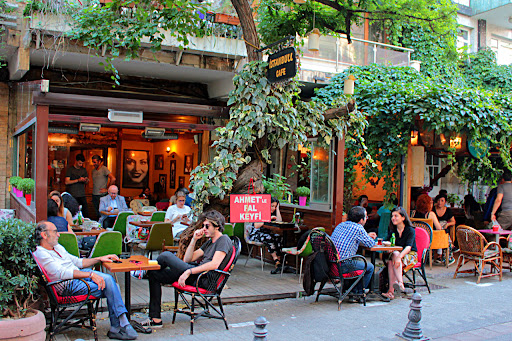
There are even special cafes dedicated to fortune telling in İstanbul. Here is one from Kadıköy. It says ‘fortune telling pleasure with Ahmet’ on the name plate
Turks also believe in the negative energy of the evil eye and interpret anything that is bad on the evil eye of others. So almost everyone in İstanbul has a protection against the evil eye which are blue beads with ‘eyes’ inside them as a talisman for protection.
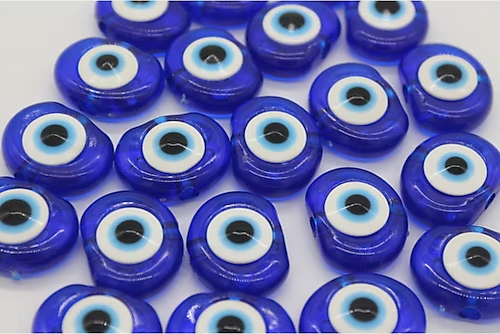
Evil eye beads
So the evil eye beads are everywhere and in all shapes and forms as a part of people’s lives. People wear them, keep them in, hang them on their walls, use them as ornaments for their homes. It is a very common gift for the newly weds that must be protected from evil energies. Within years, I have realised that this evil eye tradition belongs to many civilisations in our region and has been with us for thousands of years. I have even seen one in the Cairo Museum dating back to Ancient Egypt.
If there is too much negative energy around you, you have ‘lead poured’. I mean literally. As someone who has been a part of the process, it is quite a bizarre experience! As strange as it might sound, it is a tradition that has been going on for a very long time and that is passed on from one generation to the other. You have to find a lady who does it and she carries out all the ritual with prayers in order to remove the bad energies, spirits from you!
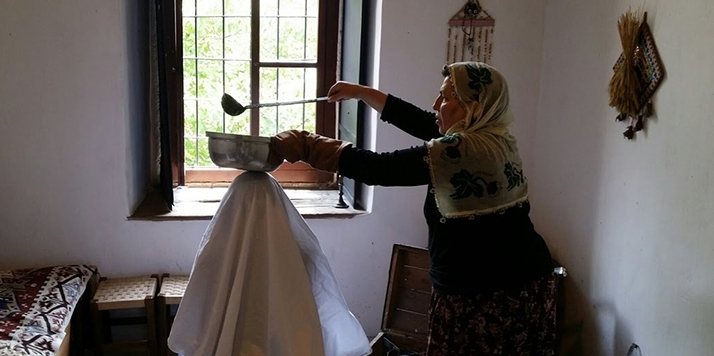
A ritual of pouring lead
Turkish people have a strong belief in wishful thinking which means that we can make things happen only by wishing. Although I never saw that happen, millions in İstanbul have a tendency to tie up rags in places known to be holy such as entombed Muslim saints or churches across İstanbul especially on specific days known to be holy. One of these holy places is the Hagia Yorgi (Saint George) Monastery on top of the biggest İsland among the Princess İslands in the sea of Marmara on the 23rd of April. People walk for miles and miles to reach the Monastery which is on top of a steep hill and they tie rags on the trees along the way with their prayers.
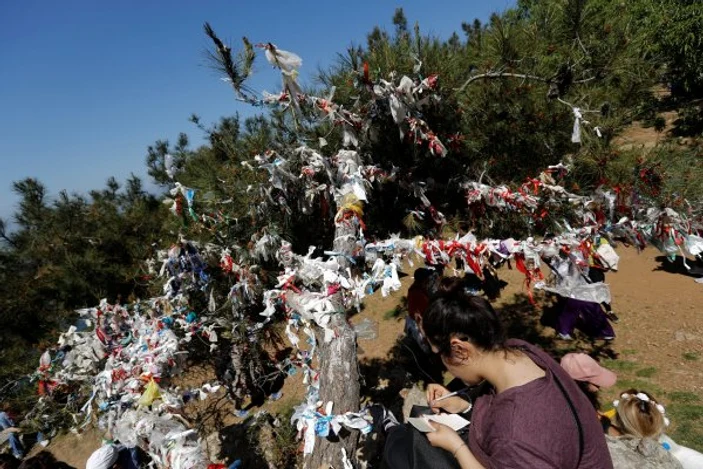
On the road to Hagia Yorgi people writing their wishes, wrapping them up and hanging them on trees or simply tying rags with their wishes and prayers

The legend says that Hagia Yorgi (Saint George) Monastic tradition on top of Büyükada dates back to 963 AD and served Orthodox Christian monks as a refuge away from the politics of Constantinople. The current church was built in 1909.
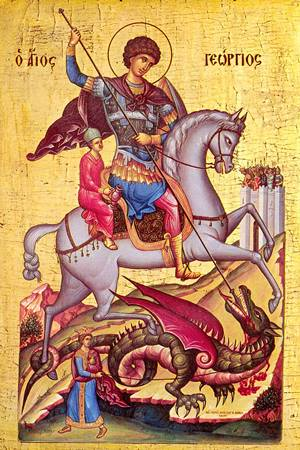
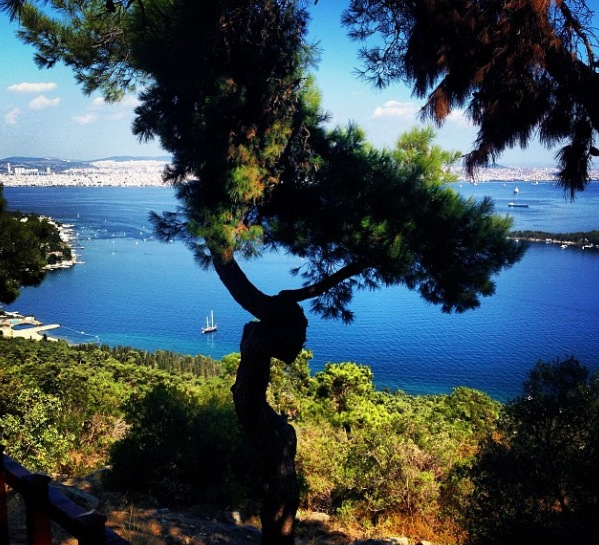
View of the Hagia Yorgi Monastery

Some people who visit Hagia Yorgi Monastery on the 23rd of May
simply roll a thread all across the road for their wishes to come true
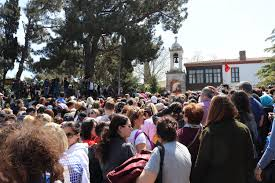
Thousand on the door step of Hagia Yorgi Monastery on the 23rd of May
Historians tie Turks obsession with tying rags to our pre-Islamic pagan traditions as İslam excludes all types of superstition.
İstanbulites also have fascination with entombed Muslim saints and think that visit to their tombs with prayers can make wishes come true. One of the most popular of these holy tombs belongs to Yuşa Efendi who is seen as the protector of the Bosphorus in Anadolu Kavağı.

Visitors around Yuşa Efendi Tomb

Anadolu Kavağı is one of the most beautiful small neighbourhoods along the Bosphorus coast line
Regardless of one’s belief in superstitions, it is a delight to see that millions in İstanbul do and try their best to protect themselves and their loved ones from ‘evil’ and to make their wishes come true!