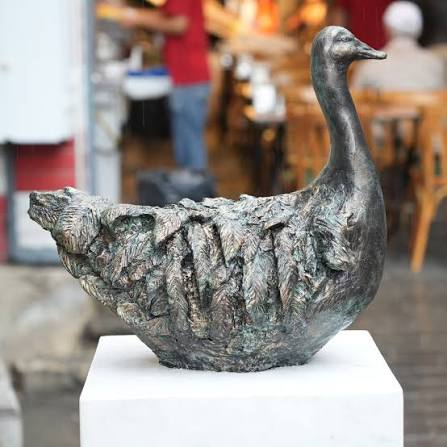

‘The flower blooms, in the month of May, my soul darkens, tormented by love.’ from the lyrics of the Sephardic Song Los Bilbilicos
The decree signed on March 31, 1492 in Spain by Ferdinand of Aragon and Isabella of Castile left Spanish Jews with two choices and that was either to convert to Christianity or leave their homeland.

Ahrida Synagogue in İstanbul. Note that the rostrum looks like a boat. This boat symbolises the boats that brought Jews from Spain to the Ottoman Empire in the 13th century
One of the most cataclysmic events of Jewish history, the Alhambra Decree ordered Jews “to depart and never to return to” Spain.

Ferdinand of Aragon and Isabella of Castile
Expelled from their homeland by August. 2, 1492, tens of thousands of jews found a safe haven in the Ottoman Empire after they have been invited by the Ottoman Sultan Bayezid II. Most of these Sephardic Jews set for sail in ships sent by the Ottoman Sultan settled either in İstanbul and Thessaloniki.

Decree of Expulsion of the Jews in 1492
Famous Turkish historian Halil Inalcik explains this historical event in the following fashion: “In the Ottoman mind, Spain was a major antagonist, and the Ottomans made little distinction between the plight of the Andalusian Muslims and that of the Jews when both communities were threatened by Spain and both appealed for Ottoman aid and protection.”
This led Iberian Jews to outnumber the local Jews who were already a part of the Ottoman Empire. After 1492, Up to 90% of Jews who lived in the Ottoman Empire were of Sephardic origin.
Sephardic Jews brought their own unique culture to İstanbul with their language, music, customs and cuisine but also integrated elements of İstanbul culture into their own.
Throughout the centuries, they have created a wonderful Sephardic musical tradition that feels so local to us whenever we hear it. This musical traditional has also been adopted by Turkish musicians making it even more local. Here is a wonderful example of a Sephardic musical tradition most Turks would think it is ‘ours’! Note that the name of the song is Los Bilbilicos meaning the nightingale in Ladino. This ladino word was derived from the Turkish bird bülbül having the exact same meaning.
Listen to the original Spanish version followed by the Turkish to see how a Sephardic song was made our own. I think both cultural traditions share a deep sense sorrow and grief related to historical traumas of their own which unit us in music.
The Turkish version of this song was sung by many but I chose the version by Kibariye who is a very popular singer for millions. Note that she had been the queen of “arabesque” music in Turkey which is a style inspired by Arab melodies and have been loved by the masses, especially those who had their roots in rural Anatolia. She sings it in a very ‘Turkish spirit’ which touches a very deep cord in anyone Turkish.
What is even more interesting is that older generations of Sephardic Jews speak a very special language called Ladino which is a unique combination of old Spanish with Greek, Turkish and Hebrew words. Although less and less people in the newer generations speak it, it is such a unique language many people whose native language is Spanish had never heard of.
Sephardic Jews also brought the printing press with them to the Ottoman Empire and started printing their own books around 225 years earlier than the Muslim community in the Ottoman Empire.
And don’t forget that Muslim Turks and Jews have not only been friends and neighbours in Istanbul but fell for one another and married! Here is a lovely story that shows that love knows no boundaries of culture or religion!
This year, Sephardic jews will celebrate their 533th year in İstanbul most of which they have spent in peaceful harmony with Christians and Muslims.
There is an interesting Jewish Museum in İstanbul which is the sole Jewish Museum in a Muslim country. If you are interested in this unique cultural tradition, I would recommend you to visit it!
Balat on the European side and Kuzguncuk on the Asian side were homes to İstanbul’s Jewish community which has completely vanished throughout the years but their buildings and memories remain. Pay a visit to both of the neighbourhoods which have been hype in recent years with their cafes, boutiques and antique shops!

Balat houses once a home to the Jewish community

Kuzguncuk Houses
And one last word. The Jewish community in Turkey has almost always been very introverted. It is difficult to befriend Turkish Jews at a personal level. It is difficult to know the different voices within the Jewish community so Jews of Istanbul have always felt like a hidden treasure to me. Being the curious person I am, I have recently discovered that there is a young group of Jews in İstanbul who have a website called Avlaremoz which means ‘let’s speak’ in contrast to the rule of Kayades of the older generations meaning ‘to stay silent and be invisible’ in the Ladino language. If you are interested in hearing their voices, visit them at avlaremoz.com.