
In Ottoman Istanbul, scent was not a luxury added to life. It was part of life’s grammar.
The Ottoman culture of fragrance drew from older Islamic, Persian, Byzantine and Anatolian traditions. Long before modern perfumery, rosewater, musk, amber, sandalwood, oud, lavender, clove, hyacinth and violet formed an invisible architecture of refinement. Fragrance belonged to the body, the home, the mosque, the palace, the marketplace and even the written word. There were scented fabrics, scented inks, scented handkerchiefs, scented sherbets, perfumed hair oils and aromatic waters poured over the hands of guests.
The reason was not merely aesthetic. In Ottoman culture, beautiful scent was also linked to cleanliness, hospitality and religious refinement. The love of good fragrance was associated with the Prophet’s example, and therefore became woven into everyday Muslim practice. Rosewater appeared at engagements, circumcision ceremonies, Qur’an recitations, mosque openings and festive gatherings.
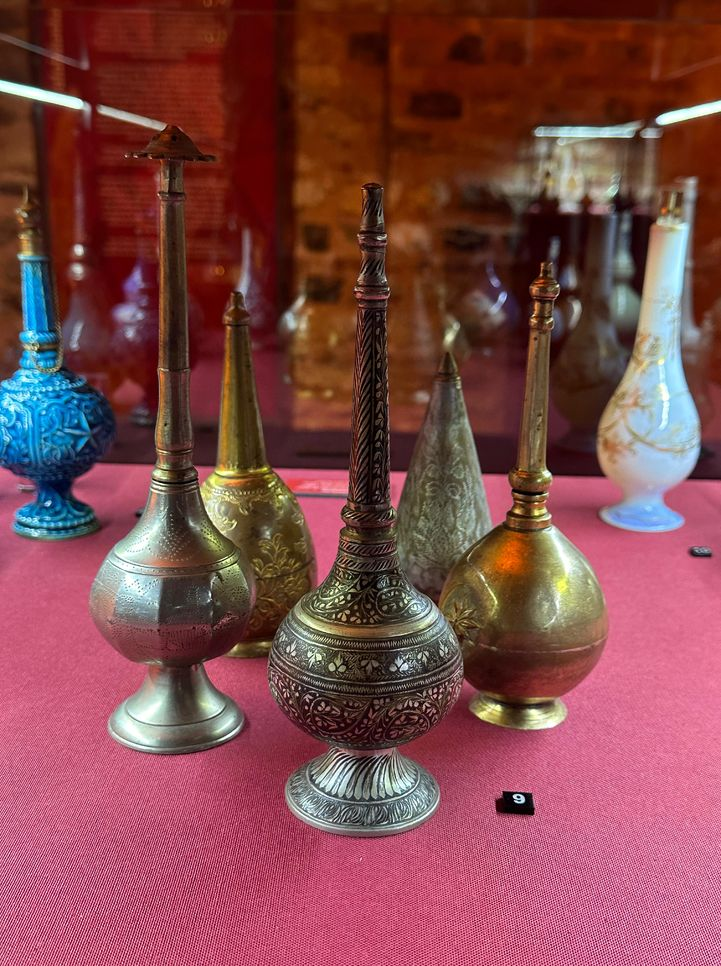
Ottoman Rosewater Sprinklers
In the palace, fragrance functioned almost like a silent language.
Foreign ambassadors received rosewater when they were admitted to the imperial presence. In the Divan-ı Hümayun, viziers and grand viziers perfumed their beards, turbans and garments with oud, amber and musk. The sacred relics were also perfumed according to carefully preserved rituals. Before Kadir Gecesi, amber, musk, sandalwood, oud and rosewater were obtained from the imperial treasury, and that the rooms of the sacred relics were wiped with a composition containing musk, amber, oud, sandalwood, rose oil and rosewater.

Ottoman rosewater sprinkler
Even the sultan’s body carried ritual meaning. When the imperial barber cut the sultan’s hair and beard, the clippings could be washed with rosewater, dried with care and preserved with reverence. In such gestures, fragrance became more than beauty; it became devotion, memory and sacred proximity.
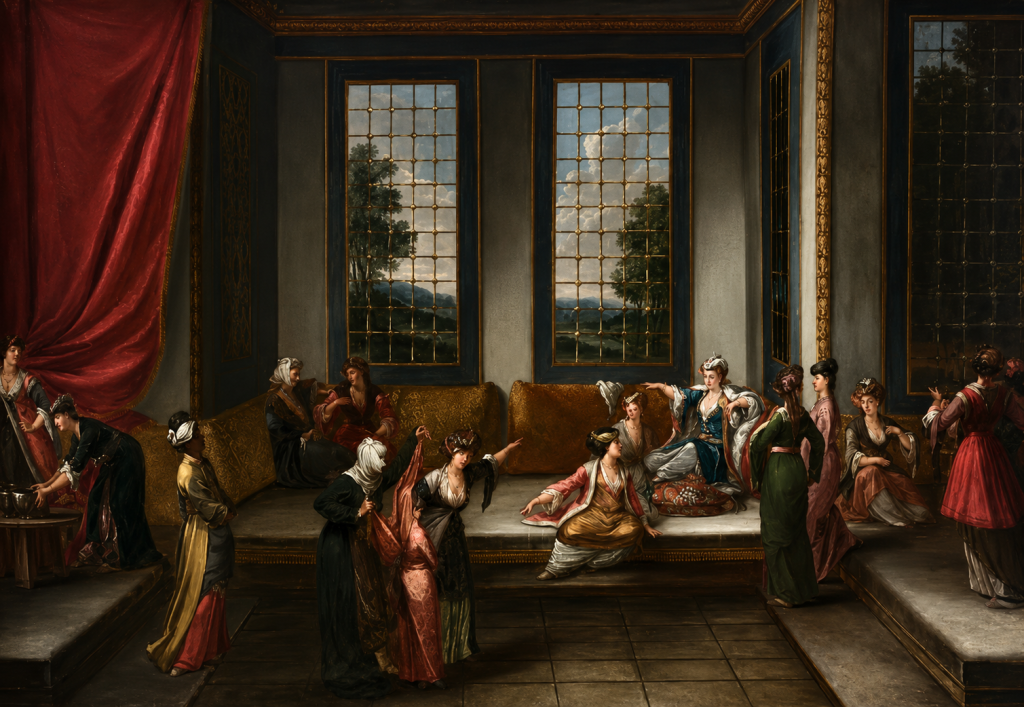
New Arrival in the Harem by Jean Baptiste Vanmour (1671-1737)
The harem, too, had its own sophisticated world of scent. Valide sultans and palace women used rose, hyacinth, violet, clove and other floral oils in baths, hair care and bodily rituals. Fragrance was part of feminine elegance, but also part of presence. A woman’s scent lingered in rooms, on textiles, in hair and on skin. It was a trace of identity.

Ottoman glass perfume bottles
Ottoman scent culture also had its craftsmen and guilds. The attar—a word related to today’s aktar—sold fragrant substances, flower waters, creams, ointments and aromatic mixtures. The buhurciyan specialized in incense materials such as oud, amber, musk, frankincense, resin and rue. The gülabciyan sold rosewater and rose oil. The amberciyan dealt in ambergris, often imported through long-distance trade routes. The finest materials were offered to the palace before reaching the public.

Bayezid II Complex in Edirne
Scents were also used for health. In the Bayezid II Complex in Edirne, Evliya Çelebi describes practices in which music and fragrance supported the treatment of psychological suffering. Rosewater was sprinkled on the hands, face and head of patients. The person who offered rosewater in this therapeutic context was known as a güllabici. Here, scent was not merely decorative; it was soothing, regulating, almost psychological.
Ottoman fragrance also had a hygienic dimension. During epidemics, incense and buhur suyu were used in streets, neighborhoods and public spaces; places such as the Grand Bazaar were opened with prayers, incense and aromatic smoke. Buhur suyu was prepared by boiling rosewater with sandalwood, cedar, oud, cinnamon and other aromatic plant waters, then storing it in crystal bottles.
This is fascinating because it reveals how beauty, belief and hygiene were not separate categories. A good smell purified the air, pleased the senses, honored the guest and elevated the soul.
Yet tastes changed.
Classical Ottoman scent culture loved deep, resinous and floral notes: rose, musk, amber, oud, sandalwood, hyacinth, violet, clove. These were dense, lingering, ceremonial fragrances. They belonged to palaces, mosques, hammams, dowries and sacred rituals.
The eighteenth century opened another door.
Yirmisekiz Mehmed Çelebi’s embassy to France in 1720 placed Ottoman elites in direct contact with French courtly culture at a crucial moment in European taste. His Sefâretnâme became one of the symbolic texts of the Tulip Era and Ottoman curiosity toward the West. From then on, Ottoman Istanbul did not abandon its older fragrance world, but began to absorb a lighter, more European sensibility.
By the nineteenth century, cologne entered Ottoman life. Under Abdülhamid II, kolonya became both a modern fragrance and a disinfectant. Its popularity was helped by the fact that it could easily join an already existing tradition: the offering of scented water to guests. What rosewater had once done in palace and home, lemon cologne now began to do in modern apartments, shops and family gatherings.
This is where Atelier Rebul enters the story.

Founded in 1895 by French pharmacist Jean César Reboul on Rue de Pera, today’s İstiklal Avenue, Rebul began as the Grande Pharmacie Parisienne and became one of Istanbul’s enduring fragrance institutions. Its legendary lavender cologne, produced in 1938 from lavender grown in Reboul’s own garden, became one of Turkey’s longest-running cologne products.
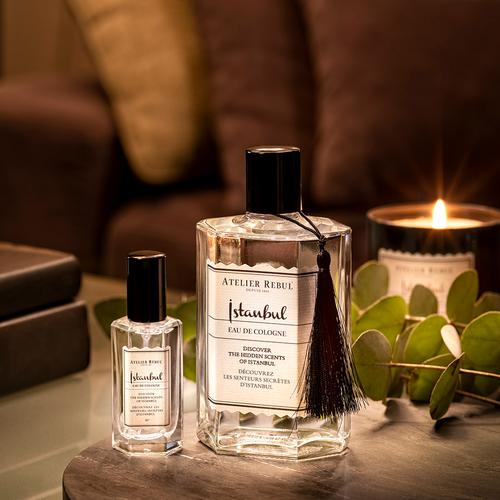
Rebul is important because it stands exactly at the crossing point of Ottoman memory and modern Istanbul. It belongs to Pera, to pharmacies, to European formulation, to Turkish hospitality, to barbershops, family visits, clean hands, fresh linen and old cupboards. It transformed fragrance from palace ritual into urban habit.
And still, Istanbul smells of all its centuries at once.
There is rosewater in religious ceremonies, incense in old interiors, kolonya in every home, linden in spring, and lavender rising from a bottle of Rebul.
The city has never chosen between East and West, sacred and secular, old and new. It lets them mingle.

A glimpse at the Spice Market
Perhaps that is why Istanbul’s true archive is not only in its stones, manuscripts and museums. It is also in the air: in rose, amber, musk, oud, lavender and lemon cologne — an invisible memory of empire, intimacy, devotion and everyday grace.

visuals are taken from haberturk.com, orientalauctions.com, atelierrebul.com and artvee.com.
Note that the video is embedded via YouTube and all rights belong to the respective rights holders.