

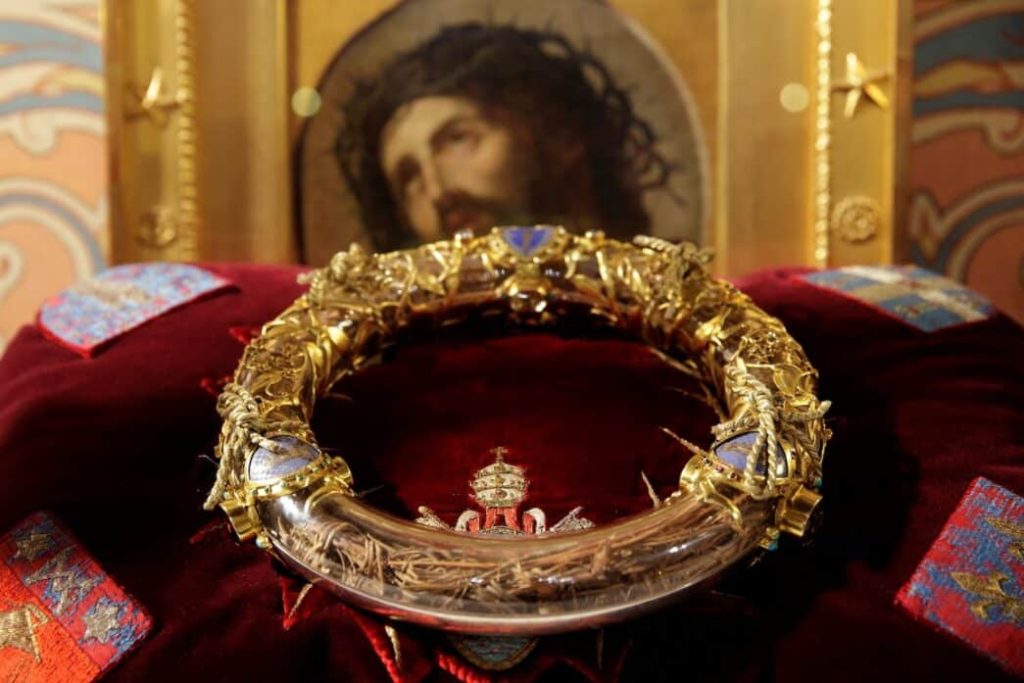
The Crown of Thorns is one of the most famous relics associated with the suffering of Jesus Christ. According to the Gospel narratives describing the Crucifixion of Jesus, Roman soldiers mocked Jesus by placing a crown woven from thorny branches on his head, presenting him sarcastically as “King of the Jews.” What began as an instrument of humiliation later became an object of deep Christian veneration.
Early Christian tradition holds that the relic was preserved in Jerusalem, where pilgrims in late antiquity reported seeing objects connected to the Passion. At some point during the early medieval period, the crown was transferred to Constantinople, the capital of the Byzantine Empire. There it became one of the most treasured Passion relics in the imperial collection. Kept in the imperial chapel and displayed on important religious occasions, the crown formed part of a broader Byzantine tradition in which sacred relics reinforced both devotion and imperial authority. Constantinople’s emperors carefully gathered and protected such objects, presenting the city as the spiritual heart of the Christian world.
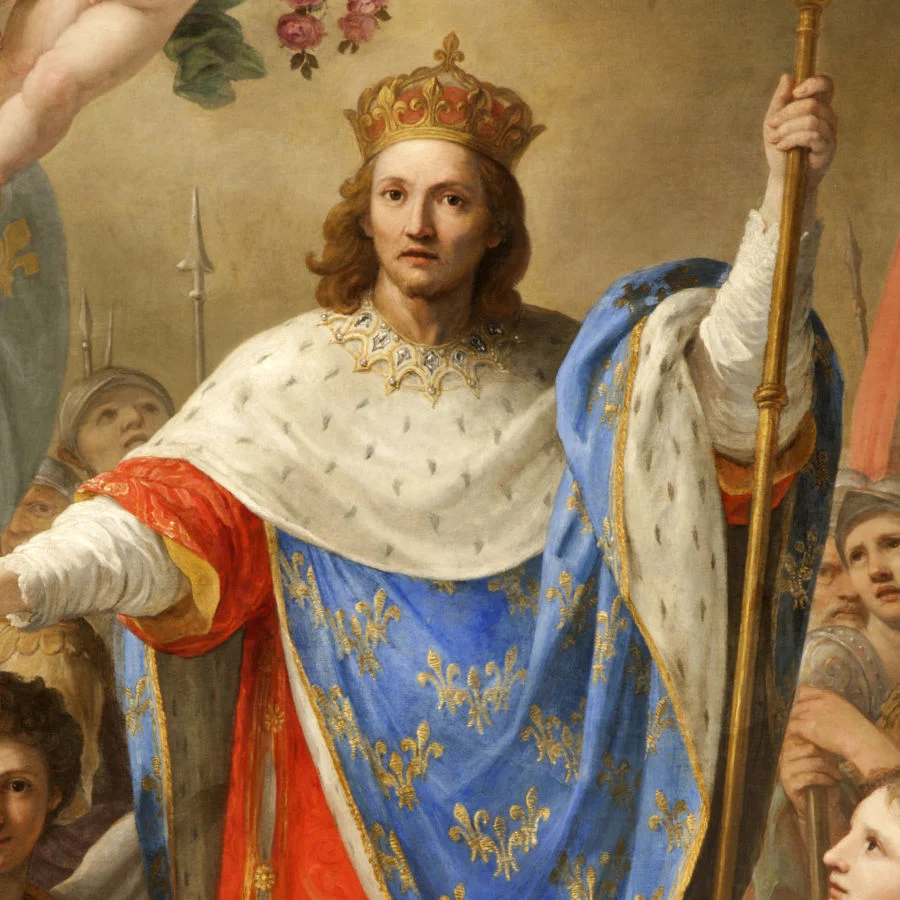
Louis IX of France
The relic’s fate changed dramatically after the Fourth Crusade, when crusaders captured the Byzantine capital. The new Latin emperor, Baldwin II of Constantinople, struggled financially and eventually pawned the Crown of Thorns to Venetian merchants. In 1239 it was purchased by the deeply pious Louis IX of France, who brought the relic to Paris in a solemn procession. To house it, he built the magnificent Sainte-Chapelle, a Gothic chapel designed almost as a monumental reliquary.
For several centuries, Sainte-Chapelle functioned essentially as a royal reliquary where the crown and other relics were preserved under the protection of the French monarchy. The move to Notre-Dame Cathedral happened much later, during the upheavals of the French Revolution. Revolutionary authorities confiscated church property and dismantled many royal and ecclesiastical institutions. Sainte-Chapelle was secularized and turned into a state archive, and the relics it housed were removed.
To protect them from destruction, the Crown of Thorns and other Passion relics were transferred to the National Library of France for safekeeping. In the early 19th century, after the political climate stabilized and religious life was partially restored, the relic was returned to the Catholic Church. It was then placed in the treasury of Notre-Dame Cathedral, which had become the principal cathedral of Paris.

During the devastating Notre-Dame Cathedral fire, the Crown of Thorns was dramatically rescued. As flames spread through the medieval cathedral, firefighters and clergy worked together to remove the most precious relics from the building. Forming a human chain, they carried the Crown of Thorns and other sacred objects out of the cathedral and transferred them to safety. The relic survived the fire intact and was later placed in secure storage while the restoration of Notre-Dame continues.
From Jerusalem to Constantinople and finally to Paris, the Crown of Thorns reflects how sacred objects moved through the political and spiritual centers of Christianity, carrying with them both devotion and the ambitions of the empires that guarded them.

Return of the Crown of Thorns to Notre-Dame Cathedral