

“My lady, I am a slave, a servant bound to you; strike me or kill me if you wish—I surrender myself to you.”
Abdülhamid I

Abdülhamid I (1725-1789)
Behind the ceremonial silence of Topkapı Palace, behind its guarded doors, hierarchies, protocols, and carefully controlled encounters, an Ottoman Sultan was writing letters that sound remarkably unlike the words of an absolute monarch.
His name was Abdülhamid I, who ruled the Ottoman Empire from 1774 to 1789. The woman he wrote to was Ruhşah.
Nine surviving letters from Abdülhamid to Ruhşah were published by the historian M. Çağatay Uluçay from material in the Topkapı Palace Museum Archives. They offer an unusually intimate glimpse into the emotional life of an Ottoman ruler: not the public language of sovereignty, but the private language of longing, dependence, jealousy, and desire.
What makes the letters extraordinary is not simply that a Sultan fell in love. It is what happens to the language of power when love enters the room.
In one letter Abdülhamid addresses her:
“My Ruhşah, may your Hamid be sacrificed for you.”
The choice of name is striking. He does not present himself as Sultan Abdülhamid. He becomes simply Hamid.
Then comes an even more remarkable declaration:
“My lady, I am a slave, a servant bound to you; strike me or kill me if you wish—I surrender myself to you.”
The word kul carries particular weight here. In the Ottoman imperial order, kul was not merely an affectionate synonym for “servant.” It belonged to the political vocabulary of dependence upon the Sultan: members of the imperial household and governing apparatus could themselves be understood as the Sultan’s kullar.

A glimpse at one of Abdülhamid I‘s love letters which are kept in the Ottoman Archives in Istanbul
Yet Abdülhamid reverses this hierarchy. The sovereign becomes the kul. Ruhşah becomes efendim—“my lady,” but literally also “my master.” The inversion is extraordinary. The man standing at the apex of an imperial system of obedience describes himself as bound to a woman within his own Harem. And when distance enters the relationship, the language becomes increasingly desperate. He begs Ruhşah to come to him. He tells her that separation is making him ill and may even cause his death. In one extraordinary passage he imagines placing his face beneath her feet while pleading with her:
“I beg you, rubbing my face and eyes beneath your feet.”
Elsewhere he implores her not to forget him because of some fault:
“Do not forget me because of one fault.”
And he vows that only death could end his devotion:
“You are mine, and I am yours.”
These are not the words of imperial ceremony. They are the words of a man overwhelmed by attachment. And perhaps that makes them more recognizably human. A Sultan could command armies, appoint officials, distribute fortunes and govern millions of subjects. Yet intimacy belonged to a different realm. Political authority could determine rank, residence and ceremony; it could not eliminate longing. It could not prevent the beloved from being missed. It could not protect a man from waiting for his beloved to come through a door.
The contrast becomes even more striking when we remember where these letters were written. Topkapı Palace was an architecture of controlled access. Courtyards, gates, corridors and thresholds determined who could approach whom. Rank regulated proximity. Silence, gesture and ceremony maintained the extraordinary distance surrounding the Sultan’s body.
Yet somewhere inside this meticulously ordered world, its sovereign was writing, in effect: Come tonight.
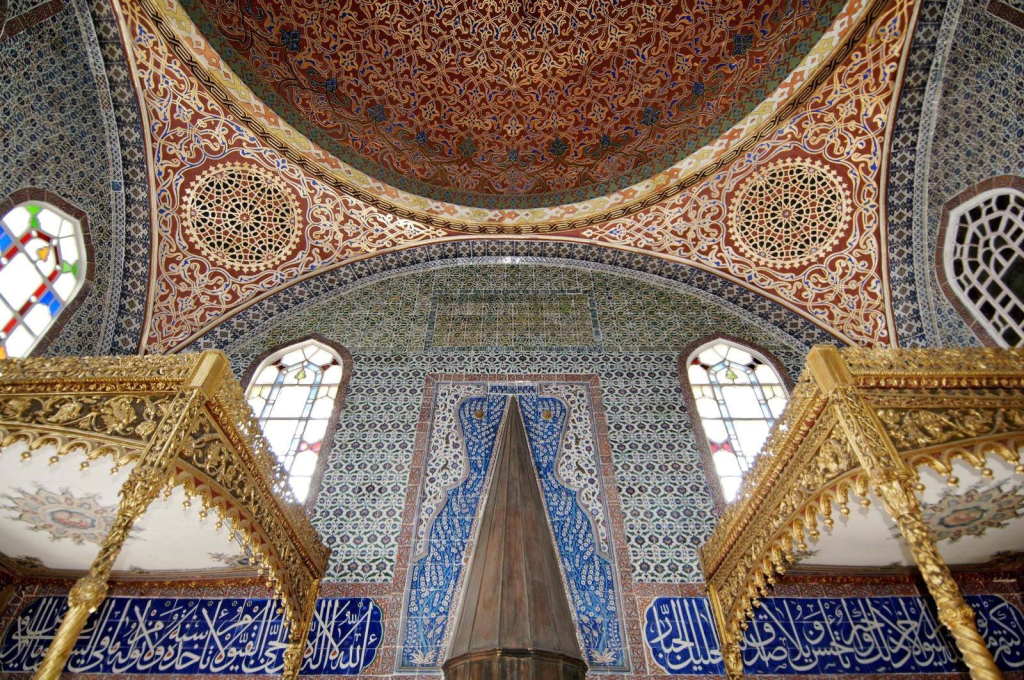
A glimpse into the Sultan’s Bedchamber at Topkapı Palace
Suddenly the Ottoman Empire contracts into something astonishingly small: a room, a night, a woman not yet there, and a man waiting for her.
And the story did not end with those nights. Ruhşah remained part of Abdülhamid’s household and eventually became his First Consort. Abdülhamid died in 1789. Ruhşah survived him for nearly two decades. When she died, she was buried in the burial ground beside Abdülhamid I’s tomb in Istanbul.
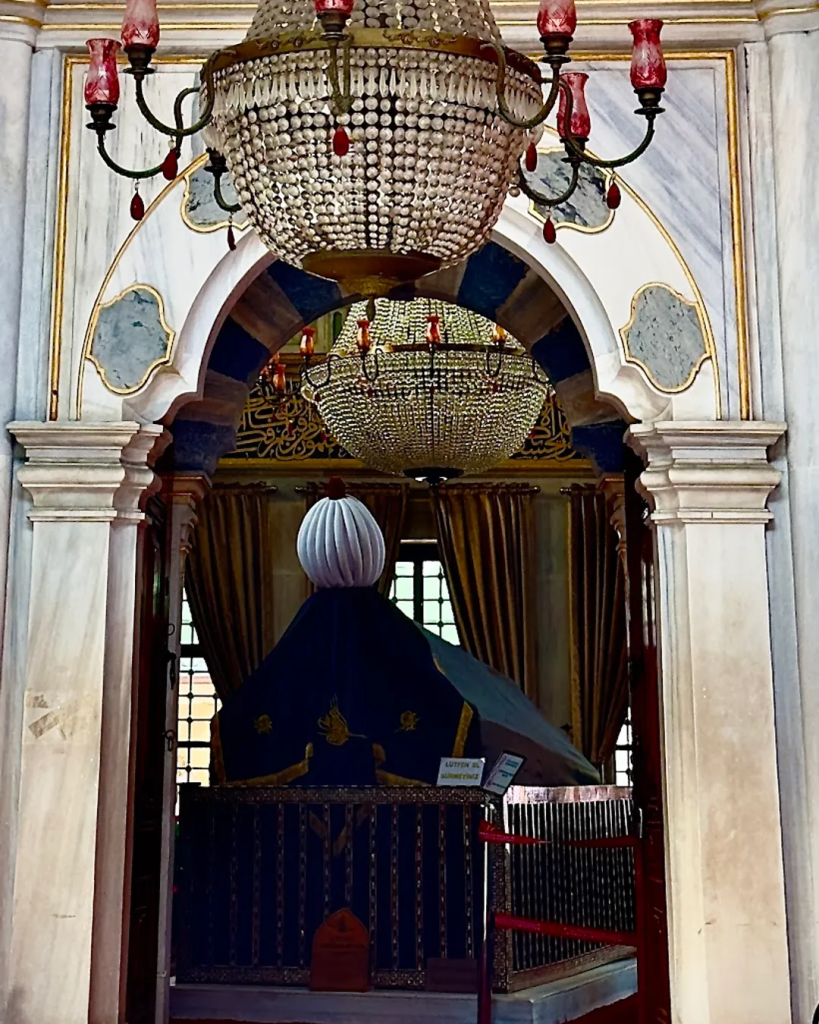
Abdülhamid I’s tomb in Eminönü
They still lie within the same funerary complex today.
Perhaps this is what makes the letters so moving. For a few fragile pages, the monumental institution of the Sultanate falls away. Titles become irrelevant. Political hierarchy turns upside down. The master calls himself the servant. And the Sultan becomes simply a man, pleading for the presence of the woman he loves.

Jean Auguste Dominique Ingres, Head of the Grand Odalisgue, 1814-18
Let’s pay tribute to this love story with a love song from the 18th-century Ottoman world, composed by Tanburi Mustafa Çavuş!


