
Dedicated to my dearest friends Okan Diköz and Chloé Saint-Liphard who are resting in eternal light.
Bil ki cân bir kuştur, ten bir kafes.
Know that the soul is a bird, the body a cage.
a Sufi saying attributed to Rumi
Yesterday, I joined a walking tour in Üsküdar, exploring the traces of Istanbul’s old tekkes — the Sufi lodges that once formed an essential part of the city’s spiritual and social landscape. As we wandered through this neighbourhood, where the memory of Ottoman religious life still lingers in its streets, courtyards and cemeteries, I came across something that stayed with me.
In front of a beautiful Ottoman gravestone, belonging to a woman and adorned with delicate decorative motifs, there was a small, heart-shaped cavity carved into the stone. It was a bird-watering niche, designed to collect rainwater for birds and other small creatures.
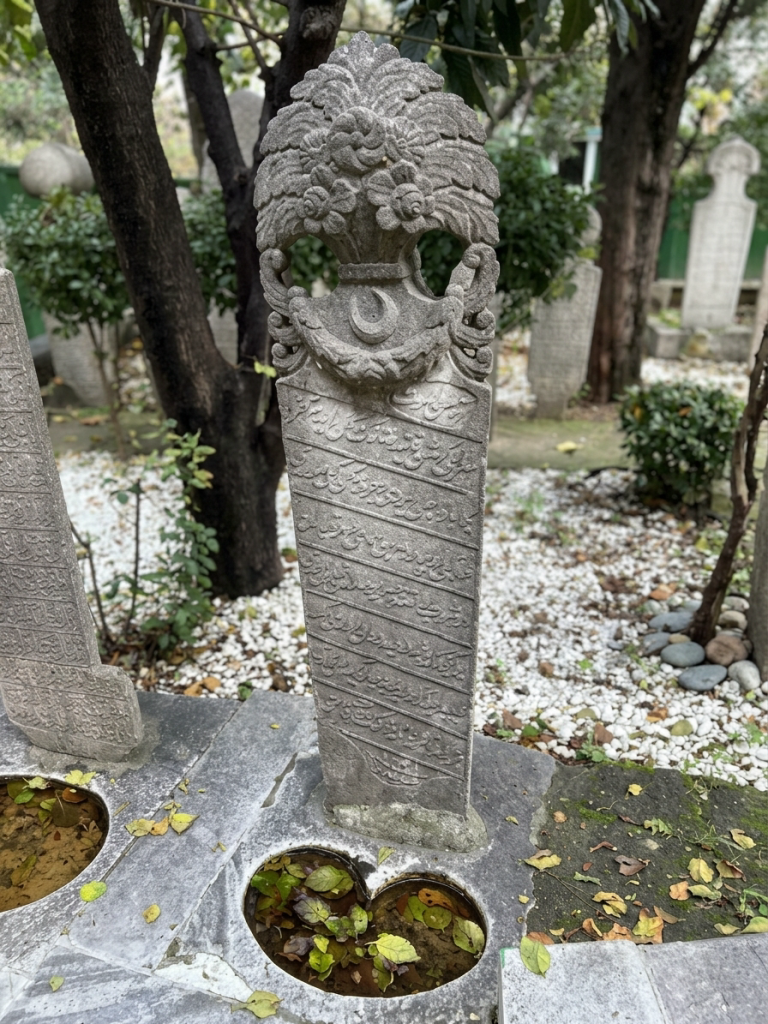
A tombstone in the cemetery of Fenâî Ali Efendi Mosque and Dervish Lodge, with a heart-shaped water basin carved into the stone in front of it (photo by Mahan Doğrusöz)
I found myself looking at it for quite some time. Why would someone carve a little place for birds into a gravestone? Was it simply an expression of kindness towards animals, or was there something deeper in this seemingly modest gesture? And what might it tell us about the Ottoman understanding of death, charity and the relationship between human beings and the natural world?
The more I thought about it, the more I realised that this small detail opened a window onto a much larger world of ideas.
The Bird as a Metaphor for the Soul
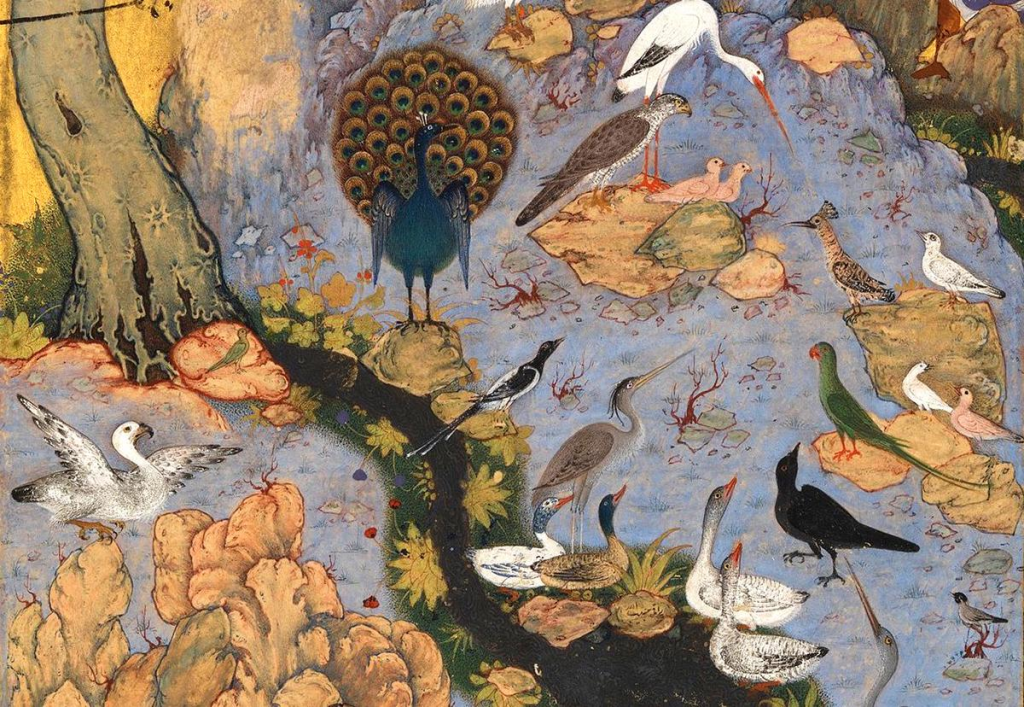
‘The birds gather and listen to the message of the hoopoe about their king. Detail from Folio 11r of the royal manuscript of Conference of the Birds, 1487, Isfahan, Iran; illustration an addition by Habibullah of Mashad, c. 1600. Image © The Metropolitan Museum of Art, New York’ (visual and image caption is taken from besharmagazine.org)
Birds occupy a particularly rich place in Islamic mystical literature. In Sufi thought, the bird frequently becomes an image of the human soul: something that belongs to a higher, spiritual realm but finds itself temporarily confined within the material body.
Perhaps the most beautiful literary expression of this idea can be found in Mantiq al-Tayr (The Conference of the Birds), the celebrated twelfth-century Persian poem by Farid ud-Din Attar. In this allegorical work, a group of birds embark on a long and difficult journey in search of the Simurgh, their mysterious sovereign. Led by the hoopoe, they must overcome their fears, attachments and illusions before reaching their destination.
Their journey is not simply a quest for a mythical bird. It represents the spiritual journey of the human soul towards self-knowledge and ultimately towards the Divine. The birds embody different human characteristics, weaknesses and attachments, while their journey reflects the difficult process of spiritual transformation.
The bird as a representation of the soul also appears in the wider tradition of Persian and Islamic mystical thought, including the writings of Rumi, Ibn Sina and Suhrawardi. One recurring image is that of the body as a cage and the soul as a bird. Death, in this metaphor, can be understood as the moment when the bird leaves its cage.
It is a remarkably different way of imagining death. Rather than seeing it exclusively as an ending, it suggests a release: the departure of something that was never entirely at home in the material world.
Looking at the little water niche on the woman’s gravestone, I began to think about this symbolism. There is no reason to assume that the person who commissioned the gravestone intended to make a direct reference to Sufi poetry. The water niche had a practical and charitable purpose. Yet the juxtaposition of the bird and the grave invites us to reflect on the relationship between the soul’s imagined journey and the living birds that continue to visit the place.
Charity That Continues Beyond Death
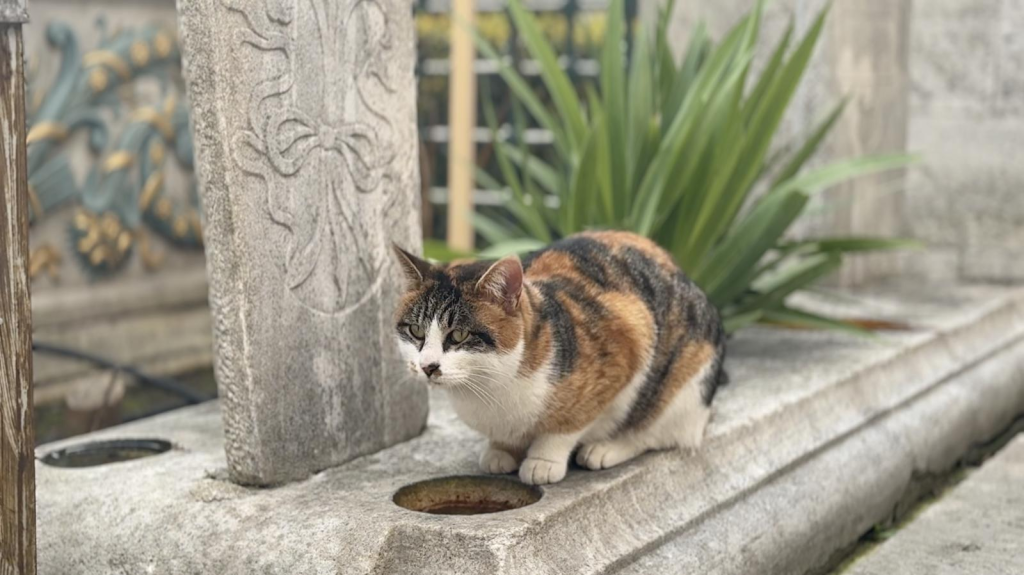
Visual is taken from turkiyetoday.com
There is another important Islamic concept that helps explain this tradition: sadaka-i câriye, or continuing charity.
In Islamic belief, certain good deeds continue to bring spiritual benefit even after the person who performed them has died. A person who establishes something beneficial for others — a fountain, a well, a school, a place of shelter or a source of knowledge — leaves behind an act of kindness that continues to serve the world.
Providing water has a particularly important place in this understanding of charity. Islamic traditions emphasise the spiritual value of giving water to thirsty living beings, including animals. The well-known story of a person rewarded by God for giving water to a thirsty dog illustrates how compassion towards animals is understood as a meaningful religious act.
The little water basins carved into Ottoman gravestones can be understood within this wider culture of generosity. They transformed a funerary monument into something useful. A grave was no longer simply a place marking the absence of a person. It could also become a source of nourishment for other living creatures.
There is something deeply moving about this idea. The person is gone, but an act of kindness remains. A bird comes to drink without knowing the name of the person whose grave provides its water. The identity of the deceased may eventually fade from collective memory, but the gesture continues to have a purpose.
In this sense, the gravestone becomes a small instrument of continuing charity.
Ottoman Cemeteries: Sanctuaries for Birds and Other Creatures
This practice was part of a much broader Ottoman sensibility towards animals and their place in the urban environment.
Ottoman Istanbul developed a remarkable culture of everyday care for animals. Birdhouses were incorporated into the façades of mosques, fountains, palaces and private houses. Water was provided for birds, food was left for stray animals, and charitable foundations supported various forms of animal care.
Cemeteries were particularly suited to this coexistence. Often surrounded by cypress trees, flowering shrubs and other vegetation, they provided habitats for birds, cats and other animals. Their quietness and abundance of greenery made them places of refuge within an increasingly dense urban environment.
Ottoman cemeteries were therefore not exclusively places belonging to the dead. They were also living environments, shared with creatures that continued their ordinary lives among the gravestones.
There is an interesting reversal here. We tend to think of cemeteries as places separated from the activity of everyday life. But for the birds, these spaces were never exclusively places of death. They were habitats, resting places and sources of water.
The same space accommodated two radically different experiences of existence.
When Death and Life Occupy the Same Space
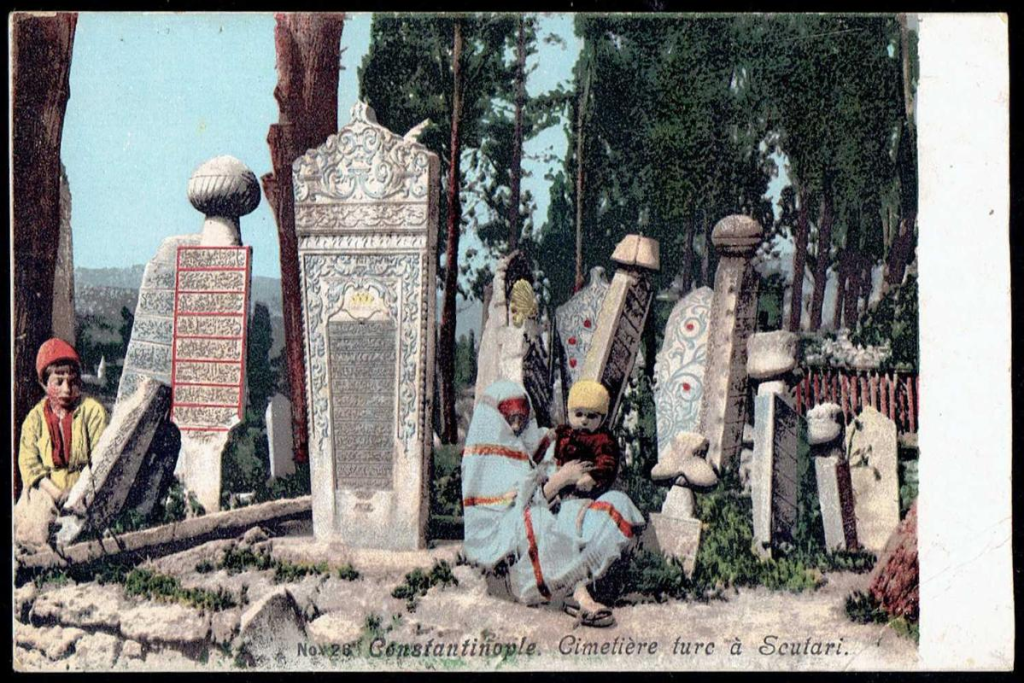
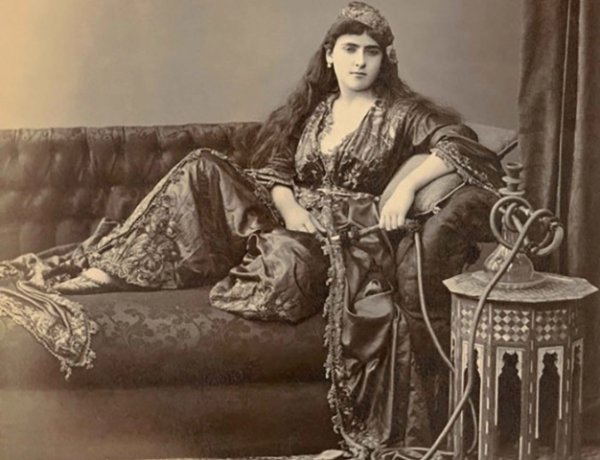
An Üsküdar Cemetery, 1900
Perhaps this is what I found most compelling about the little heart-shaped niche in Üsküdar.
In many modern urban settings, we tend to separate life and death quite sharply. Cemeteries are enclosed spaces, set apart from everyday life, while animals and the natural world are increasingly pushed to the margins of the city.
The Ottoman cemetery, at least in this particular tradition, suggests a different relationship. Death was not necessarily imagined as a complete withdrawal from the world of the living. The grave could remain connected to the surrounding environment through acts of generosity, however small.
A bird drinking from a gravestone is, in a sense, participating in the continuing life of the place. The bird does not remember the deceased, and it does not need to. Its very presence gives the grave another purpose.
There is also something quietly beautiful about the contrast between the permanence of stone and the transience of a bird. The gravestone remains, weathering over generations, while the birds arrive and depart. Water gathers, is consumed, evaporates and gathers again. Life continues through these small, almost imperceptible cycles.
I began the day looking for the traces of Istanbul’s Sufi lodges, hoping to find fragments of a spiritual world that has largely disappeared from the city’s contemporary landscape. Instead, I found a small detail that made that world feel unexpectedly present.
It reminded me that Ottoman spirituality was expressed not only through elaborate rituals, monumental architecture or the writings of great mystics. It could also be found in the smallest gestures: a bowl of water, a shelter for a bird, a little hollow in a gravestone.
Perhaps one of the most beautiful aspects of this tradition is that it refuses to make death entirely separate from life. Even in a cemetery, there is room for generosity, movement, thirst and nourishment. Even a grave can give something back to the world.
The woman whose grave this stone marks may have died centuries ago. Her name and the circumstances of her life may have long been forgotten. But the little heart carved into the stone continues to offer something to creatures passing by.
And that, perhaps, is one of the most touching ways in which a human life can leave its mark.
Note that the video is embedded via YouTube and all rights belong to the respective rights holders.