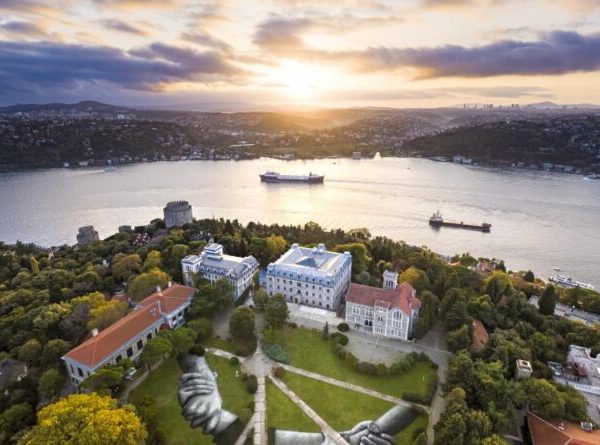

Istanbul did not slowly become modern; it was forced to carry several centuries of urban transformation at once, and its architectural memory paid the price.
When visitors walk through Istanbul today, they often remark on its extraordinary layers of history. A Byzantine cistern lies beneath an Ottoman neighborhood. A nineteenth-century Art Nouveau apartment stands beside a concrete block from the 1970s. A restored imperial fountain faces a glass shopping center. The city appears timeless, an accumulation of civilizations rather than a place subjected to historical rupture.
Yet beneath this image lies another story: one of astonishing speed, loss, and discontinuity.
To understand this transformation, the sociological concept of compressed modernity, developed by the Korean sociologist Chang Kyung-Sup, offers a valuable framework. Chang argued that societies such as South Korea experienced in a few decades the kinds of economic, political, and cultural changes that had unfolded over centuries in Western Europe. Different historical epochs did not replace one another gradually; instead, they overlapped, collided, and coexisted.
Istanbul presents a striking architectural version of this phenomenon.
A City That Lived Several Centuries at Once
Unlike Paris or London, whose urban transformations occurred incrementally across hundreds of years, Istanbul endured successive waves of modernization within an exceptionally short historical period.
The late Ottoman reforms of the nineteenth century introduced European boulevards, apartment houses, and municipal planning. The early Republican era sought to create a new national identity through architecture and urban design. The massive internal migrations of the 1950s transformed the city’s demographic composition almost overnight. Neoliberal development after the 1980s introduced global finance, tourism, and speculative real estate. In the twenty-first century, mega-projects and urban renewal schemes accelerated these processes even further.
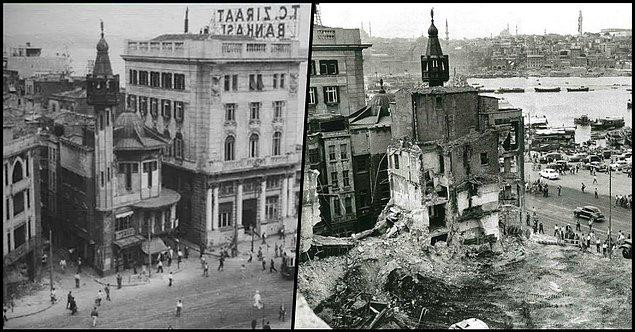
Destruction of Karaköy Mosque in 1958
What took centuries elsewhere unfolded within a handful of generations.
The consequence was not merely modernization, but the compression of historical time itself.
The Violence of Acceleration
Architectural destruction in Istanbul rarely occurred through a single catastrophic event. Rather, it emerged through cumulative waves of accelerated change.
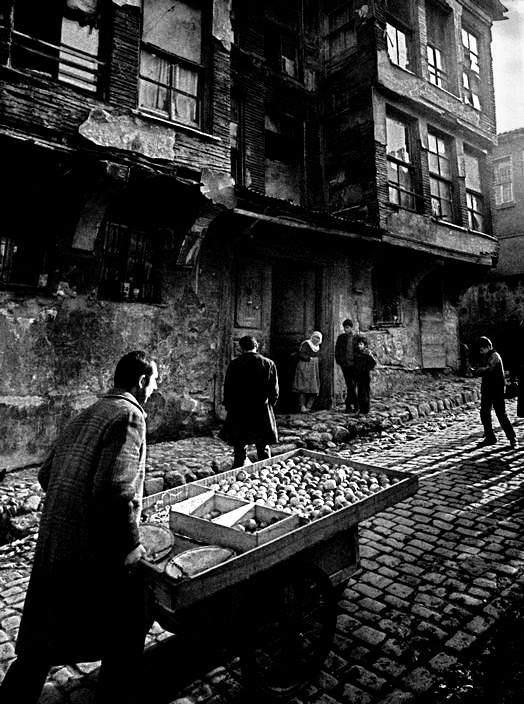
Photo by Ara Güler
The wooden neighborhoods that once defined Ottoman urban life gradually disappeared through fires, redevelopment, and changing building regulations. Levantine mansions along the Bosphorus gave way to apartment blocks and commercial structures. Armenian, Greek, and Jewish quarters lost much of their original character following demographic upheavals in the twentieth century. Countless examples of late Ottoman domestic architecture vanished without documentation or public debate.

Destruction of Karaköy Square, 1958 (photo by Ara Güler)
Perhaps nowhere was this process more visible than during the extensive urban interventions of the 1950s. Entire districts were cut apart to create modern avenues designed for automobiles rather than pedestrians. Historic urban fabrics that had evolved organically over centuries were sacrificed in the name of progress and modernization.
Yet these destructions did not erase the past completely.
Instead, they produced a peculiar coexistence of temporal worlds.
Asynchronous Landscapes
One of the central insights of compressed modernity is the simultaneous presence of different historical stages within the same social reality.
Istanbul embodies this principle physically.
A Byzantine wall borders a modern highway. Ottoman fountains survive beneath elevated overpasses. Art Nouveau apartments stand beside anonymous reinforced-concrete structures. Former palaces function as luxury hotels, while medieval churches serve contemporary urban needs.

The city resembles a palimpsest upon which successive civilizations have written without entirely removing previous inscriptions.
But unlike the romantic image of harmonious layering often presented in tourist literature, these layers frequently reflect unresolved tensions. They reveal not continuity, but compression.
The city contains multiple historical rhythms operating at once.
Compressed Nostalgia

Photo by Ara Güler
Perhaps the most profound consequence of architectural compressed modernity is psychological rather than physical.
In many European cities, nostalgia accumulates slowly across centuries. The medieval past belongs to distant ancestors, separated from contemporary experience by long stretches of historical time.
In Istanbul, however, entire worlds disappeared within living memory.
A grandmother might recall wooden mansions, neighborhood gardens, minority communities, ferry cultures, and architectural landscapes that her grandchildren have never seen. The distance between memory and reality is extraordinarily short.
The result is what might be called compressed nostalgia: an intensified awareness of loss produced by accelerated historical transformation.
Istanbul residents do not simply inherit memories from previous centuries. We mourn places that existed within our own lifetimes.
This creates a unique emotional relationship with the city. The past feels both irretrievably lost and strangely immediate.
One turns a corner in Balat, Kuzguncuk, or Moda and encounters fragments of vanished worlds embedded within contemporary urban life. Memory persists materially, even as the social realities that sustained it have disappeared.
Beyond Preservation
Understanding Istanbul through the lens of compressed modernity also challenges conventional approaches to heritage preservation.
The issue is not merely the protection of isolated monuments. Mosques, churches, palaces, and fountains can survive while entire cultural ecosystems vanish around them.
What is endangered is the continuity of urban memory itself.
Neighborhood patterns, architectural scales, local crafts, communal relationships, and everyday rituals constitute forms of heritage no less important than monumental structures. When modernization proceeds too rapidly, these intangible dimensions become difficult to sustain.
The city retains its physical artifacts while losing the worlds that gave them meaning.
This may explain why Istanbul often evokes contradictory emotions among its inhabitants: pride and grief, wonder and melancholy, permanence and impermanence.
The Eternal City is also a city of accelerated forgetting.
Epilogue
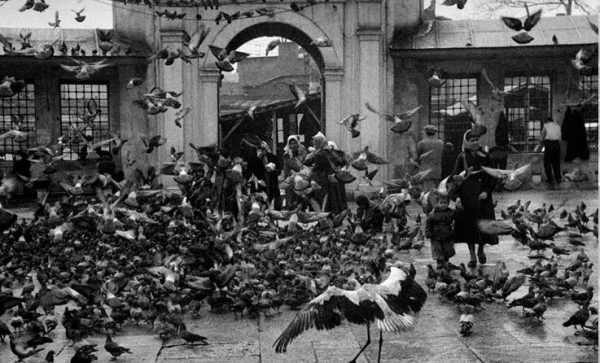
Photo by Ara Güler
Compressed modernity offers a powerful framework for understanding the architectural fate of Istanbul. The city did not experience modernization as a gradual transition from one historical stage to another. Instead, imperial decline, nation-building, mass migration, industrialization, neoliberal capitalism, and global urbanism unfolded in overlapping succession within a remarkably short period.
The result was an urban landscape where Byzantine, Ottoman, Republican, and global forms coexist amid continuous cycles of destruction and renewal.
Istanbul remains one of the world’s greatest repositories of historical memory. Yet it also stands as a reminder that memory itself can be compressed, accelerated, and endangered.
Perhaps this is the city’s deepest paradox.
It has survived for nearly three millennia.
And yet, within a single century, it has repeatedly had to learn how to remember itself.
Ara Güler’s photos are taken from araguler.net.
Video is embedded via YouTube and all rights belong to the respective rights holders.