
“Think not your love will wholly yield to you;
You rule Istanbul, yet she reigns o’er Galata.”Sultan Mehmet II

Gentile Bellini
In the late fifteenth century, at a moment when Europe and the Ottoman Empire were often imagined as irreconcilable civilizational rivals, an extraordinary encounter took place in Constantinople. The Venetian painter Gentile Bellini who was one of the leading artists of the Italian Renaissance was invited to the court of Sultan Mehmed II, the conqueror of Constantinople, to work as an imperial artist. This encounter was not merely artistic; it was profoundly political, intellectual, and symbolic, marking one of the earliest sustained visual dialogues between Renaissance Europe and the Ottoman world.
Bellini’s arrival in former Constantinople in 1479 was the result of diplomacy rather than artistic curiosity alone. Following years of warfare, Venice and the Ottoman Empire signed a peace treaty that same year. As part of the renewed relations, Mehmed II who was deeply interested in Western learning, classical antiquity, and Renaissance culture requested that Venice send him a painter capable of rendering lifelike portraits in the new naturalistic style. Venice chose Gentile Bellini, whose reputation and family lineage made him an ideal cultural envoy.
Bellini remained in Constantinople for approximately sixteen months. During this time, he was hosted at the Ottoman court, observing its ceremonies, costumes, and figures at close range. His presence itself was exceptional: a Christian Renaissance artist working openly for a Muslim ruler in the imperial capital of Islam.
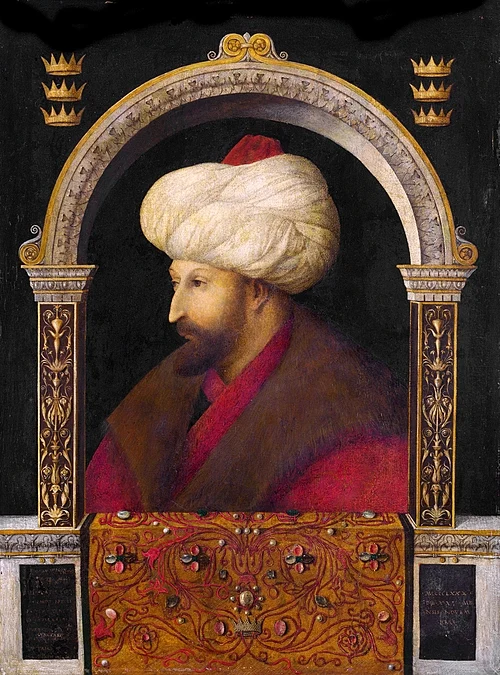
The most celebrated outcome of Bellini’s stay is the Portrait of Sultan Mehmed II, painted around 1480. Rendered in oil with striking realism, the portrait depicts the Sultan in profile beneath an architectural arch, wearing a turban. The image combines Ottoman imperial symbolism with European conventions of portraiture, recalling Roman imperial medallions and Renaissance humanist ideals.
This painting is significant not only as a likeness but as a statement. Portraiture of this kind was not traditionally emphasized in Islamic visual culture, particularly in a public or naturalistic mode. Mehmed II’s commissioning of such a work signals his self-conscious engagement with European forms of representation and his desire to be seen—by both East and West—as a universal ruler, heir to Roman, Byzantine, and Islamic imperial traditions alike.
Today, the most widely accepted autograph portrait by Bellini is housed in the Victoria and Albert Museum in London. Other related works, including a controversial double portrait attributed to Bellini or his workshop, have surfaced over time and have recently been exhibited in İstanbul, reflecting ongoing debates around attribution and provenance.

Bellini’s contribution to Ottoman visual culture was not limited to a single painting. During his time at court, he and artists within his circle produced bronze medallions depicting Mehmed II, which circulated in Europe as diplomatic objects and helped shape Western visual conceptions of the Ottoman ruler. These medallions, durable and portable, functioned as instruments of soft power long before the term existed.
Historical sources also suggest that Bellini created numerous sketches and studies of court figures, costumes, and possibly urban scenes of Constantinople. While most of these works have been lost or remain unattributed, their influence can be traced in later European depictions of the Ottoman world, where figures appear with a new sense of specificity and observational detail.

Another painting by Bellini of Sultan Mehmet II and presumably one of his sons. This painting was bought on a Christie’s Auction by Istanbul Municipality and brought back home after centuries.
Gentile Bellini’s sojourn in Constantinople occupies a unique place in art history. It represents one of the earliest sustained moments of cross-cultural artistic exchange between Renaissance Europe and the Ottoman Empire, an encounter grounded not in conquest, but in curiosity, diplomacy, and mutual recognition of power.

Seated Scribe by Bellini. Note that some art historians attribute this painting to Costanzo da Ferrara
For Mehmed II, Bellini’s presence affirmed his identity as a ruler of global stature, fluent in multiple cultural languages. For Europe, Bellini’s works became foundational images through which the Ottoman world was seen and imagined. And for art history, this episode challenges simplistic notions of East and West, reminding us that the fifteenth century was not only an age of division, but also one of profound and productive encounter.