


1950s Istanbul is often remembered as a city caught between two accelerations: rapid urban modernization and the deepening entanglement of politics with informal economies of ‘desire’. In Şaziye Karlıklı’s Resmi Aşk Taciri Lüks Nermin (Lüks Nermin, the Official Love Broker), this tension is not background but structure. Desire is never merely personal; it is administered, circulated, and ultimately governed.
At the center of the narrative stands Lüks Nermin, a figure who embodies both upward mobility and moral ambiguity. Her trajectory—from poverty to Beyoğlu’s nightlife and eventually to incarceration—maps onto a larger social reality: in 1950s Istanbul, intimacy and power are rarely separable. Her world is not simply an underworld but a parallel institution that mirrors the state itself, complete with hierarchies, records, and protectors embedded in high places. In this sense, she is not only a “madam” figure but also a broker of affective exchange. Bodies, conversations, and secrets circulate through her spaces like currency, and what emerges is a city where erotic life is structurally embedded in governance.
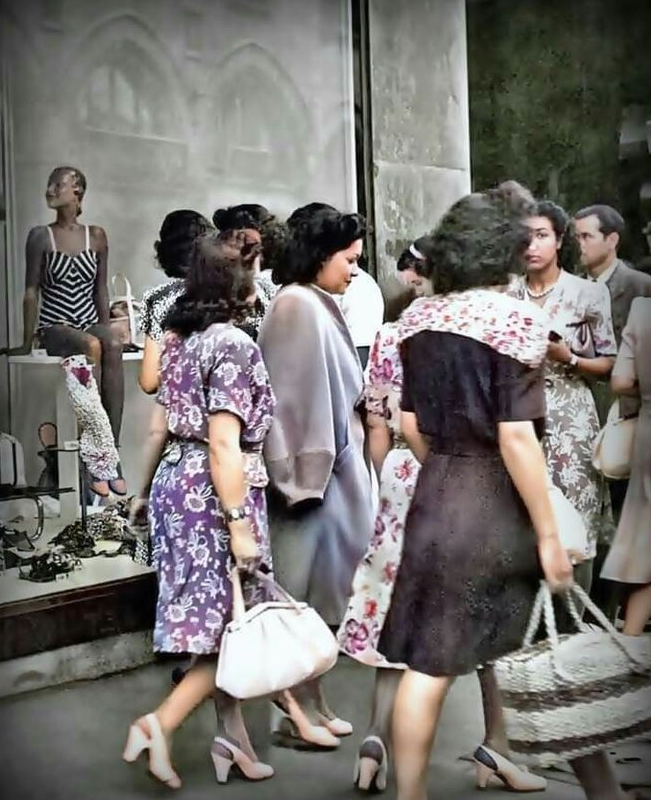
A snapshot from 1950s Istanbul
One of the book’s most unsettling implications is the porous boundary between state authority and private vice. Elite male power appears repeatedly within spaces of intimacy—private gatherings, salons, bedrooms—where decisions are not formalized through institutions but through proximity, vulnerability, and exchange. Above ground there is bureaucratic order, but beneath it an informal republic of desire both supports and destabilizes that order. Legality becomes performative, while real power moves through unofficial channels of dependency and secrecy.
Within this structure, Lüks Nermin’s figure complicates any simple reading of victimhood or villainy. She is both empowered and constrained by the system she navigates. Her rise depends on her ability to read men, institutions, and desires; her fall reflects the system’s need to periodically purge what it simultaneously depends on. Female agency here is not absent, but structurally fragile. It exists in a field where visibility itself becomes dangerous, and where increasing centrality to the system also increases exposure to its disciplinary reversals.
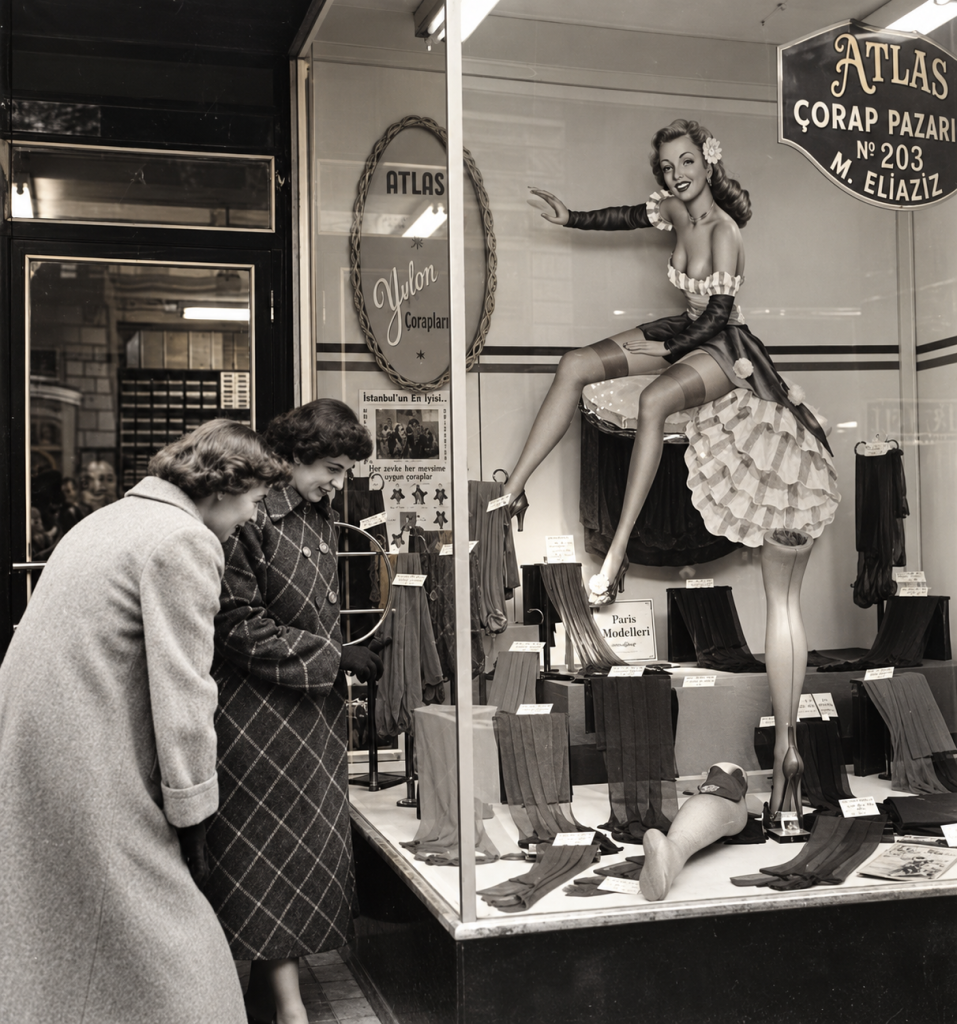
Istanbul, 1954, photo by Bert Hardy
The Istanbul of the 1950s, as reconstructed through this narrative, functions as a moral geography divided into zones of respectability and zones of excess. Yet these zones constantly leak into one another. Beyoğlu’s nightlife, bureaucratic offices, diplomatic circles, and private homes are not separate worlds but overlapping circuits. This spatial fluidity produces a specific political psychology in which nothing is fully private and nothing is fully public. Every interaction carries potential institutional consequence, and desire becomes less a form of liberation than a mechanism of risk management.

Lüks Nermin
Ultimately, Resmi Aşk Taciri Lüks Nermin (Lüks Nermin, the Official Love Broker) reads 1950s Istanbul as a city where desire is not opposed to politics but operates as one of its most effective technologies. It organizes loyalty, produces vulnerability, and enables negotiation between visible authority and invisible influence. Lüks Nermin’s story is not only about one woman’s rise and fall; it is about a system in which intimacy is monetized, morality is situational, and power is often exercised through the most private of human exchanges. In this Istanbul, nothing is more political than desire—and nothing more desired than politics itself.