

It. says: “İstanbul women’s first reward of freedom, earned after a 10–15 year struggle: the abolition (removal) of the curtains on ferries and trams.”
In the late Ottoman period, the expansion of modern public transportation in Istanbul brought with it a curious — and stubbornly persistent — social regulation: curtains separating men and women inside trams, omnibuses, and ferries. These curtains were meant to enforce modesty and spatial separation between the sexes, reflecting broader norms about gender, privacy, and public presence. Women boarded behind screens that created a spatial division, often isolating them even as the city around them grew ever more connected and interwoven.
Ottoman women challenged the curtain by writing, ridiculing, and refusing to accept it as normal: in newspapers and journals they mocked its absurdity, argued that it humiliated women and disrupted daily life, and reframed the issue as one of dignity and citizenship, not morality. By making the practice look outdated and unreasonable, they weakened it socially long before it was abolished.
In 1923, Istanbul did something quietly scandalous. It removed the curtain. Istanbul suddenly discovered something contagious: desire. Once the curtain disappeared, the city’s trams turned into moving laboratories of social experimentation. Men and women found themselves sharing benches, poles, air and occasionally knees. No one quite knew where to look. Or where to put their hands.

Inside a tram in 1920s, Istanbul
This is where rampa comes in. Rampa refers to that deliciously awkward moment when two bodies are close but not yet touching—when intention moves faster than permission. Istanbul’s public transportation became exactly that: a collective rampa, swaying through Beyoğlu and Galata. Every stop was a negotiation.
Every jolt of the tram: an invitation or an accusation. Suddenly, men leaned just slightly when the tram turned. Women adjusted bags with suspicious precision. Hands met poles at the same time. Apologies were exchanged with a little too much eye contact.
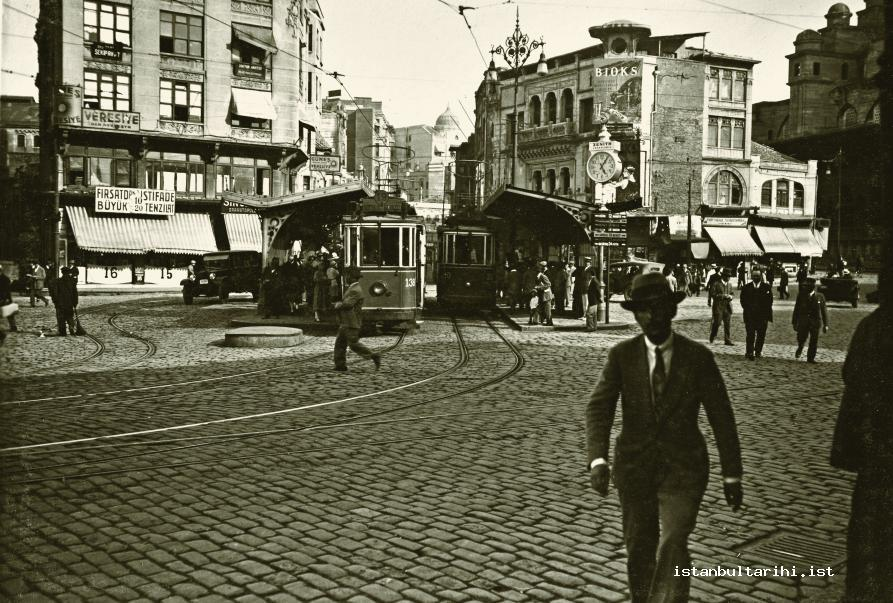
Beyoğlu, 1920s
As contemporary commentators joked, you could remove the curtain, but you couldn’t remove gravity. Nor curiosity. Nor the human tendency to test limits when fabric—and supervision—disappears.
The removal of the curtain didn’t invent love in Istanbul, but it did change its posture. Love stopped hiding. It learned to stand, to sway, to hold on during sudden stops.
For women especially, this was revolutionary. Being visible, present, and unpartitioned meant being recognized not as a moral risk but as a citizen with a body. And bodies, inconveniently, feel things.
For men, it was equally disorienting. The familiar comfort of separation gave way to a new requirement: self-regulation. Desire could no longer be projected onto an unseen “other side” of a curtain. It had to coexist politely, awkwardly, in shared space.
So this Valentine’s Day, remember:
Before roses and restaurants, Istanbul had trams.
Before romance, there was rampa.
And before love learned to dance, it learned to stand very still, hoping the next stop wouldn’t come too soon.

Mahmure Handan Hanım
And here is a hundred-year-old kanto titled Rampa and performed by Mahmure Handan Hanım, playfully referring to the newly uncurtained encounters of men and women on Istanbul’s trams and ferries, with all their wit, and social awkwardness.
Note: This video is embedded via YouTube. All rights belong to the respective rights holders.