

Old Palace and its Garden by Matrakçu Nasuh (1480-1564)
After the conquest of Constantinople in 1453, Fatih Sultan Mehmed sought a fitting residence for his imperial court in the heart of the newly captured city. Shortly thereafter, construction began in the Beyazıt area, between where the Süleymaniye and Bayezid II Mosques would later rise. This first great Ottoman palace in Istanbul became known as the Eski Saray (Old Palace), or Saray‑ı Atîk‑i Âmire. Completed between 1453 and 1458, it initially served as the primary residence of the sultans and their households.

Suleiman the Magnificient Hunting in the Gardens of the Old Palace, taken from Hünername
The Old Palace was built to house the Ottoman court in its entirety: the sultan’s harem, administrative chambers, ceremonial halls, and numerous auxiliary buildings. However, as the empire expanded and imperial tastes changed, the Old Palace gradually lost its centrality. Fires and structural damage, coupled with the growing demands of courtly life, diminished its importance. With the construction of the grander Topkapı Palace, the Old Palace was eventually eclipsed as the main seat of power.

An old engraving showing the ‘Palace of Tears’
In time, the Old Palace acquired a darker reputation. When members of the imperial harem fell out of favor, or when concubines were pregnant and therefore removed from the immediate sphere of political life, they were often relocated to the Old Palace. For many, this transfer meant a permanent separation from the heart of power and privilege. The palace thus came to symbolize sorrow, loss, and exile within the courtly world. Because of these associations, the Eski Saray became known as the “Palace of Tears.” The name reflects not just the physical isolation of its residents, but also the emotional weight carried by those who once lived in the splendor of the Topkapı only to end their days in the shadows of the Old Palace.
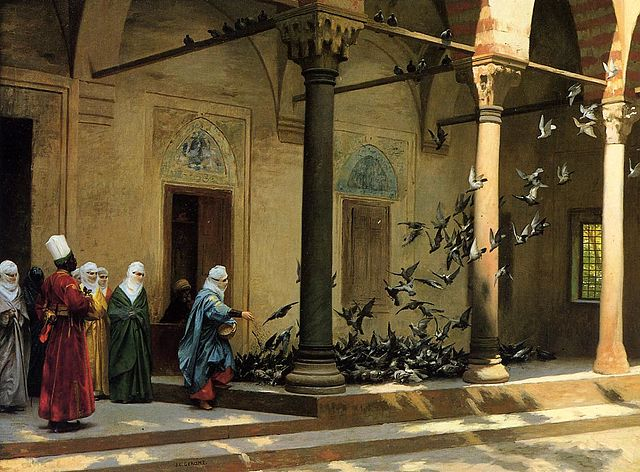
Harem women feeding pigeons in the courtyard, Jean Leon Gerome (1824-1904)
Over the centuries, the Old Palace suffered repeated fires and structural damage. By the late Ottoman period, very little of the original palace complex remained. In 1810, during the reign of Sultan Mahmud II, a devastating fire destroyed much of what was left of the Old Palace. Mahmud II, a reformist ruler known for his sweeping modernization policies, chose not to restore the Old Palace as a royal residence. Instead, he repurposed the grounds for new state institutions, in keeping with his vision of modernization. The site gradually became home to military and government buildings and later to educational facilities.

In the 20th century, with the founding of the Republic of Turkey, this historic site was transformed into the main campus of Istanbul University. Today, when you see the grand archway of Istanbul University in Beyazıt Square, you are standing on what was once the central grounds of the Palace of Tears.
Although nothing has stayed from the palace of tears, its memory lingers in historical texts, maps, and travelers’ accounts. It stands as a reminder that Ottoman court life was not only about grandeur and ceremony but also about hierarchy, exile, and emotional cost!