
The word nostalgia carries a quiet, aching history. Coined from two Greek roots—nostos, meaning “return home,” and algos, meaning “pain” or “grief”—it originally described a literal medical condition: the debilitating homesickness felt by sailors and soldiers marooned far from their native shores. To experience nostos was to long for a physical geography that still existed somewhere across the sea, waiting to welcome the traveler back.
But what happens when you haven’t left, yet home has departed from under your feet?
In modern Istanbul, a different kind of exile takes place every day. It doesn’t require a passport or a departure terminal. It happens through the relentless rumble of excavators, the shroud of construction dust, and the legal mechanism known as urban transformation.
In many neighborhoods across Istanbul, urban transformation is not merely a process of modernizing concrete or strengthening foundations against seismic risk; it has become an act of total spatial amnesia.
To walk through a neighborhood in the grip of this transformation is to witness a personal timeline systematically dismantled. It begins with a single corner and spreads until the entire topography of a life is flattened.
Walking through my neighbourhood, I witness this dismantling every day. The house where I was born has been replaced by a concrete apartment block. There is now a vast hollow where the apartment building in which I grew up once stood, waiting to be rebuilt. My primary school and my high school are both gone, replaced by buildings with absolutely no character. A towering residential complex now stands where the mansion of a hero of the Turkish War of Independence once stood. It was in the garden of that very mansion that we played as children. The beautiful mid-century house that later became a language school is now hidden behind metal panels, announcing the death of yet another beautiful Istanbul home. It was there that I had my first job as an English teacher.
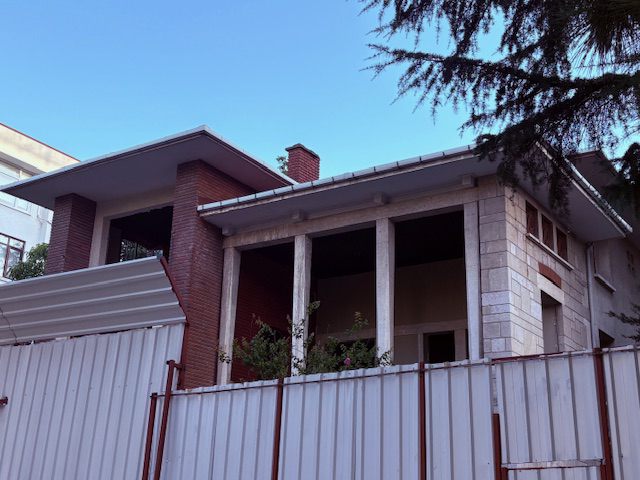
Farewell to the beautiful mid-century Istanbul house in Çiftehavuzlar that once housed Batı Dilleri (Western Languages) School. (photo taken on July 27, 2026)
When the tangible world is wiped clean, we are forced to ask a fundamental question: What is left of home?
For centuries, human memory has relied on physical anchors—the hollowed stone steps of an old building, the specific shade of paint peeling on a classroom wall, the creak of a familiar stairwell. These objects act as external hard drives for our minds. When urban transformation pulverizes those anchors, it attempts to evict the memory along with the structure.
Nostos in the age of rapid urban re-engineering can no longer be a journey across space to a physical house. It becomes an internal return—an intentional act of holding onto the ghost landscapes of Istanbul, keeping them alive even when the world around you moves on oblivious.
Header photo by Manca Juvan, courtesy of oeaw.ac.at.
Note that the video is embedded via YouTube and all rights belong to the respective rights holders.