
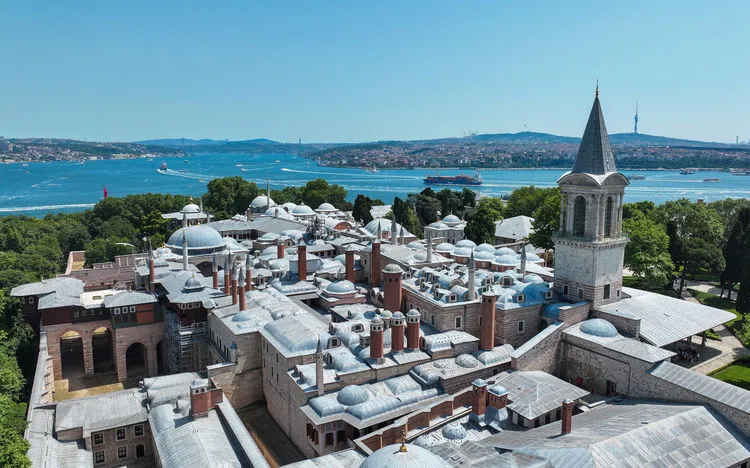
For centuries, European diplomats visiting Topkapı Palace returned to their home capitals with reports of a phenomenon that unnerved and fascinated them in equal measure. Within Topkapı Palace—and particularly as one approached the restricted spaces of the Third Court—European observers repeatedly remarked upon an extraordinary culture of silence and restraint. To foreign observers accustomed to different forms of court ceremonial, the disciplined stillness of the Ottoman court stood out as a deeply striking expression of order.
This silence was neither accidental nor passive. It was a deliberate architecture of power, security, and refined courtly culture.
The Sultan’s Awful Majesty and ‘Bîzebân’s
In Ottoman statecraft, proximity to the Sultan demanded absolute restraint. As the sovereign came to be viewed as the “Shadow of God on Earth” (Zillullah-i fi’l-Arz), his presence was framed by an aura of aloof majesty (haşmet).To speak loudly in the presence of the monarch was considered a breach of decorum (edep) and an infringement upon imperial dignity.

Sir Paul Rycaut
The seventeenth-century English diplomat Sir Paul Rycaut left one of the most vivid contemporary descriptions of the culture of silence at the Ottoman court. In The Present State of the Ottoman Empire (1667), he described a group of palace attendants whom he called the “Mutes,” using the term bîzebân—literally “without a tongue” or “speechless”—for these officials. Rather than assuming that all of these men were deaf, it is more historically accurate to emphasize their muteness and their remarkable use of signed communication.
Rycaut reported that some forty bîzebân lived among the palace pages and regularly practised a sophisticated system of signs capable of conveying not only everyday messages but stories, religious teachings, and complex ideas. Most strikingly, this language was not confined to the bîzebân themselves. Rycaut observed that the “Language of the Mutes” had become “so much in fashion in the Ottoman Court” that hearing courtiers could also communicate through it. He explicitly connected this practice with the etiquette surrounding the Sultan, noting that signing was particularly useful in his presence, “before whom it is not reverent or seemly so much as to whisper.” His account suggests that silence at Topkapı was more than the absence of noise: it was a cultivated element of courtly behaviour, sufficiently important to foster an elaborate culture of communication through gesture.
The Sultan himself rarely spoke directly to low-ranking visitors or court servants, communicating instead through brief gestures or quiet directives. By minimizing verbal exchange, the dynasty cultivated an image of absolute, untouchable authority.
Acoustic Engineering: Fountains and Discretion
Where human protocol ended, architectural design stepped in.
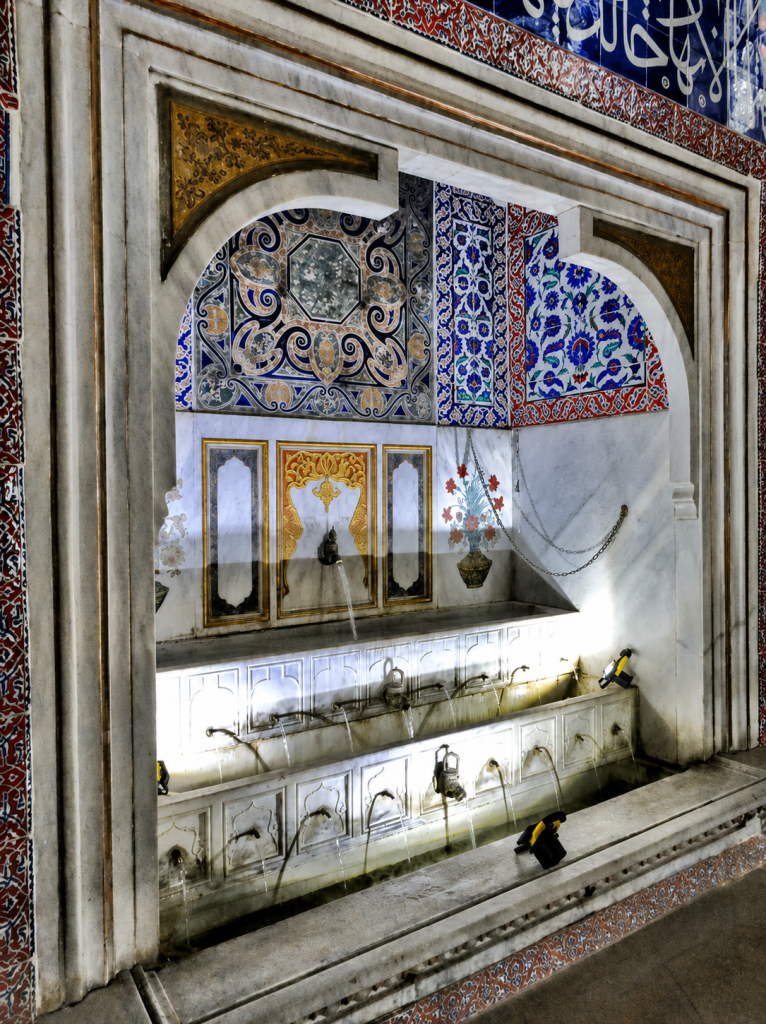
Fountain in the Sultan’s Private Chamber
Visitors to the Arz Odası (Audience Hall) or the Sultan’s private chambers in the Harem will notice delicate marble fountains mounted directly onto interior walls. These were not merely aesthetic features. The continuous sound of running water provided acoustic masking, drowning out spoken conversations so that critical discussions within could not be easily overheard from the outside.

Audience Hall
An Echo Across Time
Today, that historical stillness is long gone. Surrounded by the constant roar of modern Istanbul—from honking traffic and Bosphorus ferry horns to the bustling chatter of thousands of daily tourists—Topkapı Palace is now a lively, noisy place. Yet, if you stand quietly by an old marble fountain in the inner courtyards, it isn’t hard to imagine a time when the empire’s greatest power was held in total, dramatic silence.