
Cats are not impure; they are among those who go around among you.’
attributed to Prophet Muhammad
History usually remembers palaces through their grandest doors. At Topkapı Palace, there are monumental gates through which sultans, viziers, ambassadors and soldiers once passed. There are ceremonial courtyards, imperial chambers and corridors designed to express the elaborate hierarchies of the Ottoman court. Yet hidden within the Harem is another, considerably smaller entrance—one that tells us something about palace life that official chronicles rarely capture.

Topkapı Palace
It is a door made for a cat.
Located in the Karaağalar Koğuşu, the dormitory of the Black Eunuchs of the Imperial Harem, the tiny opening was built into the bottom of an ordinary wooden door so that the cats living alongside the palace inhabitants could come and go as they pleased. Following the restoration of the building, the little passage has returned to use. Among its present-day occupants is a cat called Şerbet.

A glimpse at the Dormitory of the Black Eunuchs
There is something wonderfully Ottoman about her name. Şerbet—sherbet—was the sweet, fragrant drink of fruits, flowers and spices that belonged to the culinary world of the palace and the wider Ottoman city.
And now Şerbet the cat wanders through the Harem, apparently indifferent to the fact that she inhabits one of the most famous historical monuments in the world.
Yet she also has a palace lineage.
Şerbet is the granddaughter of Mülayim, a well-known Topkapı cat who lived in the palace for many years and regularly used the same little door. Mülayim has been missing for around three years. But his granddaughter and the palace’s other cats continue to pass through his old entrance. In this tiny feline genealogy—Mülayim followed by Şerbet—the palace has acquired an unexpected continuity of its own.
The Other History of the Harem
The Harem is one of those historical spaces almost crushed beneath the weight of its own mythology. Western travellers imagined it as a forbidden erotic world; popular culture subsequently populated it with beautiful concubines, jealous favourites and omnipotent sultans.
The historical Harem was considerably more complicated.
It was not simply the private quarters of the sultan’s women but an enormous domestic institution: a world of mothers and children, servants and officials, teachers and guards, meals and illnesses, births and deaths, rivalries, routines and long stretches of ordinary daily life.
And apparently, cats.
The restored cat door is located in the Karaağalar Koğuşu, the quarters associated with the Black Eunuchs who served within the Harem and were entrusted with the security of the sultan and his family. The restoration of this relatively little-known section of Topkapı took more than a decade. According to Topkapı Palace Department Head İlhan Kocaman, the room containing the cat door belonged to high-ranking officials immediately below the Darüssaade Ağası, the Chief Black Eunuch, in the hierarchy.
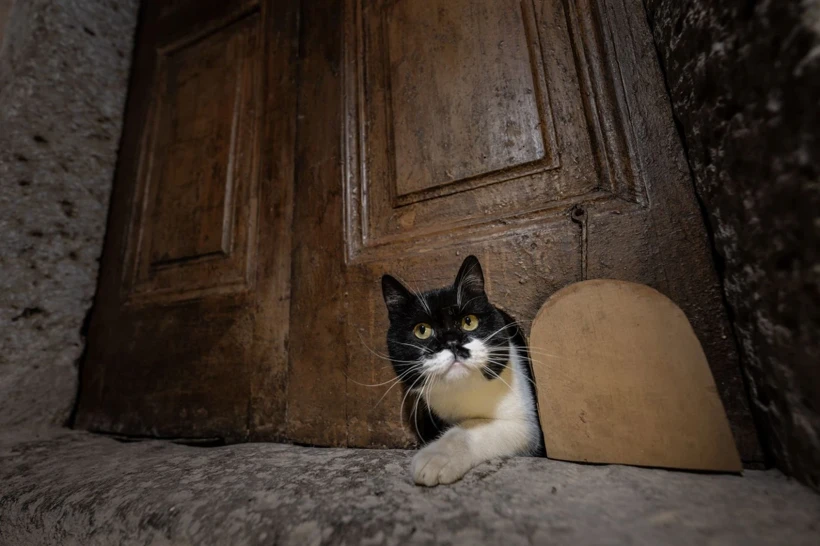
This makes the little opening particularly fascinating. Someone did not merely tolerate a cat wandering into the room. The building was physically adapted to accommodate it.
A human door opens when a human decides to open it. A cat door gives the animal something rather different: autonomy. The cat could enter. The cat could leave. The cat, as cats have always preferred, could make its own arrangements.
Cats in the Ottoman World
Şerbet’s little doorway also belongs to a much larger history of animals in Ottoman urban life.
Animals were not entirely pushed outside the human environment. Cats, dogs, birds and other creatures inhabited the same streets, courtyards, gardens and buildings as people. Animals appear both in Ottoman written sources and in miniatures, and Topkapı itself preserves traces of this coexistence. In the palace’s Second Courtyard, for example, there are water troughs associated with gazelles and other animals once kept within the palace grounds.

The cat door therefore reveals something that monumental architecture easily conceals. A palace is not only an expression of power. It is also a habitat.
People slept there. Children played there. Food was cooked. Clothes were washed. Someone opened a window because the room was hot. Someone complained about the cold. Somewhere a cat waited to be fed. And at some point, someone looked at a door and thought that the cat needed an entrance of its own. That anonymous decision may tell us as much about everyday Ottoman life as many far grander surviving objects.
The Cats Who Inherit Palaces
Today, Topkapı is no longer the residence of an imperial dynasty. The sultans are gone. The eunuchs and concubines are gone. The political intrigues that once made the Harem one of the most powerful domestic spaces in the empire have long since become history.
But the cats remain.
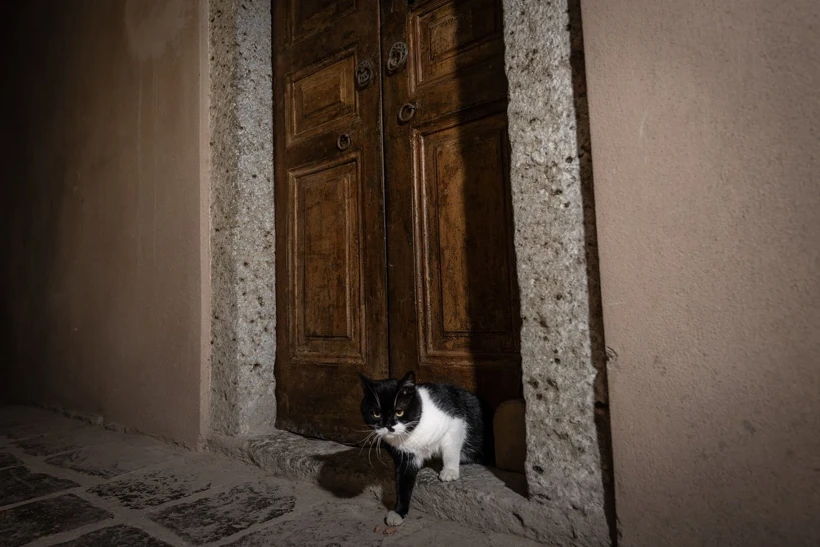
They walk across stones polished by centuries of footsteps, sleep beneath trees in the courtyards and occupy spaces whose political meanings are entirely irrelevant to them. Palace staff continue to care for the cats living within the complex, while Şerbet and her companions have resumed using a doorway made for their predecessors centuries ago.
There is something almost poetic about this.
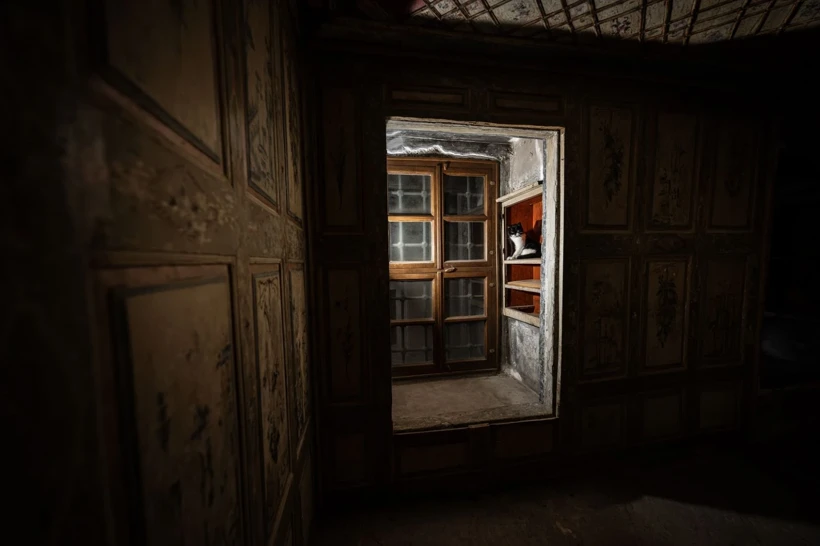
Human beings construct elaborate hierarchies. We invent titles, ceremonies and distinctions. We separate the sovereign from the servant, the public from the private, the sacred from the ordinary. Topkapı Palace was perhaps one of the most sophisticated architectural expressions of such distinctions ever created.
And then, near the bottom of one of its doors, there is a hole for a cat.
Perhaps this is why Şerbet is such an appealing inhabitant of the Harem. She belongs simultaneously to the historical palace and to the living city outside it. She turns a museum back into a home simply by walking through a doorway.
The great gates of Topkapı preserve the memory of empire. Şerbet’s little door preserves something gentler: the memory of everyday life. And perhaps, after centuries of sultans, princes, concubines, eunuchs and courtiers, it is fitting that one of the smallest doors in the palace still belongs to someone who has never cared very much about rank. A cat.
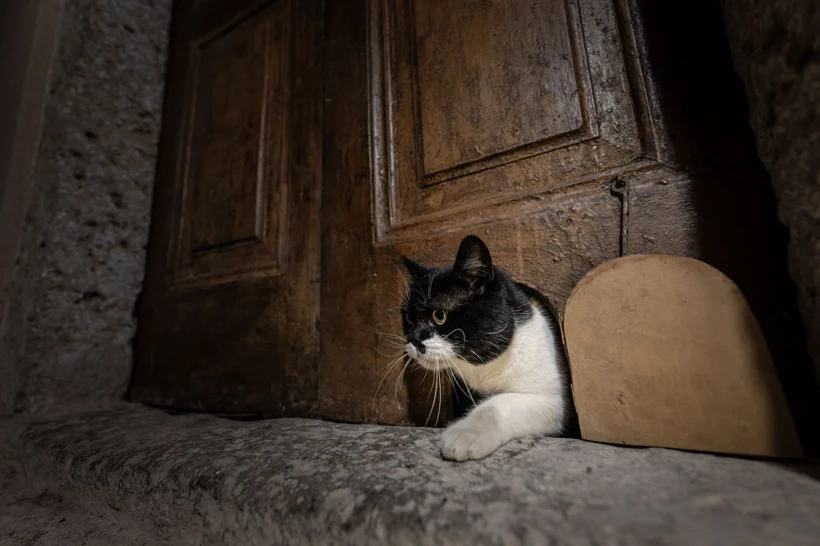
Note that all visuals are of Şerbet’s and are taken from odatv.com.