
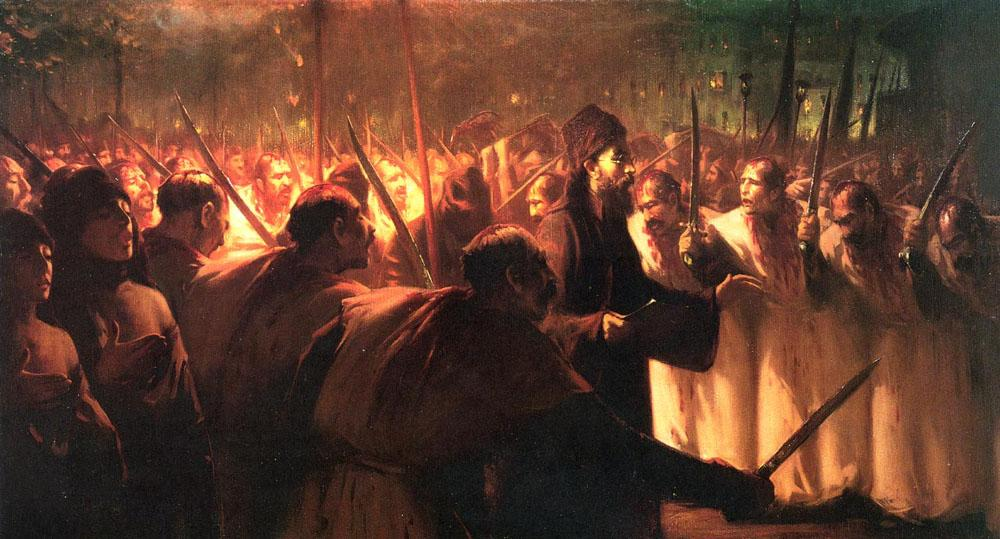
Italian painter Fausto Zonaro (1854–1929) painted the Sinezens in Üsküdar, around the Iranian Cemetery and the Seyyid Ahmed Deresi area.
Hidden within Büyük Valide Han, among the workshops and warehouses between the Grand Bazaar and Eminönü, survives one of Istanbul’s least-known religious traditions. During Muharram, Shi’a worshippers still gather here to mourn the martyrdom of Imam Hussein at Karbala. Among them are the sinezens, who rhythmically strike their chests while elegies for Hussein are sung.
The tradition is a legacy of Istanbul’s once considerable Iranian community.
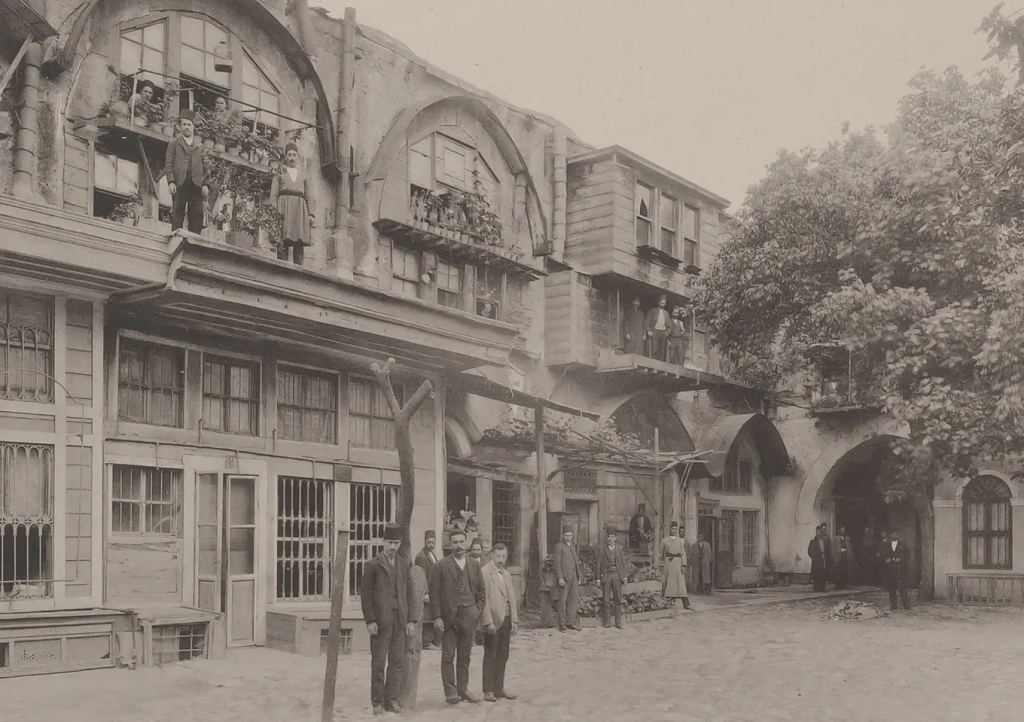
Iranian merchants in Valideha Han (Istanbul University Archives) – visual is taken from ajammc.com.
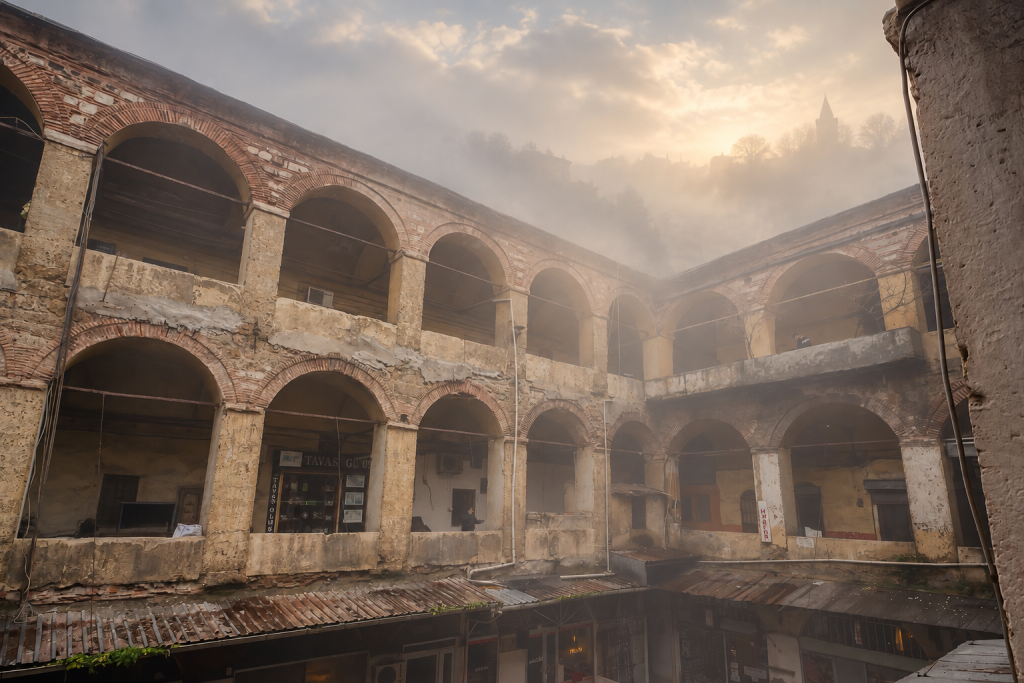
Built by Kösem Sultan in the seventeenth century, Büyük Valide Han gradually became an important centre for merchants arriving from Iran and Azerbaijan. Their presence increased substantially during the nineteenth century as commercial relations between the Ottoman and Qajar empires expanded. So closely associated did the han become with Iranian merchants that a small Shi’a mosque within it became known as Mescid-i İrâniyân — the Mosque of the Iranians.
Büyük Valide Han
It was here that the community gathered during Muharram, the month commemorating the killing of Hussein, grandson of the Prophet Muhammad, at the Battle of Karbala in 680. In Shi’a tradition, Karbala represents not only a historical tragedy but the eternal struggle between justice and oppression. Remembering Hussein therefore involves mourning him.
One of the oldest expressions of this mourning is sine-zanī, literally “beating the chest.” Participants stand together while mersiyes—elegies recounting the suffering of Hussein and his companions—are sung, striking their chests in rhythm. Grief is thus expressed not only through words but through the body itself.
Although Iranian merchants had lived in Istanbul much earlier, organised public Muharram ceremonies at Büyük Valide Han appear to have become particularly prominent during the nineteenth century, probably around the 1860s. By the late Ottoman period they had grown into major events. Hundreds gathered at the han, while processions sometimes continued through the surrounding streets. Contemporary accounts even describe Istanbulites and European visitors arriving simply to watch the extraordinary ceremonies.
Some rituals were considerably more extreme than those practised today. Alongside chest-beating were zincir-zanī, involving chains, and qama-zanī, in which participants cut themselves with blades. Ottoman authorities generally tolerated the community’s religious observances but periodically intervened when the processions spilled into public streets and attracted enormous crowds.
Painting by Fausto Zonaro

The large public ceremonies eventually disappeared, and the more violent forms of self-mortification are no longer characteristic of the Valide Han gatherings. Yet the central tradition survived.
The original Iranian mosque burned down around 1950 and was rebuilt by the Iranian community in 1951. Today, the modest İranlılar Camii still stands within Büyük Valide Han. During Muharram, Turkish, Iranian and Azerbaijani Shi’a worshippers gather there beneath black mourning banners. Mersiyes are recited, prayers are said and the sinezens continue their rhythmic mourning for Hussein.
Perhaps this is what makes the tradition so moving.

A glimpse at the Sinezen ceremony in Istanbul
The Ottoman Empire disappeared. The Qajar Empire disappeared. The Iranian merchant community that once filled the rooms of Büyük Valide Han largely dispersed. The caravans stopped arriving long ago.
Yet the ritual remained.
Every Muharram, behind the crowded streets of modern Istanbul, men still gather in a seventeenth-century Ottoman han, raise their hands and strike their chests to a rhythm carried to the city generations ago.
The merchants have gone, but their memory still has a heartbeat.