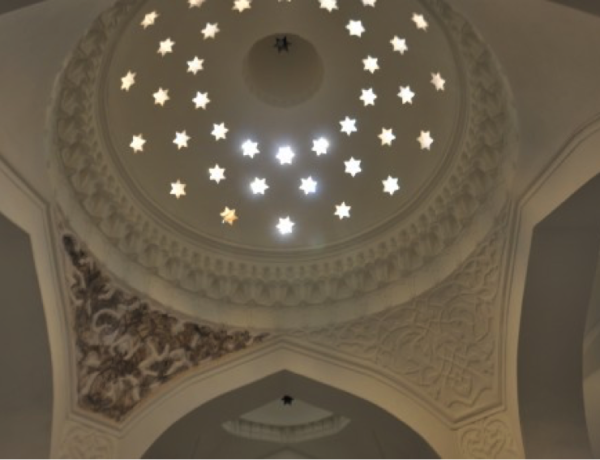

A dead youth lies here,
a nineteen-year-old lad,
under the sun by day,
under the stars by night,
in Istanbul, in Beyazıt Square.’
Nazım Hikmet
Millions in Istanbul rush through Beyazıt Square and Taksim Gezi Park every day, passing right by monuments of bronze and marble without realizing the history carved into them. Yet, these public works of art stand as quiet, permanent reminders of a long-held desire for freedom and peace—sculpted by pioneering women whose own names have largely faded from public memory.
The Flashpoint at Beyazıt Square
I love walking around Istanbul University in Beyazıt, trying to follow the traces of the past, and I have always been surprised by an abstract sculpture standing in sharp contrast to everything around it. I have always been intrigued by it, without knowing what it stood for or who created it.

It is only recently that I learnt that this monument is inextricably linked to a dramatic incident which took place in April 28, 1960, when university student Turan Emeksiz was killed by a police bullet during demonstrations against the oppressive Democratic Party administration. His death transformed him into a potent symbol of academic freedom and youth activism. Following the May 27 coup, Emeksiz was designated a “Freedom Martyr” and temporarily buried at Anıtkabir with state honors, before the 1980 military regime subsequently transferred his remains to Cebeci Cemetery. It was due to him that Beyazıt Square itself was officially renamed “Hürriyet Meydanı” (Freedom Square), setting the stage for a monumental commemorative work.

Turan Emeksiz (1940-1960)
In 1960, a prominent national competition was organized. A distinguished jury—including figures like Rudolf Belling, Hadi Bara, Turgut Cansever, and Nezih Eldem—selected the design submitted by sculptor Semahat Acuner. Unveiled on the third anniversary of the May 27 coup, Acuner’s bronze Hürriyet Anıtı (Freedom Monument / Turan Emeksiz Monument) broke away from rigid neoclassical portraiture, employing dynamic geometric forms to embody the momentum of youth resistance.
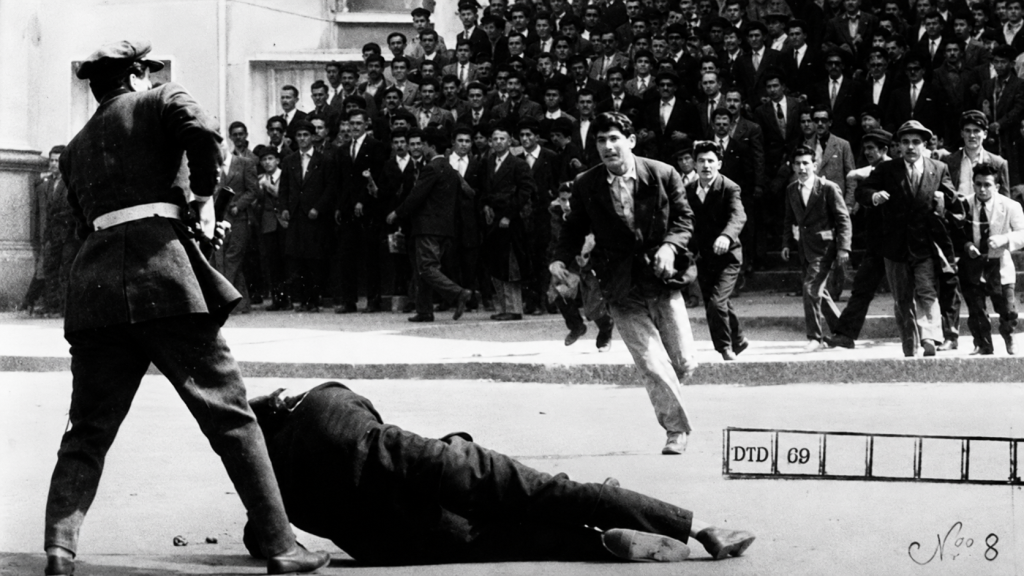
A photo from the tragic incident when Turan Emeksiz lost his life
Over the subsequent decades, the monument became a symbolic nucleus for political movements in the late 1960s. However, urban redevelopments and political shifts altered its physical and cultural stance. Unveiled in 1963 directly across the street at the precise location where Emeksiz fell, the monument was later moved to an elevated green space near the Istanbul University Central Library, parallel to the tramline. Today, commercial arcades occupy the original site of the shooting, and the monument stands quietly without the annual commemorations that once defined its presence.
Today, it sits in total silence without any trace of of its historical references and a reminder of the female sculpture who has created it.
It is also such a pity that there is not even one visual record of the female sculptor Semahat Acuner who has created this masterpiece. I could not even find a photo of this remarkable woman.
Note that poet Enver Gökçe wrote a poem titled ‘Katline Ferman’ (Death warrant) dedicated to Turan Emeksiz following his tragic death at only 20 years of age. The poem was later set to music by the prominent musician Ahmet Kaya. Contemporary Alternative Rock Music group Büyük Ev Ablukada performs its raw, explosive version, proving that the cry of a 20-year-old youth still reverberates in the hearts of today’s music lovers.
A Sanctuary of Peace in Gezi Park
Further north along the city’s civic spine lies Taksim Gezi Park. Long before it became globally synonymous with civil protests, Gezi Park was conceived during the early Republican era as a modern democratic green space. In 1974, amid international discourse surrounding peace and reconciliation, a public sculpture titled Barış Heykeli (Peace Sculpture) was installed within its shaded pathways.
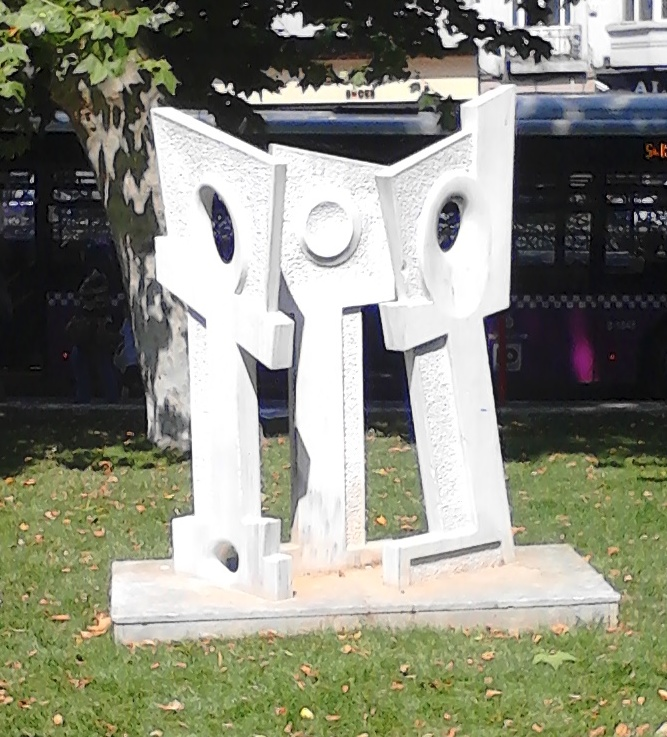
The creator of this understated masterpiece was Lerzan Bengisu (1906-1978), a towering figure among Turkey’s first generation of modern women sculptors. Bengisu spent decades working with wood, stone, and bronze, refining organic forms into universal symbols.

Retrospective Exhibition Brochure Cover, March 19-31, 1979
Her Peace Sculpture is characterized by flowing, interconnected volumetric curves that communicate harmony through balance and structural elegance rather than overt political motifs.
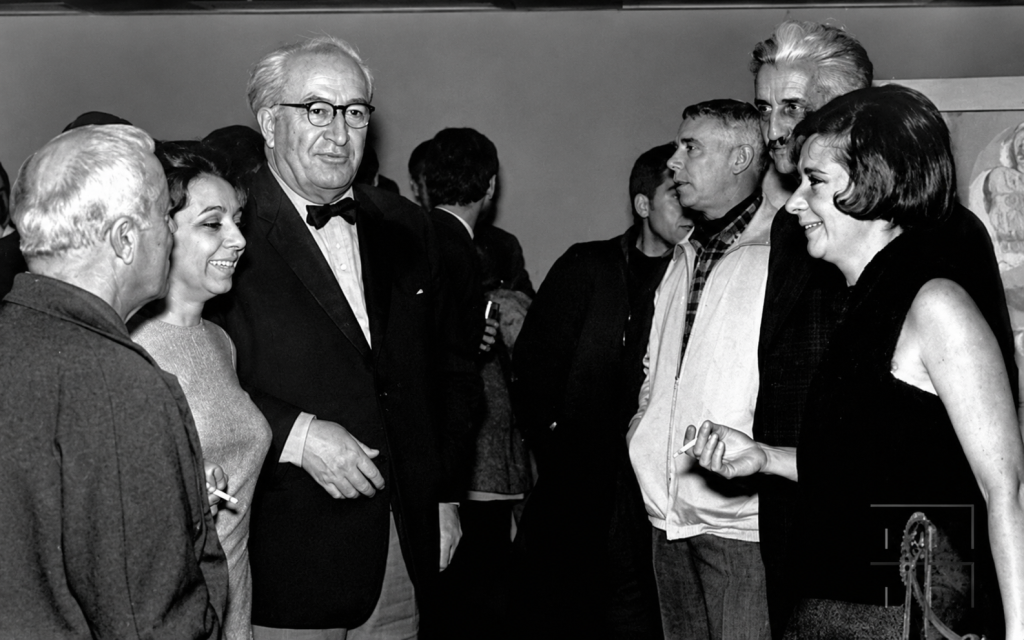
Hadi Bara, Müfide Çalık, Edip Hakkı Köseoğlu, İlhan Koman, Şadi Çalık, Lerzan Bengisu. 1968.
Over the decades, Taksim Gezi Park has evolved into Turkey’s defining hotspot for political uprisings and a collective cry for peace, justice, and civic rights. Originally envisioned as a peaceful urban sanctuary, the park became globally recognized as the epicenter of mass democratic protests, where diverse voices gathered to demand freedom and resist authoritarian overreach.
Placed quietly along its shaded pathways long before these historic movements, Lerzan Bengisu’s Peace Sculpture (Barış Heykeli) carries a remarkably prophetic symbolism. Amid a space marked by tear gas, resistance, and the relentless struggle for democratic expression, the sculpture’s flowing, harmonious curves stand as a permanent, physical reminder of the society’s deep-seated longing for peace.
Restoring the Axis of Memory
Revisiting Beyazıt Square and Gezi Park reveals how public memory is continually reshaped by spatial relocation and social forgetting. Semahat Acuner’s monument at Beyazıt and Lerzan Bengisu’s sculpture at Gezi Park form a significant artistic axis across Istanbul. Documenting their history ensures that the stories of peace, freedom, and artistic innovation remain tied to the women who sculpted them. Decades after these pioneering female artists envisioned these monuments, our society finds itself still actively reaching for the very ideals of freedom and peace they carved into stone and bronze. The ongoing resonance of their work serves as a reminder that the pursuit of a just and peaceful public sphere is not a settled historical landmark, but a continuous, living struggle—one that requires us to repeatedly honor and reclaim both the physical monuments and the values they embody.
Let me end with a song dedicated to all the lives lost during the Gezi Protests in 2013, which unfolded under the watchful eye of Lerzan Bengisu’s peace sculpture, Taksim Meydanı. It is a poignant reminder that the road to peace is much longer than we had ever hoped.
Note that videos are embedded via YouTube and all rights belong to the respective rights holders.
Visuals are taken from artirummodern.com, wikipedia.com, bengiozkan.blogspot.com, simurg.info.