
I am a fallen star, a destitute wanderer—
a lover estranged from himself.
Like the sun, I drift in the ocean of Your love,
utterly helpless.
I have become Your servant;
where else could I turn but to Your threshold?
O You of subtle grace—
while You remain,
to whom else could I ever bow or beg?Mehmet Sâdî Bey
To love in 19th-century Istanbul was to live in a city where desire and restraint shared the same narrow streets. It was an age of glances, pauses, carefully staged coincidences and secret letters.
This was a world in which a woman might “accidentally” drop her handkerchief and change the course of a man’s inner life, while both parties pretended nothing had happened. Love existed in the space between what was felt and what could be shown.
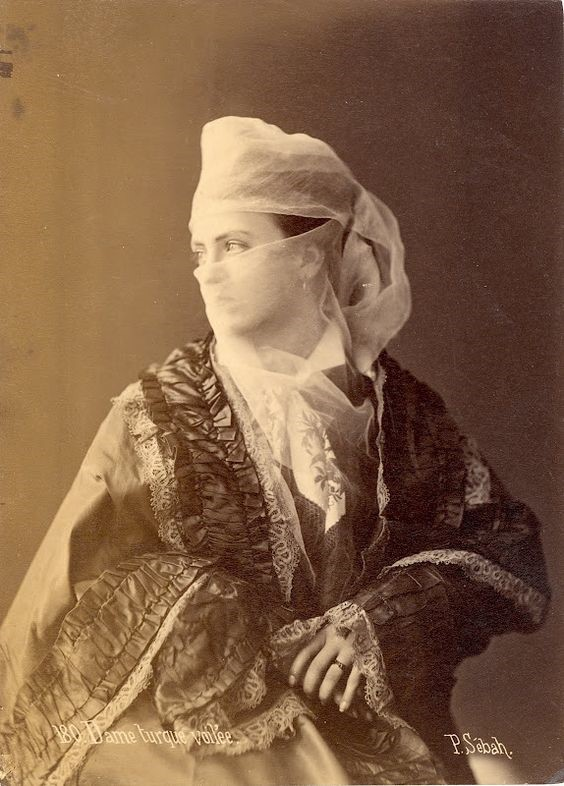
An Ottoman woman behind the veil in 19th Century İstanbul
Urban Ottoman love was neither naïve nor reckless. It was intelligent, strategic, and deeply aesthetic. Feelings were not denied, but they were disciplined. One did not rush toward the beloved; one circled. Desire learned patience. Passion learned manners.

Kağıthane river, 1880s
This was when lovers in Istanbul could only meet in secrecy away from the public gaze. Then there were promenades in Kağıthane, Göksu, Çamlıca where families picnicked and boats drifted slowly along the water. These were semi-public, semi-private spaces where love could breathe a little more freely. A carefully timed boat ride, a glimpse from across the water, a song carried by the breeze. Romance unfolded horizontally, never directly.

Göksu in the 19th Century
The beloved was often distant, elusive, and powerful. ‘Naz’ (coyness) was not cruelty but currency. To make the other wait was to increase one’s value. The lover, in turn, proved devotion through endurance: sleepless nights, quiet jealousy, dignified sorrow. To suffer well was to love well just like this 19th century love song composed by İsmail Hakkı Bey that says ‘Have pity on me just once, my rosebud-mouthed beloved.’
Eroticism existed everywhere, yet nowhere explicitly. A glimpse of a wrist, the curve of a brow, the fall of a veil, these were enough. The imagination did the rest. Pleasure did not lay in fulfillment but in anticipation. Love was something to be sustained, not consumed.

Painting by Fausto Zanora depicting an Ottoman woman in 19th century Istanbul
This delicate balance also carried pain. Misunderstandings lasted long. Silence could stretch for months. A missed meeting became e a lifelong wound. And yet, drama was contained within a code of decorum. One did not collapse; one endured. Heartbreak, like love itself, required composure.
What emerges from this period is a distinct emotional style: l’amour à la turca . A love that thrived on contradictions: bold yet cautious, passionate yet restrained, deeply felt yet carefully hidden. Perhaps this is why love in the 19th-century Istanbul still fascinates us. In a time before speed and instant gratification, love was something one learned to carry, not immediately resolve. It was slow, risky, and exquisitely alive, forever balanced on the edge between revelation and silence.
Music played a central role in this emotional economy. The popular şarkı form, lighter than the solemn gazel, more refined than folk song became the soundtrack of flirtation. These songs did not describe bodies; they described effects. They were a look that disturbed sleep, a smile that caused suffering, a voice that made the heart lose its way.
Lend an ear to Hacı Arif Bey, a 19th-century Istanbul composer who gave voice to an urban love that spoke softly and suffered elegantly, in a world where most lovers could not unite unlike our own age of immediate gratification and fleeting emotions. One cannot help but wonder whether eros has fully abandoned us.
Lyrics of the song says:
I am a fallen star, a destitute wanderer—
a lover estranged from himself.
Like the sun, I drift in the ocean of Your love,
utterly helpless.
I have become Your servant;
where else could I turn but to Your threshold?
O You of subtle grace—
while You remain,
to whom else could I ever bow or beg?