
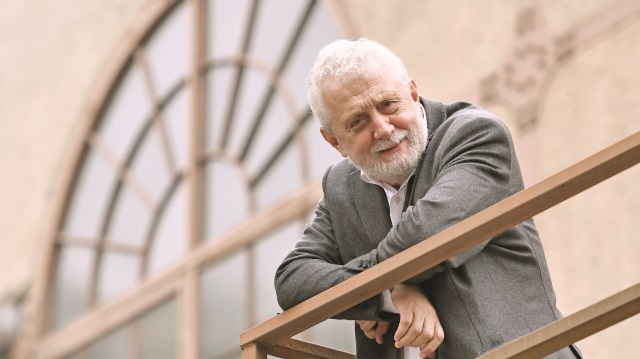
Turks have a long tradition of conformity to authority which includes conformity to intellectual authorities. Disruptive thought and originality have never been culturally celebrated in Turkish culture. There are very few original thinkers in Turkish academia and among the Turkish intellectuals and Uğur Tanyeli is one of them. Reading him always feels like a breath of fresh air among the midst of repetitive ideas about Turkish modernisation and urbanisation.
He is a professor of architecture and ‘his academic interests are Ottoman/Turkish modernity in a world-historical context, beginning with the 16th century, and its physical and spatial aspects. Some of his books are “İstanbul 1900-2000: Konutu ve Modernleşmeyi Metropolden Okumak / Istanbul 1900-2000: Reading Modernity and Housing on the Metropolis” (Akın Nalça, 2004), “Turgut Cansever: Düşünce Adamı ve Mimar / Turgut Cansever: Thinker and Architect” (with A. Yücel, Osmanlı Bankası Arşiv Araştırma Merkezi and GG, 2007), “Mimarlığın Aktörleri: Türkiye 1900-2000 / Actors of Architecture: Turkey 1900-2000 ” (GG, 2007), “Rüya, İnşa, İtiraz: Mimari Eleştiri Metinleri / Dream, Construction and Objection: Texts of Architectural Criticism” (Boyut, 2011), “Sınıraşımı Metinleri: Osmanlı Mekanının Peşinde / Texts of Transgression: Searching for the Ottoman Space” (Akın Nalça, 2015), “Yıkarak Yapmak / Construction by Destruction” (Metis, 2017) and “Mütereddit Modernler: Türkiye’de ve Dünyada Mimar İdeologlar / Hesitating Moderns: Architect Ideologues in Turkey and in the World” (Işık University Publ., 2018).‘ (source İstinye University website).

But my most favourite book of Uğur Tanyeli is ‘Korku Metropolu İstanbul 18. Yüzyıldan Bugüne/Metropolis of Fear Istanbul from 18th Century to Today’. The book draws the large panorama of Istanbulites’ fears from women to foreigners, from natural disasters to modernisation. He is defining an ’empire of fear’ that has been haunting Istanbulites for centuries. That is an İstanbul the locals feared would be destroyed by natural disasters, invaded by foreigners, ‘polluted’ by women and transformed by modernisation. His book is a psychosocial analysis of the inhabitants of this multilayered city throughout centuries. Many of the Istanbulites’ paranoias he draws attention to are still with us today. We are still afraid of an earthquake that will destroy our city, complain about refugees and ‘unwanted’ visitors that have ‘corrupted’ the city; some still fear the female body and female presence in all walks of life and feel a deep nostalgia for a past that has been transformed by modernisation.
It is so sad to think that his book has not been translated into English but it is a must to get a copy of the book as soon as it is translated as it is one of the best books that could widen one’s horizon on the psychosocial landscape of our multilayered city.
When you get a chance to read him, you will see how opposed he is to the deep sense of nostalgia for Istanbul’s past. He is a thinker who believes in the constant recreation of cities and is against the ‘construction’ of an ideal past and a longing to revive it. He is rather interested in the dynamism of change in our urban surroundings and how we shape and are shaped by this dynamism.
If you want to have a glimpse of his thinking about Istanbul and its history of urbanisation, consider reading his article of The Phase of Radical Changes in Istanbul’s Architecture, the XVIIIth and XIXth Centuries (https://istanbultarihi.ist/704-the-phase-of-radical-changes-in-istanbuls-architecture-the-xviiith-and-xixth-centuries).