
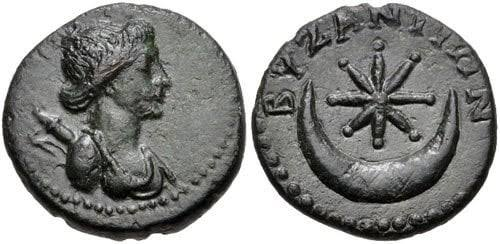
Byzantion coins from 3rd BC
More than two thousand years ago, some six centuries before Byzantion was transformed into Constantinople under Constantine the Great, a woman was writing poetry in the ancient Greek city on the Bosphorus.
Her name was Moero of Byzantion — also known as Moiro or Myro.
She lived around the late fourth and early third centuries BCE, in the early Hellenistic period. Almost all of her work has disappeared, yet what remains allows us to hear one of the earliest known female literary voices associated with the city that would one day become Constantinople and Istanbul.
Moero was more than a local curiosity. Centuries after her lifetime, Antipater of Thessalonica included her among his celebrated nine women poets, earthly counterparts to the nine Muses. Meleager, in the introduction to his Garland, associated each poet with a flower and remembered the “lilies of Moero.” Such references suggest that her poetry continued to circulate and was admired long after her death.
Ancient sources attribute several kinds of poetry to her, including a work entitled Mnemosyne, a collection called Arai (Curses), and a hymn to Poseidon. Yet only a tiny portion of her poetry has come down to us: two epigrams preserved in the Greek Anthology and ten hexameter lines from Mnemosyne, quoted by Athenaeus.
The Grapes Beneath Aphrodite’s Golden Chamber
One of Moero’s surviving epigrams appears in Book VI of the Greek Anthology, the book devoted to dedicatory epigrams. This context matters: the cluster of grapes in the poem is not simply an image from nature but an offering placed in the sanctuary of Aphrodite.
You lie beneath Aphrodite’s golden chamber,
O cluster of grapes, filled with the drops of Dionysus.
No longer will your mother vine lovingly wrap
her branch around you, nor spread her nectar-sweet leaf above your head.
English adaptation by the author, based on translations of Greek Anthology 6.119
In four lines, Moero transforms a votive offering into something almost human. The vine becomes a mother whose child has been separated from her embrace. Aphrodite presides over the dedication, while Dionysus is present within the grapes themselves.
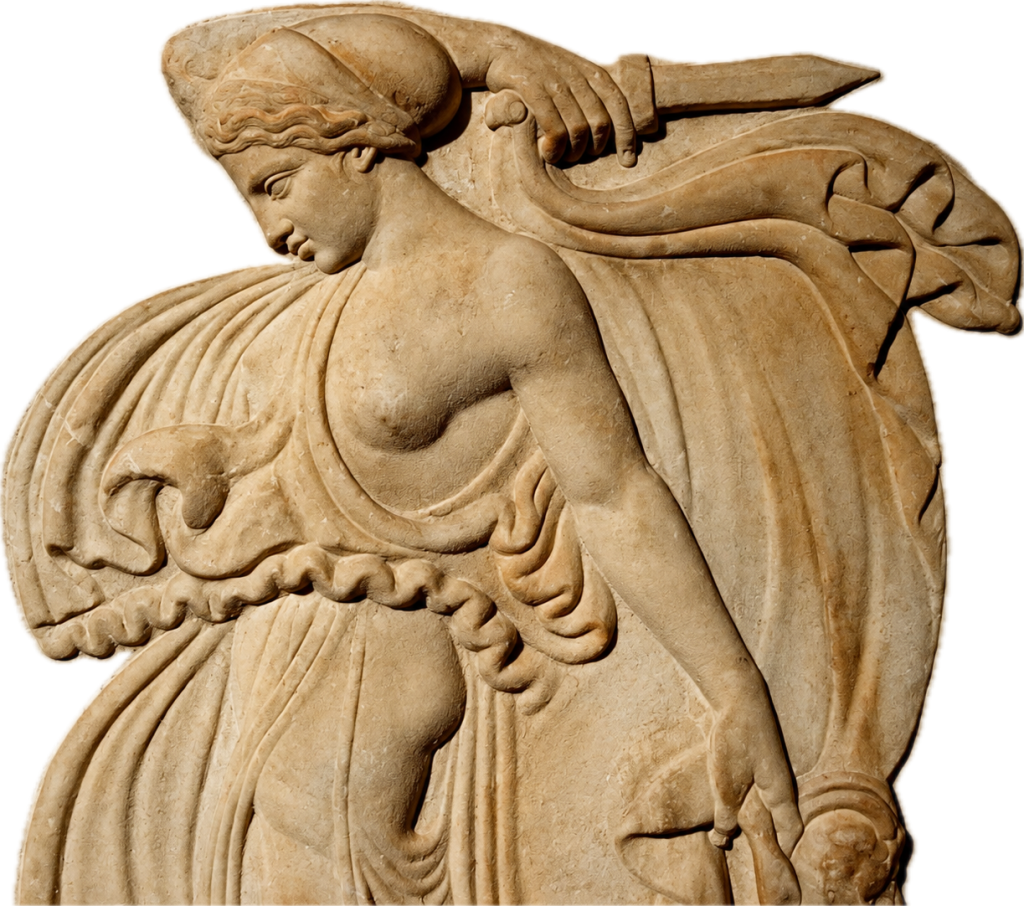
Dancing Maenad, Roman copy (1st–3rd century CE) after a Greek original of the late 5th century BCE. Marble relief. Maenads were the female followers of Dionysus, the god invoked in Moero’s epigram on the grapes. Istanbul Archaeological Museums.
The religious and the intimate merge: offering, fertility, wine, motherhood and separation inhabit the same small poem.
The tenderness is particularly striking. What could have been a conventional description of a dedication becomes an image of maternal loss.
The Nymphs of Anigrus
Moero’s other surviving epigram also belongs to the dedicatory Book VI of the Greek Anthology. This time the setting is not Byzantion but the river Anigrus in Elis, in the western Peloponnese, whose waters and nymphs were associated in antiquity with healing.
Nymphs of Anigrus, daughters of the river,
immortal ones who forever tread these depths with rosy feet,
rejoice, and heal Cleonymus, who beneath the pines
placed these beautiful images here for you, goddesses.
English adaptation by the author, based on translations of Greek Anthology 6.119
The Greek is especially revealing: Cleonymus has placed xoana — sacred images — beneath the pines for the goddesses and asks in return for their healing power. The poem therefore evokes an actual landscape of cult: river, trees, sacred images and divine inhabitants.
There is another intriguing detail here. A woman poet associated with Byzantion was writing about a sanctuary hundreds of kilometres away in the Peloponnese. Whether Moero knew the place personally cannot be established, but the poem reminds us that the literary and religious world of the Hellenistic Mediterranean extended far beyond the boundaries of any single city.
Mnemosyne: A Myth Written in the Stars
The most substantial surviving piece of Moero’s poetry comes from a longer work entitled Mnemosyne — Memory — preserved because Athenaeus quoted ten of its hexameter lines centuries later.
The fragment tells of the hidden childhood of Zeus on Crete. Doves bring the young god ambrosia from Ocean, while an eagle carries nectar to him. After Zeus overthrows Cronus, he rewards the eagle by making it immortal and placing it among the stars.
But this is more than an episode from the childhood of Zeus.
Moero appears to be telling an aetiological myth of the heavens — a story explaining how creatures of myth came to be associated with the stars. The doves invite association with the Pleiades (Peleiades, “doves”), while the eagle’s reward points towards Aquila, the Eagle constellation.
The fragment therefore moves from a Cretan cave to the night sky: creatures who nourish the hidden child become part of the cosmic order established after his victory.
That makes the title Mnemosyne particularly resonant. Mnemosyne was the goddess of Memory and mother of the Muses. Moero’s poem itself performs an act of memory, preserving myth by transforming it into poetry.
And, ironically, memory is precisely what history has denied most of Moero’s own work.
A Woman Poet of Hellenistic Byzantion
Moero belonged to the extraordinary world of Hellenistic women poets that also included Anyte of Tegea and Nossis of Locri.
Their surviving works complicate the familiar image of ancient Greek literary culture as an exclusively male domain. Women were not merely subjects of poetry. They were composing it, circulating it and, in some cases, entering the literary canon.
Antipater of Thessalonica’s famous epigram makes this particularly clear. Alongside Sappho, Erinna, Anyte, Nossis and others, Moero is one of his nine mortal Muses — women whose poetry, he says, brought “deathless delight” to mortals.
Meleager’s Garland offers another glimpse of her lost reputation. In his imagined wreath of Greek poets, Moero is represented by lilies. Only a fraction of the poetry behind those lilies survives today.
Her connection with Byzantion makes that survival especially evocative.
Moero’s city was not yet Constantinople. There was no Hagia Sophia, no great imperial palace and no monumental capital of the Eastern Roman Empire. Hellenistic Byzantion was a Greek polis occupying a strategically extraordinary position at the entrance to the Bosphorus, connected by trade, religion and culture to the wider Mediterranean and Black Sea worlds.
Somewhere in that vanished city lived a woman who wrote about Aphrodite and Dionysus, sacred rivers and nymphs, the childhood of Zeus and the transformation of myth into stars.
What Remains
What survives of Moero is slight: two complete epigrams and a ten-line fragment of a larger poem. Yet the ancient testimonies surrounding her suggest that this is only the residue of a much larger literary presence.
Antipater remembered her among the great women poets. Meleager placed her lilies in his poetic garland. Athenaeus preserved part of Mnemosyne. The Greek Anthology preserved two of her dedications.
The rest disappeared.
For a city defined by successive layers of habitation and memory, there is something fitting about Moero’s survival. Byzantion became Constantinople; Constantinople became Istanbul; buildings, languages and entire literary traditions vanished or were transformed.
Yet a few lines written by a woman beside the Bosphorus more than two thousand years ago survived that transformation.
They are fragmentary, but they are enough to let Moero speak again.