

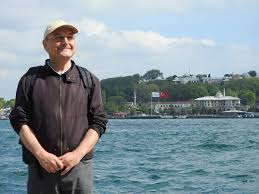
Egemen Demircioğlu
Mahan Doğrusöz: When I was searching for a name for my website dedicated to Istanbul, one word kept echoing in my mind: ‘eternal.’ In your view, what is it that makes Istanbul eternal?
Egemen Demircioğlu: Istanbul has been there since time immemorial — and definitely will be there for eternity! That’s always what comes to my mind whenever I look at the Historical Peninsula from Kadıköy. It’s Hagia Sophia, more than anything, that makes me think this way. When it was built, Ephesus was still inhabited! We’re not even talking about the Middle Ages — this is Late Antiquity! And in the late 6th century, people approaching the city by sea would have seen the SAME dome. That’s simply marvelous!
Mahan Doğrusöz: If you had to choose a single word to encapsulate your personal experience of Istanbul, what would it be—and why? What does this word evoke for you in the context of the city?
Egemen Demircioğlu: Chaos — unfortunately. But maybe that’s part of the charm! Thanks to the chaos, discovering the city’s beauty is up to you — and in a way, it becomes your own creation. If everything were perfectly ordered, exploring the city would feel like walking through a museum — passive and distant. But in Istanbul, every joyful moment feels earned.
Mahan Doğrusöz: Bettany Hughes, in her fascinating book Istanbul: A Tale of Three Cities, presents the city as a rich inheritance of its Greek, Roman, and Ottoman pasts. Reflecting on this idea, which elements do you believe Istanbul has inherited from each of these civilizations? I’m especially interested in how you see these influences woven into the fabric of contemporary Istanbul.
Egemen Demircioğlu: Istanbul has both a Roman and an Ottoman past. I don’t make a separate distinction for Byzantium. Christian Rome is simply one of the many periods within Rome’s long history. Besides, Hellenic culture and language were already essential components of Roman civilization.
Rome and the Ottoman Empire are entirely different worlds. As long as we keep this in mind, we can still search for common ground. In fact, I personally prefer to emphasize continuity rather than rupture.
The most significant commonality between Rome and the Ottoman Empire lies in their deeply institutionalized nature—reflected in their political doctrines, grand strategies, administrative structures, customs, and more. Both believed themselves to be “eternal,” or at the very least, deeply believed in their own permanence. As a natural extension of this, both had a distinct sense of identity: they knew who they were, and what they wanted. That’s why they were never afraid to change when necessary, nor did they shy away from learning from other civilizations. The best reflection of what I’m saying is the way Hagia Sophia and the Süleymaniye Mosque stand side by side on the city’s skyline, as its two most defining features. In fact, if you asked me what scene best sums up Istanbul, I’d say: walk across the Galata Bridge and take a look—first at Süleymaniye, then at Hagia Sophia.
The Ottomans turned Hagia Sophia into a grand, even the grandest mosque—immediately and without even feeling the need to change its name. Nor did they hesitate to take its architecture as a model. The Süleymaniye Mosque bears a striking resemblance to Hagia Sophia.
Today, trying to find traces of Hellenic or Roman influence in Istanbul would be a futile effort. Even finding Ottoman traces is difficult. At best, one might hope to find remnants of Anatolian cultures and the idea that their blending has formed—or once formed—a unique fabric. But even that is lacking because the cultural elements brought to the city through rural-to-urban migration are temporary; they vanish as soon as the newcomers become sufficiently wealthy and educated. Moreover, these cultural elements do not blend with one another. It’s a feature of what we might call “pre-industrial” or “traditional” societies: a refusal to integrate.
As for cosmopolitanism—that’s a different matter! Its impact on Istanbul’s cultural fabric is certainly worth discussing.
Mahan Doğrusöz: In his book Metropolis of Fear: Istanbul, Uğur Tanyeli suggests that Istanbul has not
been fully recognized as a world city—at least not in the way Paris or New York have been, either in literature or popular culture. I think that this seems to be changing in recent years. I’d love to hear your perspective on this as a professional tour guide who has welcomed international visitors for decades. How do you think Istanbul is reshaping or reinventing itself today?
Egemen Demircioğlu: Istanbul is now a “cosmopolitan” city — in the sense of a “World City.” It’s a word created by combining the Greek “kosmos” and “polis.” I believe this is what Uğur Tanyeli was referring to. Tourists from South America are flocking to Istanbul but they’re not coming for cheap food, drinks, or for the sun and the sea! They come because of Turkish TV series — which are insanely popular over there! There are also those who come solely for shopping! For example, from Middle Eastern countries. They come to buy local Turkish brands! Some come for education and they’re learning Turkish! And, of course, many come for work. There’s activity in every sector of the economy in Istanbul. That’s what cosmopolitanism must mean.
In the past, only Europeans would come — and not because Istanbul was a “World City,” but because it was attractive to them as a “Third World” city. They weren’t interested in the city itself, but its past.
To them, Istanbulites were “the locals.” Now, those same Europeans come — not only to see historical buildings, but to experience contemporary Istanbul — and they actually like it! They come for the nightlife. They come to do street art (at least until recently). They’re surprised by how clean Istanbul is! They’re impressed by its public transportation. Perhaps the best place that reflects Istanbul’s cosmopolitan nature is the St. Anthony of Padua Church. Mass is conducted in English. A significant portion of the congregation is made up of Filipino women and African men. Of course, there are others too. All of them are people who have built their lives in Istanbul. The Aya Nikola Church in Fener is another example. here, Ukrainians hold services.
This isn’t exactly related to our topic, but I’ll mention it because I like it: In both of these churches, women (even though they still can’t be priests) play leading roles in services. One time I went to St. Anthony’s and saw a Filipino woman preaching from the pulpit. At Aya Nikola, the hymns were sung entirely by Ukrainian women.
These aren’t things you typically see in Catholic or Orthodox churches!
I don’t think there’s any conscious effort being made to turn Istanbul into a world city. The city is adapting and evolving on its own. Istanbul’s depiction in the works of foreign authors isn’t always satisfying. Sometimes it’s painfully obvious they know NOTHING about the city or Turkey. They can be absurd to the point of making you angry — one of them thought there was an “Ottoman” aristocratic class still present in Istanbul and even imagined an Armenian chief inspector as a character. Another thought the Hagia Triada was a mosque — luckily, that novel hadn’t been published yet!
I know Uğur Tanyeli well, but I haven’t read that particular book of his — yet.
Mahan Doğrusöz: Istanbul has seen a surge in archaeological discoveries in recent decades. Which of these excavations has captivated you the most? What do these findings reveal about the city’s layered history, and how do they challenge or reshape the way we understand Istanbul?
Egemen Demircioğlu: Unfortunately, I have very little information about the most recent excavations. So, let me instead tell you about an older excavation that I know well and find meaningful!
When you descend from the First Courtyard of Topkapı Palace toward the Sea of Marmara, you reach the area known as Gülhane. The imperial edict that marked the beginning of our modernization history was proclaimed there, and our medical history began there… In short, Gülhane is extremely significant. And it has been a military zone for 200 years! During the Armistice period, French troops settled in the area. The French soldiers’ traditional “wine allowance” ended up serving a very useful purpose: while searching the area for a suitable place to store their wine, they came across some Byzantine cellars and cisterns. This led the French to start excavations in the area. The French take pride in conducting archaeological research in the countries they occupy. Of course, being an occupier is not a good thing—but I suppose they can take pride in the archaeology! Indeed, they got to work immediately. Thus began a serious archaeological effort that continued throughout the Armistice period. The French made significant discoveries during these excavations. They found a grand gate that was part of the city walls. It was ten meters high and six meters wide—quite a large entrance. Behind it were substructures that matched the layout of a basilica… truly magnificent ruins. They believed these remains belonged to the Church of Soteros, which is known from written sources to have existed in the area. It was also known that the church of the legendary icon of the Virgin Mary, Hodegetria—protector of Constantinople—was located in that area. That became the main goal of the excavations. Eventually, when a sacred spring (ayazma) pool and some church remains nearby were uncovered, they believed they had found what they were looking for. The marble icon of the Virgin Mary they found there is now in the Istanbul Archaeology Museum. It appears that the French complied with the Antiquities Regulation (Asar-ı Atika Nizamnamesi) and faithfully delivered what they found to the Imperial Museum (Müze-i Hümayun). Gülhane is once again undergoing transformation, and perhaps it will be excavated again.
Mahan Doğrusöz: İstanbul is a city where every neighbourhood has a unique personality—its own rhythms, flavours, and quirks. I often feel that I find fragments of myself in each of these neighbourhoods. Would you mind sharing your favorite neighborhoods and how you personally connect with them?
Egemen Demircioğlu: Beyoğlu! Since I was eleven years old, every time I step onto İstiklal Avenue, I feel excitement and joy! Beyoğlu is a place of extraordinary character. And how resilient it is! It has been through so much, yet it hasn’t lost any of its charm. Of course, I’m not happy with the way it is now—but to be honest, even when I was a child and a young adult, it wasn’t in a very delightful state either.
My love for Beyoğlu is certainly influenced by my school. I studied as a boarding student at Galatasaray High School for eight years. Since we used to watch Beyoğlu—its liveliest part, no less—from behind “iron bars,” except in our final year, going out on the avenue on weekends—or when we occasionally escaped!—was an immense joy. But I suppose the school isn’t the only reason. After all, it’s not just me—everyone loves Beyoğlu. The fact that almost all the old buildings have been preserved is undoubtedly one factor. But I think the main reason lies in Beyoğlu’s “ekalliyet” quality. Literally, the word means “minority,” but in the old usage it carried a very different connotation: something like “different,” and therefore interesting. Colorful, attractive. Right or wrong, “ekalliyet” always feels better. A Bulgarian bakery, a Greek tavern, an Armenian meze… “Ekalliyet” craftsmen, shopkeepers… “Ekalliyet” customers… Even today, in my tours with local groups, I notice how church visits fascinate people. Even if it’s an ordinary church, the moment they step inside, they feel a sense of privilege, a unique experience. There is still an allure to things that are “ekalliyet”!
Non-Muslim heritage remained outside the scope of “homogenization,” thanks to the Treaty of Lausanne. And it seems people are utterly tired of being “homogeneous”! Non-Muslim cultural heritage means multicolor. Multicolor means plurality; and plurality means freedom. Things that should never be said, words that should never be used, knowledge that must remain unknown… People are stifled, and when they encounter difference, plurality, they embrace it. That’s why, I think, they love Beyoğlu. They go to Beyoğlu, to Fener, to escape imposed homogeneity. Freedom is such a sweet thing. And people crave it, like they’re thirsty for it.
It is no coincidence that Beyoğlu is the place society chooses to express itself, to make its voice heard—the place that lives “in our hearts” during demonstrations and marches.
Mahan Doğrusöz: As a final question, I’d love to hear your hopes and concerns for Istanbul’s future. What do you most wish for the city in the years ahead—and what worries you the most?
Egemen Demircioğlu: “Overtourism” is happening in Istanbul. Crystal clear. But it hasn’t entered the public debate, and it won’t! The reason is obvious: the country urgently needs foreign currency.
Hopes and concerns about Istanbul are the same as those for the entire country, and that is a very broad topic.
It is about who governs the country and how. Which means it’s political. So let’s not go there! Let me just list a few “classic” problems that make you wonder, “How on earth is this even possible?” The area surrounding Süleymaniye is a massive wholesale district, and motorcycles are allowed in the narrow streets dating back to Byzantium! Fener’s streets are open to traffic! Sidewalks are covered with tables, the streets with cars… and no one asks, “Where are pedestrians supposed to walk?” Among the merchants of the Grand Bazaar, there is still not a single woman! The fishing rod hobbyists think the most beautiful walking paths along the Bosphorus belong to them…It is heartbreaking that Tokludede neighborhood—a truly dreamlike place where Byzantium and the Ottomans meet—has been turned into a ghost town because of a real estate investment that must be serving someone’s interest. Let me tack that on at the end.
What underlies Istanbul’s problems—using the term in its academic sense—is underdevelopment.
Underdevelopment is “total.” It includes politics. It includes the morality of both the people and the politicians. Questions like “Why can a society never quite escape underdevelopment?” or “How can the problem of development be overcome?” do not have simple answers.
Mahan Doğrusöz: Thanks a lot for all the insightful answers!