

While you live, shine!
Let no sorrow trouble you.
For life is short,
and Time demands its due.
Long before Constantinople became the capital of an empire, Byzantion was a Greek city on the shores of the Bosphorus. Founded by Greek colonists from Megara in the 7th century BC, Byzantion belonged to a world in which mythology, poetry, philosophy and music were deeply intertwined. Although very little music from this ancient world has survived, one remarkable melody has travelled across nearly two thousand years to reach us.
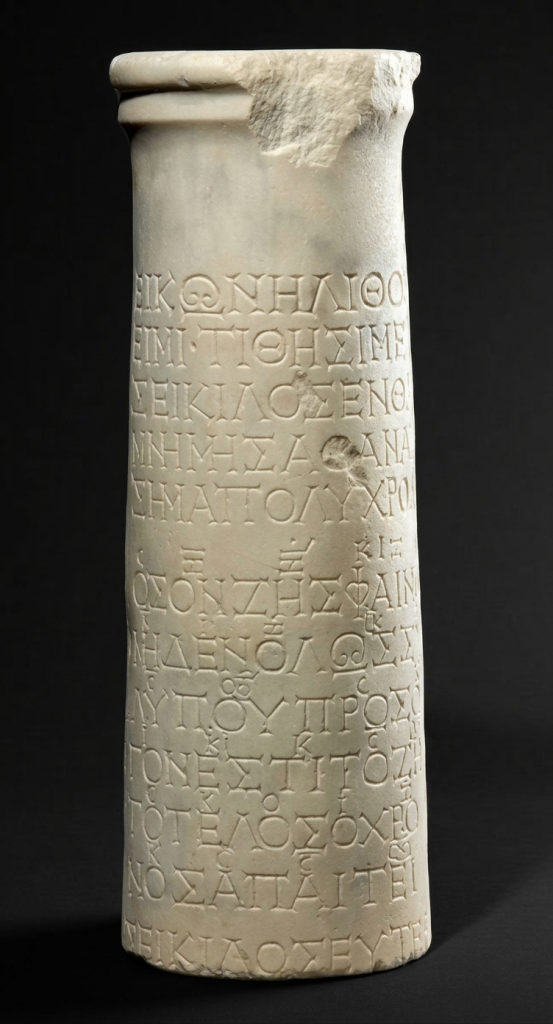
Known as the Seikilos Epitaph, it is one of the oldest surviving complete musical compositions in the world, with both its lyrics and melody preserved.
The marble stele was discovered around 1883 during railway construction work near ancient Tralleis, in present-day Aydın. Dating from the 1st or 2nd century AD, it belongs to the Roman period, although its language and musical notation are Greek. The discovery is associated with Edward Purser, an engineer working for the Ottoman railway company, while the archaeologist William Mitchell Ramsay subsequently documented and published the inscription.
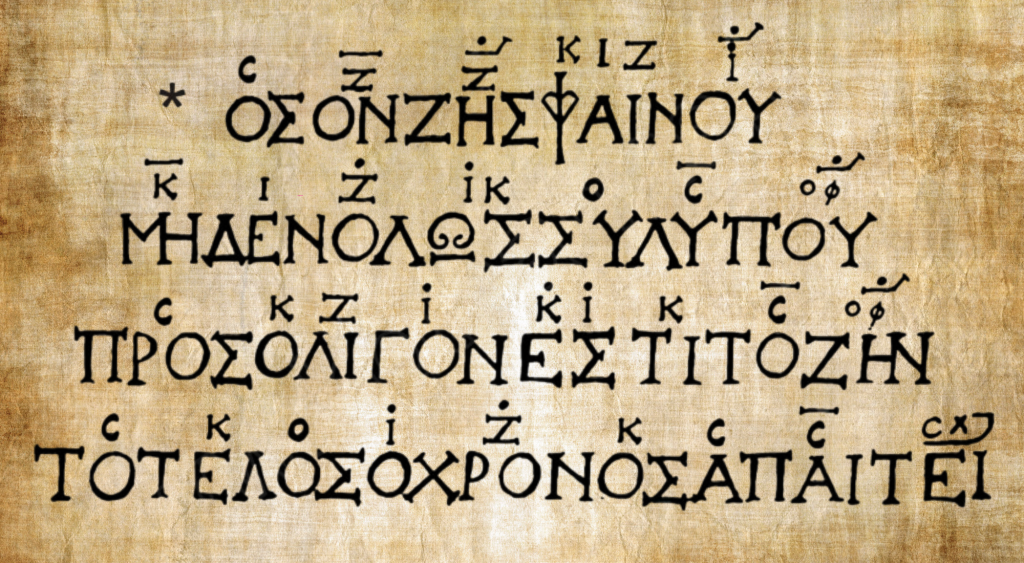
The songwriter accompanied the lyrics with musical notation. The ancient Greek letters Sigma (C), Zeta (Ζ), Kappa (Κ), Iota (I), Omicron (Ο), and Phi (Φ) represent pitch intervals and the dotted στιγμαί (stigmaí) indicate temporal directions. (visual and caption is taken from twentiers.com)
The melody can still be performed today because the musical notation was engraved above the lyrics on the stone. Its words are surprisingly simple and moving:
While you live, shine!
Let no sorrow trouble you.
For life is short,
and Time demands its due.
The inscription identifies Seikilos as the person who set up the monument, although the precise meaning of its damaged final line remains disputed. It may have been dedicated to someone named Euterpe, or may identify Seikilos as the son of Euterpos.
From Anatolia to Istanbul
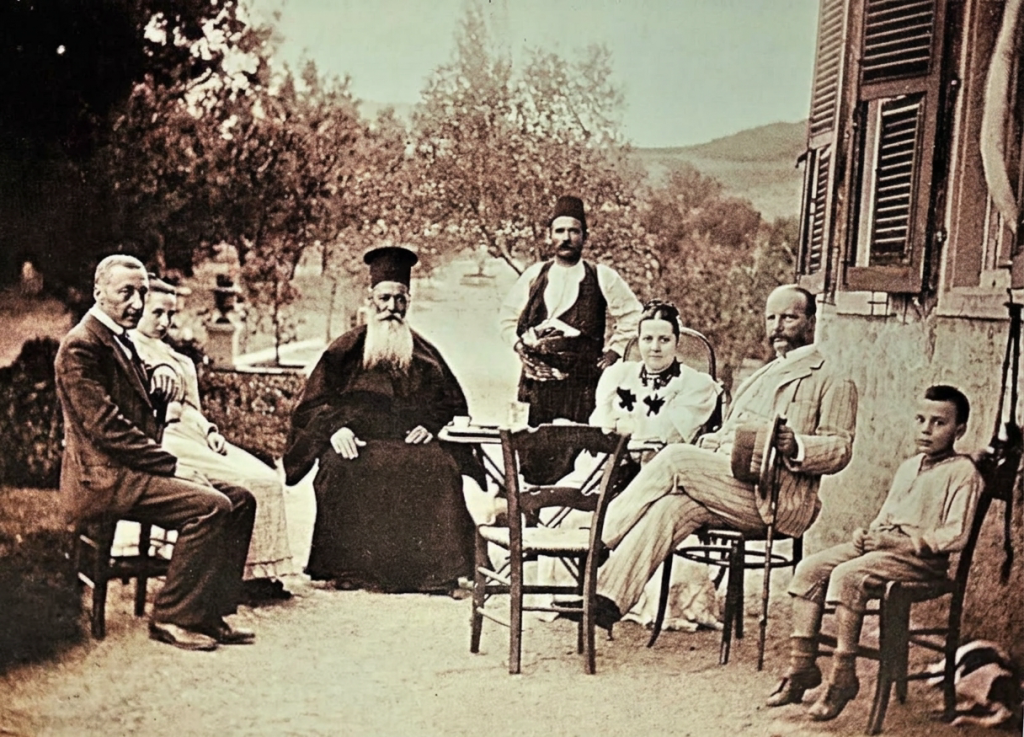
Edward Purser and his family in Aziziye near Şirince, İzmir
The discovery takes us to another fascinating chapter of Anatolian history. Edward Purser was no ordinary railway engineer. Having arrived in Smyrna (present-day İzmir) in 1859, he became chief engineer and subsequently general manager of the Smyrna–Aidin Ottoman Railway Company. His work brought him into contact with the Ottoman administration in Istanbul, the imperial capital.
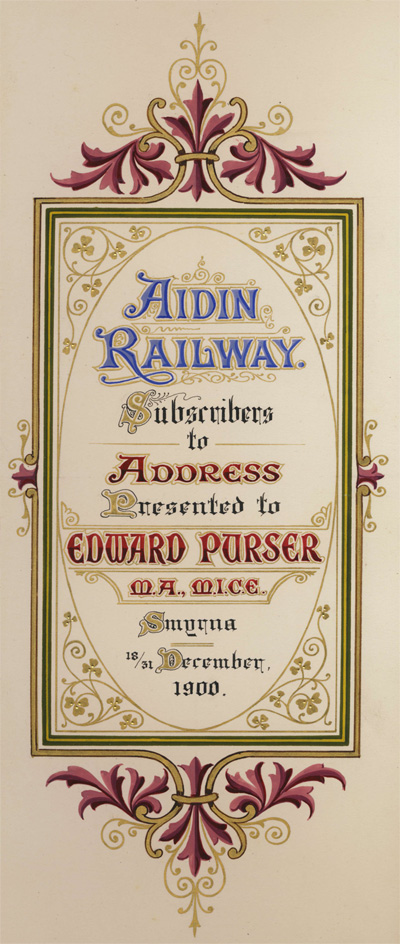
At the time, Ottoman antiquities regulations already governed archaeological discoveries and their export. The 1884 regulation, introduced shortly after the stele’s discovery, considerably strengthened state control over antiquities. Yet the Seikilos monument remained in private hands, eventually becoming part of the collection of Purser’s son-in-law, Henry Richard de Jongh, in Buca.
Its next journey began in 1922, following the Great Fire of Smyrna. The Dutch Consul reportedly took the stele into his protection. It was subsequently transported out of Anatolia by Willem Daniels, passing through Istanbul before travelling to Stockholm and eventually The Hague.
This is a particularly intriguing detail: Istanbul, still the Ottoman capital despite having been under Allied occupation since 1918, became a stop on the journey of an ancient Anatolian monument leaving its homeland.
Whether the necessary official export permission was obtained remains unclear. The 1906 Ottoman antiquities regulation prohibited unauthorised removal of archaeological objects, but the available provenance records do not establish the legal circumstances of the stele’s departure.
In 1966, the National Museum of Denmark acquired the monument. Today, it remains in Copenhagen.
A Voice Across the Centuries
The Seikilos Epitaph was not composed in Byzantion, nor do we know whether it was ever performed there. Yet it belongs to the wider Greek cultural world from which Byzantion itself emerged.
Centuries later, Byzantion would be transformed into Constantinople, where the legacy of the ancient Greek world would encounter the new religious and cultural traditions of the Christian Empire, contributing to the development of the distinctive musical heritage of Byzantium.
Perhaps this is one of the most fascinating ways to approach Istanbul: not merely as a city of monuments and empires, but as a place shaped by successive layers of human memory, imagination and sound.
Today, nearly two thousand years after its creation, the Seikilos Epitaph remains far from the land where it was discovered. Its melody has survived empires, wars and the passage of time. Yet its journey home is not merely a matter of history. Turkey has been seeking the return of the monument through diplomatic channels, although these efforts have yet to result in an agreement.
We hope that one day this remarkable piece of Anatolian heritage will return to the land that gave it life, and that we will have the opportunity to encounter it at the Istanbul Archaeological Museums, where it can once again become part of the cultural memory of the place to which it belongs.
Perhaps the final chapter of its extraordinary journey has yet to be written: the day it finds its way home.
Note that the video is embedded via YouTube and all rights belong to the respective rights holders.
Visuals are taken from wikipedia.com and levantineheritage.com.