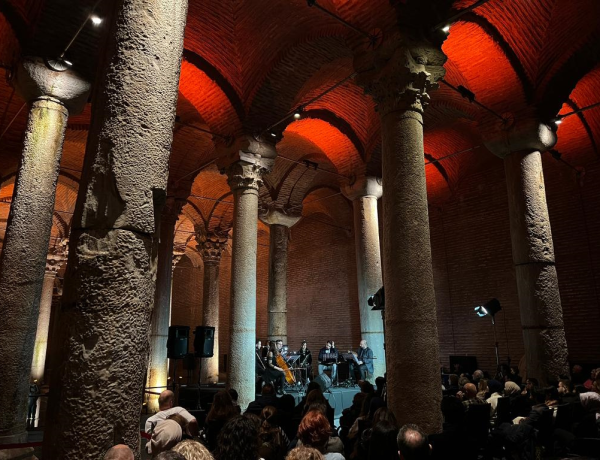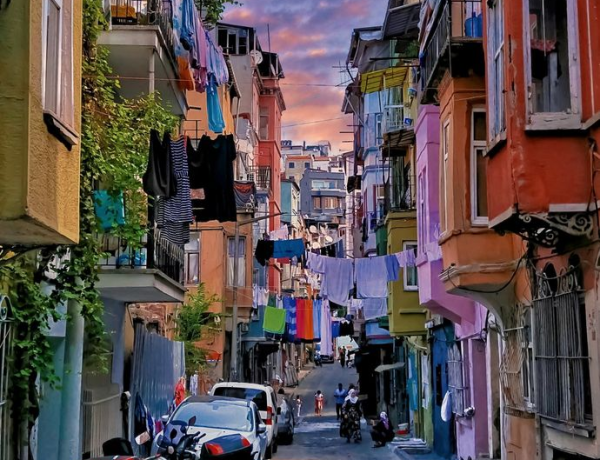

“If one day Istanbul were suddenly plunged into darkness, and an hour later daylight broke all at once, fifty thousand Turks would be caught with bottles at their mouths…”
Edmondo de Amicis, 1874
Intoxication in the Ottoman world was never simply a matter of drinking or abstaining; it unfolded in a persistent tension between religious prohibition, imperial authority, and the lived realities of urban life. In cities like Istanbul, this tension was most visible in districts such as Galata, where meyhanes—taverns run largely by the empire’s non-Muslim communities—formed the social heart of nocturnal life.
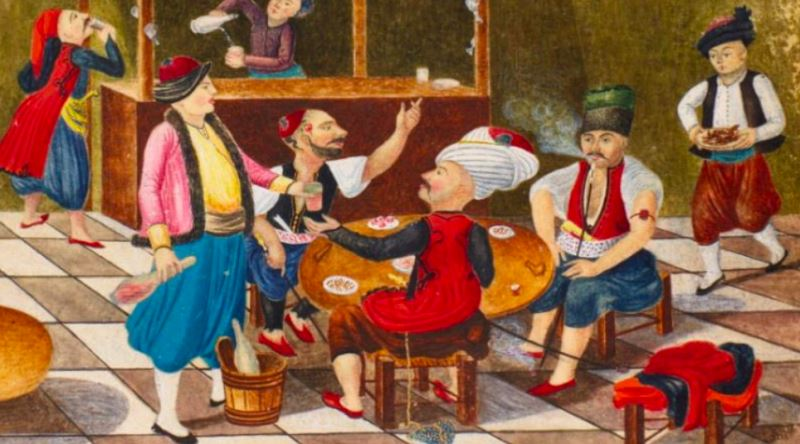
An Ottoman tavern, 18th Century
These spaces were shaped in particular by the Rums, Armenians, and Jews, who produced wine, distilled spirits, and created a culture of conviviality that blended music, poetry, and conversation. The meyhane was not only a place of intoxication but of emotional and aesthetic release—a semi-permitted world where boundaries softened. Muslim participation, though officially discouraged, was never absent; it simply moved between visibility and discretion.
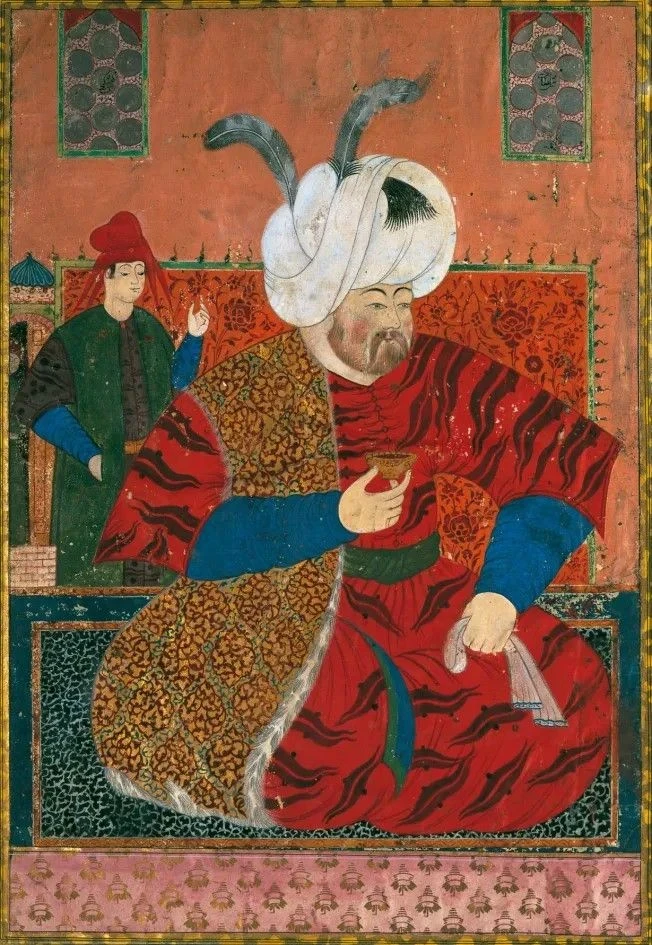
A miniature showing Selim II drinking
At the center of this ambivalent landscape stood the Ottoman sultans themselves, whose relationship with intoxication set the tone for society at large. Their attitudes were far from uniform. Selim II remains the most famous example of imperial indulgence, remembered for his fondness for wine to the point that it shaped both his reputation and historical memory. His reign reflects a court culture in which drinking, while religiously problematic, was nonetheless integrated into elite life.
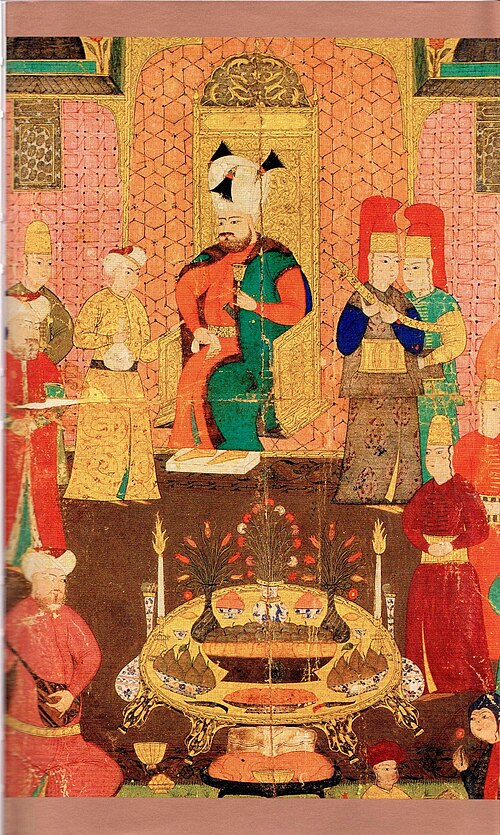
A miniature depicting Murad IV dining at his court
In sharp contrast, Murad IV represents the other extreme. In the 17th century, he imposed sweeping bans on alcohol, coffee, and tobacco, reportedly patrolling the streets in disguise and enforcing prohibition with severe punishments. Yet even such dramatic interventions proved temporary. After his death, restrictions loosened and drinking culture resurfaced with remarkable resilience.
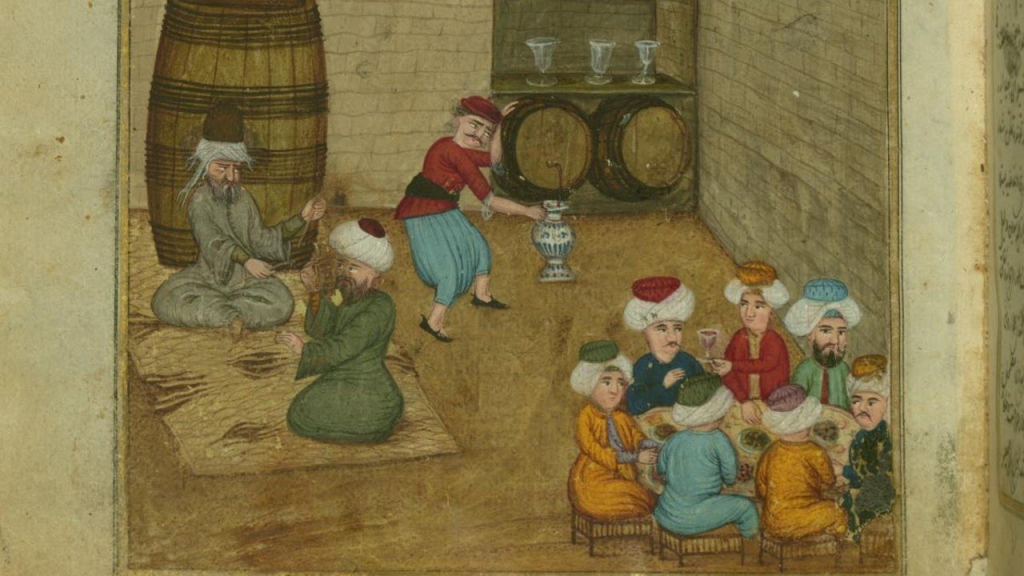
An Ottoman tavern
Between these poles lay a spectrum of quieter accommodations. Many sultans neither fully embraced nor entirely suppressed intoxication; instead, they regulated it, taxed it, or simply tolerated its existence within certain boundaries. This oscillation—between indulgence, control, and pragmatic acceptance—reveals something essential about the Ottoman state: it governed not by eliminating contradiction, but by managing it.
By the 19th century, especially during the Tanzimat reforms, this management became more systematic. Alcohol was increasingly brought into a framework of taxation and licensing rather than outright prohibition. Meyhanes became more visible, even as they retained their association with non-Muslim life and with a certain moral ambiguity.
The transition to the Republic under Mustafa Kemal Atatürk marked a conceptual shift. Alcohol was no longer primarily a religious problem but a marker of modern, secular identity. Drinking practices were reshaped, standardized, and nationalized. At the same time, the demographic transformations of the early 20th century meant that the communities who had historically sustained the meyhane culture were largely diminished. What survived was not the same world, but a reinterpreted version of it.
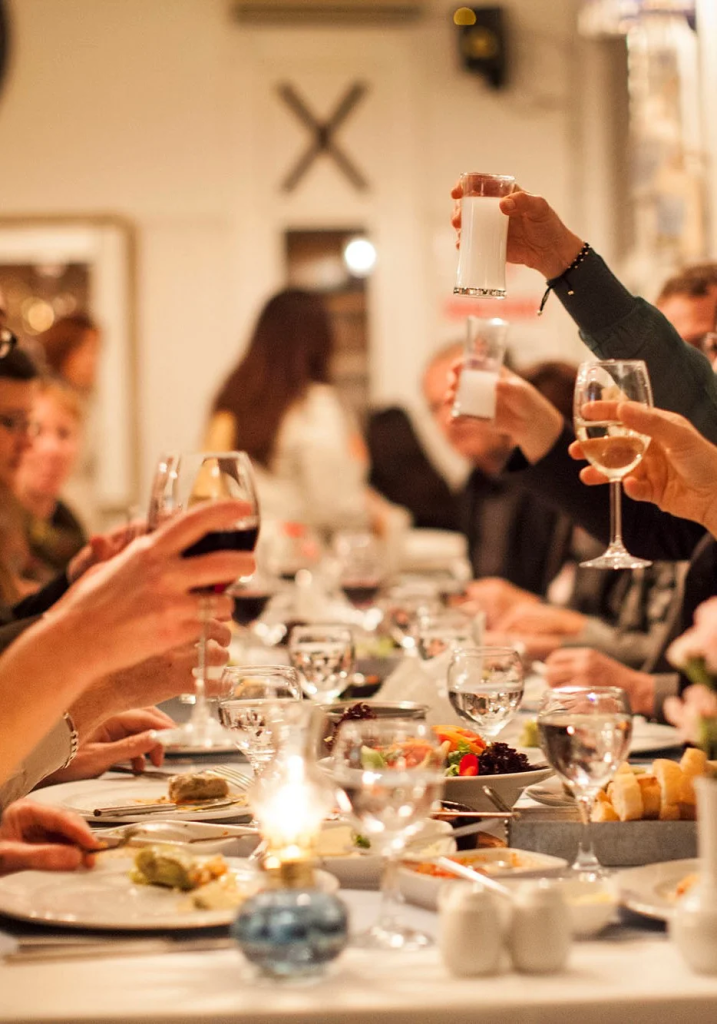
Today, Istanbul’s nightlife—stretching through Galata, Karaköy, and Beyoğlu—still carries faint echoes of this past. The meyhane endures, sometimes as a carefully staged nostalgia, sometimes as a living social form. Yet it now exists alongside bars, clubs, and a faster, more globalized culture of nightlife. Regulations continue to shift, and alcohol remains, as in the Ottoman past, a site of negotiation between authority and personal life.
What persists across centuries is less the substance itself than the role intoxication plays: as a controlled transgression, a social glue, and a way of briefly loosening the structures that govern everyday existence. The Ottoman sultans, in their alternating embrace and rejection of alcohol, did not resolve this tension—they embodied it. And in many ways, the city still does.