
We tend to imagine our ancestors as solemn and austere, forgetting that they too made music, danced, performed, and sought joy. Yet in Ottoman Istanbul, entertainment stood at the very centre of life, drawing together young and old, men but also women from every corner of society.
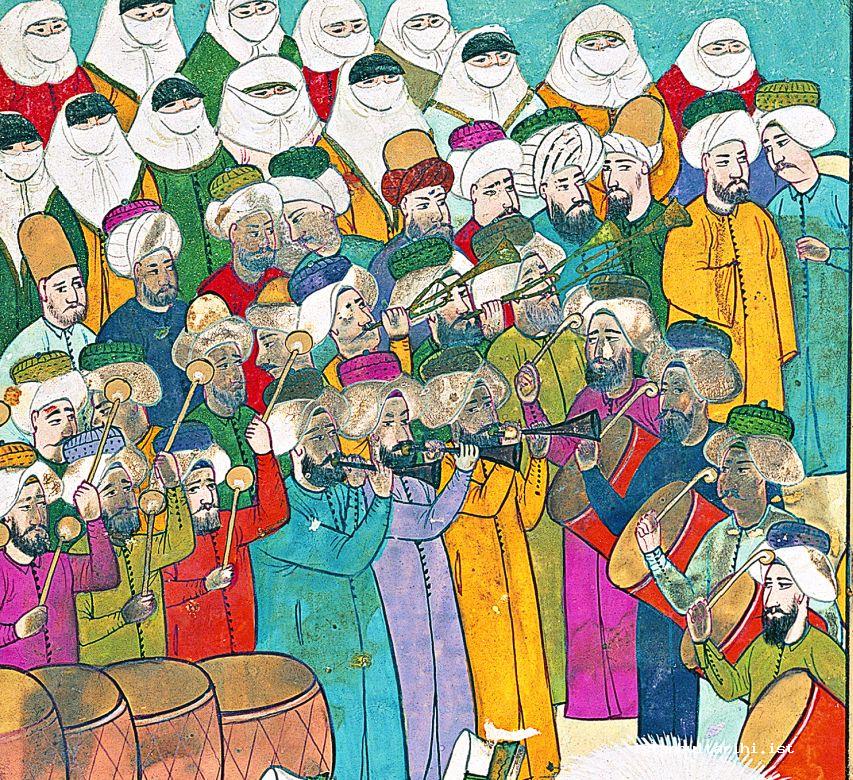
Men and Women in Istanbul watching a music performance, 1720
In Ottoman Istanbul, entertainment was not confined to palace festivities or elite gatherings; it animated the everyday life of the city. As the imperial capital, Istanbul offered its inhabitants a vibrant world of performances, games, celebrations, and communal pleasures that unfolded in neighborhoods, markets, gardens, and coffeehouses. Leisure was social, often improvised, and deeply embedded in the rhythms of urban existence.
One of the most beloved forms of popular entertainment was Orta Oyunu, an open-air improvisational theatre performed in courtyards, squares, and sometimes indoors during winter months. Built around witty dialogue and stock characters such as Kavuklu and Pişekâr, these plays humorously reflected the ethnic diversity and social hierarchies of the city. Male actors portrayed female roles known as zenne, adopting women’s clothing and gestures in stylized, often satirical performances. Music and dance accompanied the action, and the audience was not a passive observer but an active participant, responding, laughing, and sometimes intervening in the flow of the play.

Two main characters of the Shadow theatre that still live among us
Shadow theatre also held a special place in urban culture. In performances of Karagöz, translucent leather puppets were projected onto a lit screen, bringing to life characters drawn from everyday Ottoman society.
The sharp exchanges between Karagöz and Hacivat offered comic relief while subtly commenting on manners, bureaucracy, and social tensions. These performances were especially popular during Ramadan evenings, when neighborhoods gathered after the fast to share stories and laughter.

Fire works in Istanbul, 1720
Beyond theatrical forms, the streets themselves functioned as stages. Jugglers, acrobats, animal trainers, magicians, and storytellers moved through the city’s commercial centers and residential quarters, gathering crowds wherever space allowed. Many were hired for weddings, circumcision festivities, and guild celebrations, where spectacle, music, and feasting blended into communal joy. Seasonal festivities, particularly those marking religious holidays or imperial events, transformed the city into a panorama of lights, processions, and public celebration.
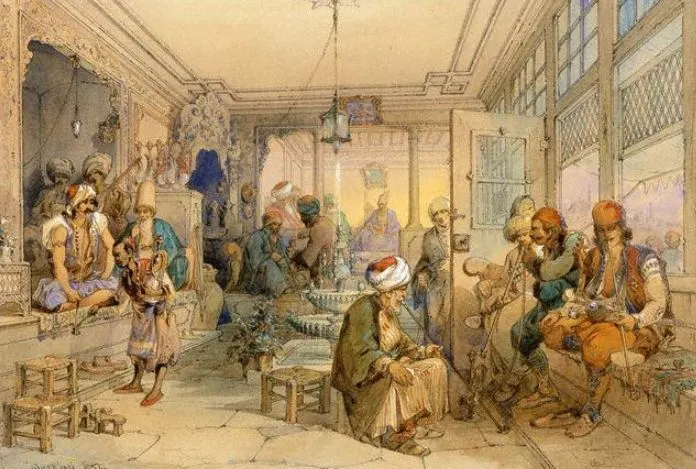
An Ottoman coffeehouse which are the forefather of modern cafes in the city
Coffeehouses were central to this culture of leisure. More than places to drink coffee, they were hubs of conversation, storytelling, gaming, and performance. Here men listened to professional storytellers, played traditional games, exchanged news, and debated politics and poetry. Food also played a role in entertainment; communal preparation and sharing of sweets such as helva accompanied gatherings, turning taste itself into a social ritual.

Acrobats in 1720s Istanbul
In Ottoman Istanbul, women’s gatherings in the hammams were not limited to ritual cleansing but unfolded as rich social and cultural occasions. The women’s quarters of these bathhouses became vibrant spaces of music, laughter, food, and ceremony, especially during bridal baths, when the steamy marble interiors filled with embroidered towels, silver basins, trays of sweets and sherbet, and sometimes the sound of hired singers or musicians.

Female musicians depicted by Levni, 1700s
Entertainment in Ottoman Istanbul emerged as a collective experience rather than a specialized industry. It allowed space for satire, cross-dressing performance, improvisation, and communal participation. In a city that brought together diverse communities under one imperial roof, amusement became a shared language, a way of negotiating difference through laughter, spectacle, and story.
Visuals are taken from istanbultarihi.ist.