
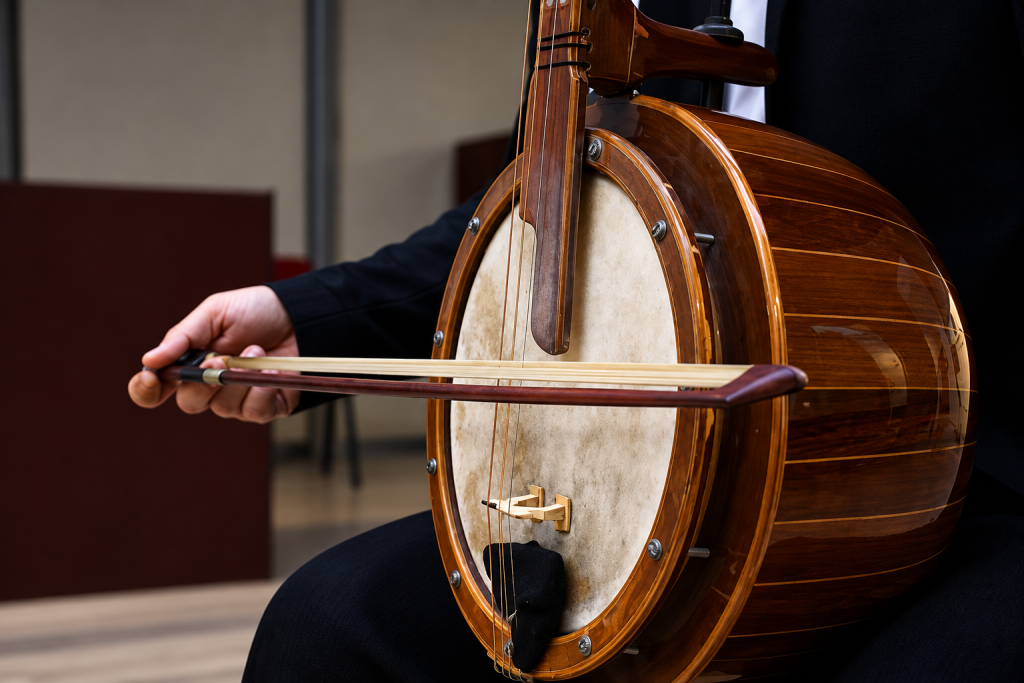
Few instruments seem to carry melancholy as naturally as the yaylı tanbur, the bowed tanbur. Its long, resonant notes have an almost otherworldly quality — somewhere between a human voice, a cello and an echo travelling across water. And although the tanbur itself has a much older history, the yaylı tanbur as we know it today has a particularly intimate connection with Istanbul.
That connection leads us to one of the most remarkable musicians of late Ottoman Istanbul: Tanbûrî Cemil Bey (1873–1916).
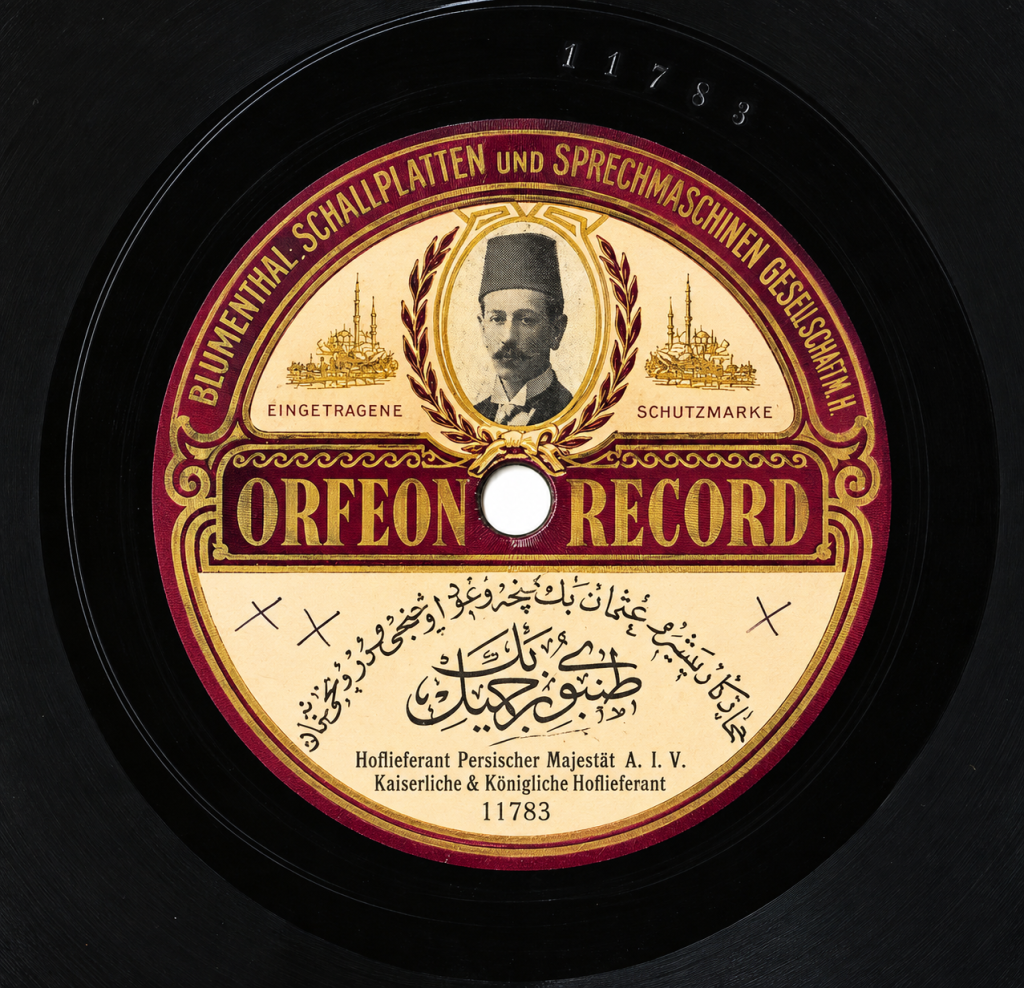
An early twentieth-century Orfeon Record featuring the legendary Ottoman musician Tanburî Cemil Bey.
Born and raised in Istanbul, Cemil Bey became one of the great instrumental virtuosos of Ottoman classical music. He was celebrated above all as a master of the tanbur, traditionally played with a long plectrum. Yet his musical curiosity led him to experiment with playing the instrument with a bow. From these experiments emerged the modern tradition of the yaylı tanbur.
The idea of playing a tanbur-like instrument with a bow was not entirely unprecedented. Earlier Ottoman and Middle Eastern musical sources contain references to related bowed instruments. It would therefore be misleading to say simply that Cemil Bey “invented” the concept. What can be said with much greater confidence is that the modern yaylı tanbur tradition took shape through Tanbûrî Cemil Bey and the musical world of early twentieth-century Istanbul.
And that world mattered.
Cemil Bey lived in an Istanbul in which music travelled constantly between different spaces and communities: mansions and coffeehouses, Mevlevi lodges and private gatherings, palace traditions and popular neighbourhood music. Ottoman classical music existed alongside Greek, Armenian, Jewish, Balkan and other musical traditions. The city itself functioned as an enormous musical crossroads.
Perhaps this is why the yaylı tanbur sounds so appropriate to Istanbul.
Its voice is sustained rather than percussive. Notes seem to appear, hover for a moment and disappear. There is something strangely architectural about its resonance: one can almost imagine the sound travelling beneath a dome, through an old wooden house, or across the Bosphorus at night.
The instrument also seems particularly suited to hüzün which is a rather difficult word to translate. It is a mixture of melancholy, longing and the awareness of things lost. Yet the melancholy of the yaylı tanbur is not simply sadness. There is distance in it, but also beauty; memory, but also presence.
In this sense, the yaylı tanbur belongs to Istanbul not merely because of where its modern history developed, but because its sound seems to express something fundamental about the city itself: a place where different worlds meet, where the past is never entirely absent, and where beauty so often arrives accompanied by longing.
The tanbur may be ancient but the haunting voice of the yaylı tanbur is inseparable from the musical imagination of Istanbul.
Note that the video is embedded via YouTube and all rights belong to the respective rights holders.